
Your little finger has its own extender muscle. Modern typing and gripping rarely use it. Here’s why independent pinky movement still matters for hand comfort and control.
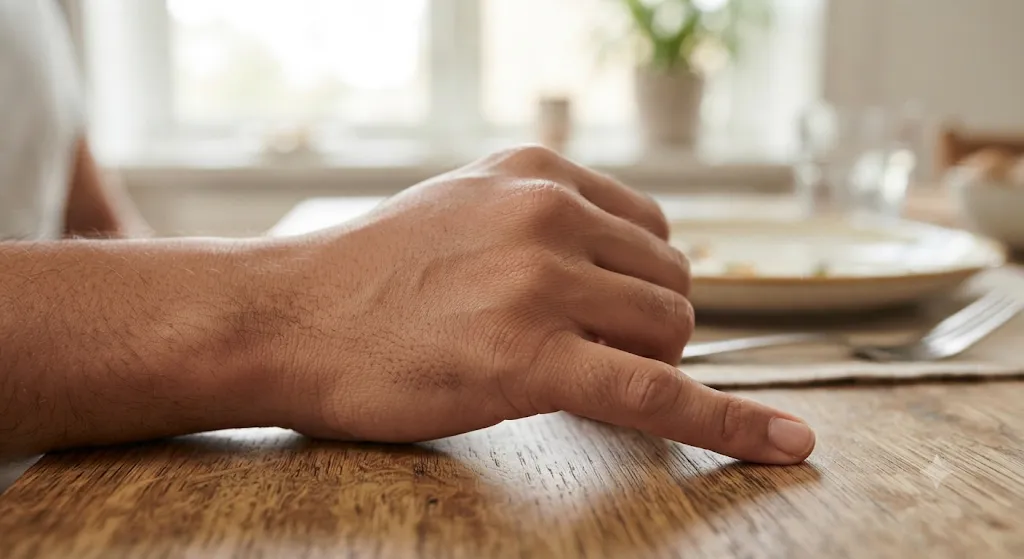
Try this: rest your hand flat on a table and lift only your little finger while keeping the others down. For many people the pinky rises easily. For others it barely moves, or the ring finger tags along. That small difference is the work of a dedicated forearm muscle called the extensor digiti minimi. It exists so the little finger can extend on its own. Human hands evolved for climbing, tool-making, and varied grips that often required one finger to act differently from its neighbors. Today most of us spend hours with fingers locked in the same typing or phone-holding shape. The muscle still expects occasional independent work it rarely gets.
What Independent Pinky Extension Actually Feels Like
The sensation is subtle. You may notice that your little finger feels stiff when you try to straighten it alone, or that it wants to stay curled while the other fingers open. Some people feel a slight pull along the outer forearm when they force the movement. Others simply discover they cannot isolate the pinky at all after years of typing. None of this is dramatic. It is the quiet under-use of a muscle whose job is precision rather than power.
Why This Muscle Exists
The extensor digiti minimi arises from the lateral epicondyle of the humerus (the same bony bump involved in tennis elbow) and inserts into the extensor hood of the little finger. Anatomist I.A. Kapandji described how this muscle, together with the extensor digitorum, allows the fifth finger to extend independently of the fourth. In everyday ancestral tasks—scraping, peeling, climbing, or shaping a stone tool—the little finger often needed to brace, hook, or release while the other fingers maintained a different grip. Finger individuation studies by researchers such as Marc Schieber have shown that the brain maintains separate control pathways for the little finger; the hardware is still there even if daily life rarely asks for it.
The Modern Mismatch
Keyboards and phone screens keep the fingers in a narrow, slightly flexed posture for hours. The pinky is usually the one resting on the edge of the keyboard or wrapped around a phone. It rarely needs to lift alone. Over time the muscle shortens slightly and the neural command for independent extension becomes less practiced. The result is not injury in most cases, just a gradual loss of easy isolation. People who play string instruments or do fine crafts often keep the movement sharper simply because they use it. Everyone else may notice the difference only when they deliberately try the table-top test.
Common Everyday Triggers
- Long typing or mouse sessions that keep the hand in a closed or semi-closed position.
- Phone use that wraps the pinky tightly around the device.
- Repetitive gripping tasks (tools, steering wheel, shopping bags) that favor flexion over extension.
- Cold weather that makes the outer forearm feel tighter.
- Previous minor strains of the lateral elbow that leave the common extensor origin a bit guarded.
When the Feeling Is Probably Benign
If the only issue is that your pinky does not lift as freely as it once did, and there is no pain, swelling, numbness, or weakness in other movements, the change is almost always simple under-use. It tends to improve within days of adding a few gentle isolation drills. The same pattern appears in other small hand muscles that modern life under-loads—see, for example, how the fingers can feel numb after texting or how the palmar interossei still expect occasional finger adduction.
When to Pay Closer Attention
See a clinician if you also have:
- Persistent pain at the outer elbow that worsens with gripping or lifting.
- True weakness so the little finger cannot extend against even light resistance.
- Numbness or tingling that travels into the pinky and ring finger (possible ulnar nerve irritation).
- Swelling, redness, or a history of trauma to the hand or forearm.
- Difficulty with other fine-motor tasks that used to be easy.
These are uncommon with simple under-use, but they are worth ruling out.
Myths Versus Facts
Myth: If you cannot lift your pinky alone, something is structurally wrong.
Fact: Most people lose a little isolation simply from lack of practice. The muscle and tendon are usually intact.
Myth: Stretching the whole hand is enough.
Fact: General stretching helps, but the brain needs the specific command “extend only the fifth finger.” Isolation drills retrain that signal faster.
Myth: Only musicians need independent finger control.
Fact: Everyday tasks such as buttoning a shirt, turning a key, or stabilizing a tool still benefit from a pinky that can move on its own.
Simple Ways to Give the Muscle What It Still Expects
You do not need equipment. A few times a day:
- Rest your hand palm-down. Lift only the little finger as high as it will go, hold two seconds, lower slowly. Repeat eight to ten times.
- Do the same with the hand palm-up so the movement is pure extension against gravity.
- While typing, occasionally lift the pinky off the keyboard and set it down again, just to break the static posture.
- When holding a phone, loosen the pinky so it is not locked in flexion the entire time.
- If the outer forearm feels tight, gently massage from elbow toward wrist for a minute.
These small doses are usually enough to restore easy isolation within a week or two. Consistency matters more than intensity.
Frequently Asked Questions
Why can some people lift their pinky easily and others cannot?
Practice and daily use. People who regularly play instruments, sew, or do fine crafts keep the neural pathway sharp. Everyone else can relearn it quickly.
Does a stiff little finger mean I have ulnar nerve problems?
Not by itself. Ulnar nerve irritation usually brings numbness or tingling in the pinky and ring finger, plus weakness in other hand muscles. Simple stiffness without those signs is more often under-use.
Can typing actually shorten this muscle?
It can leave it in a shortened resting position for long periods, so the first few extensions feel tight. The change is reversible with a few minutes of deliberate movement.
Should I worry if my ring finger always moves with my pinky?
A little co-activation is normal. The extensor digitorum and extensor digiti minimi share some connections. With practice most people can reduce the coupling.
How long before I notice a difference?
Many people feel freer movement after three to five short sessions. Full easy isolation often returns within one to two weeks of daily practice.
Conclusion
The extensor digiti minimi is a small reminder that human hands were built for varied, independent finger work. Modern keyboards and phones ask for far less of that variety. A few deliberate pinky lifts each day give the muscle the occasional independent extension it still expects, keep the outer forearm comfortable, and preserve the fine control that everyday tasks quietly rely on. The movement is minor; the difference in hand ease is not.


