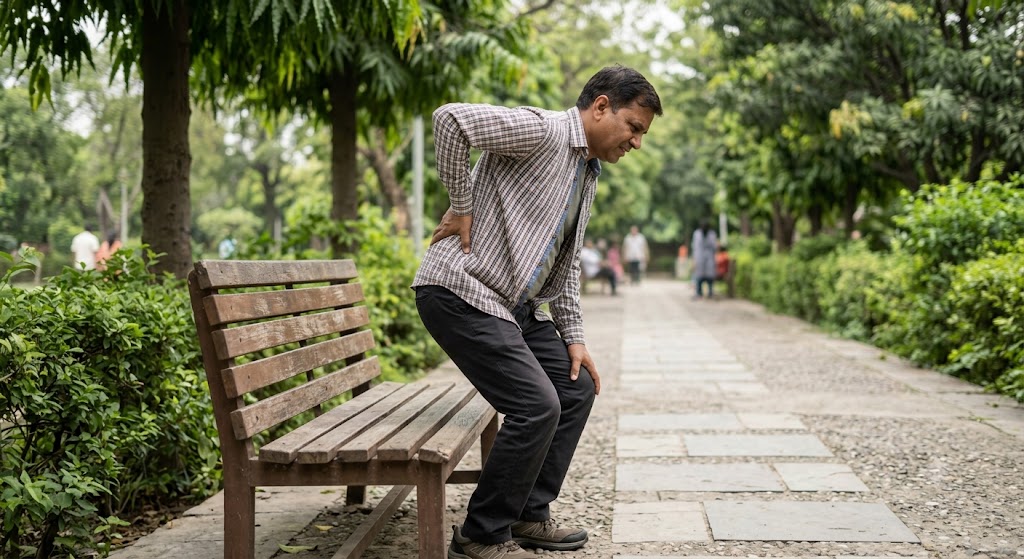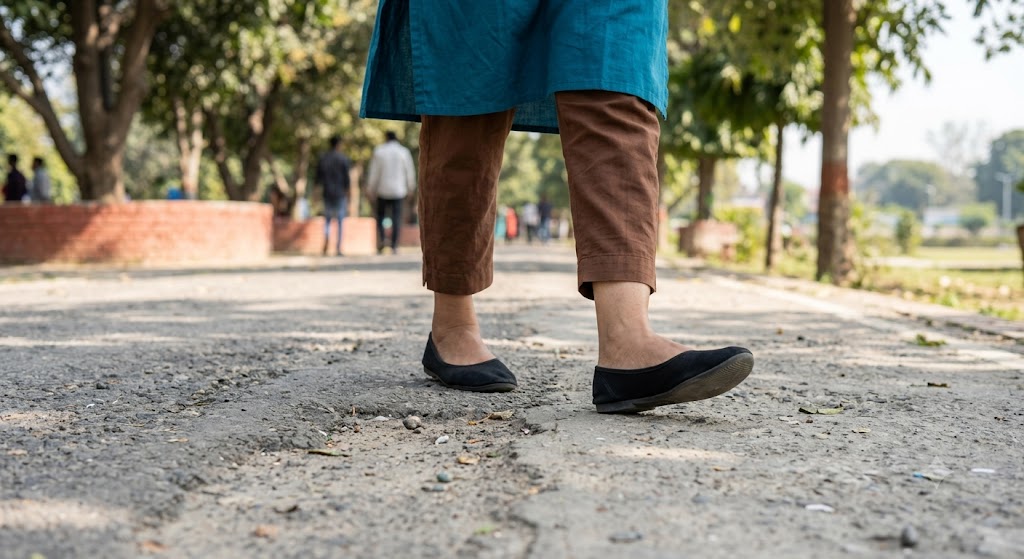
The cerebellum still expects wobble, error, and practice on uneven ground. Flat floors and still days leave its error-learning circuit underfed. How Flourens, Holmes, Ito, Marr and Albus mapped what that circuit still wants.
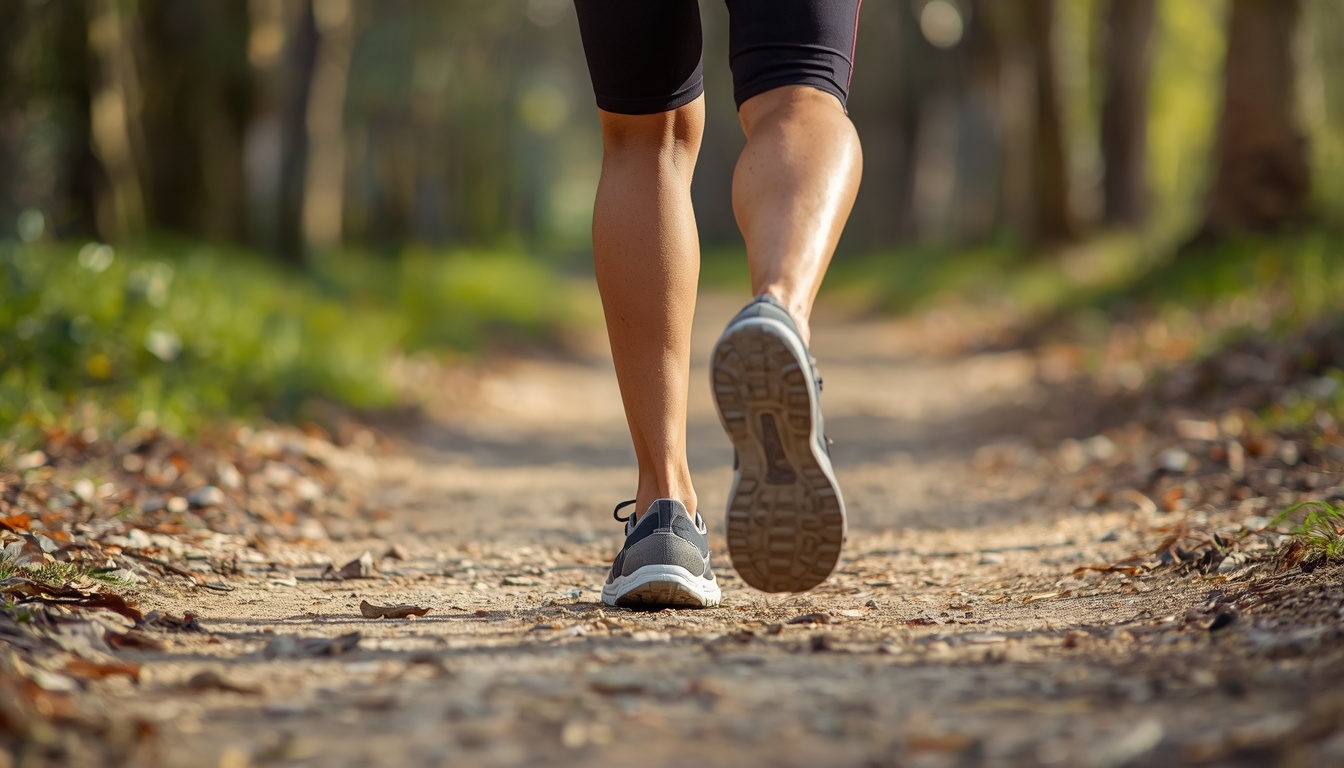
A sidewalk is a kindness your cerebellum did not evolve to receive all day. Roots, slopes, loose gravel, a sudden step down, a child darting sideways — those were the ordinary inputs. Each one created a tiny prediction error. The cerebellum’s job was not to invent movement from scratch. It was to notice that the last footfall did not land where the plan said it would, and to rewrite the next one before you fell. Flat floors, chairs, and elevators do not cancel that job. They starve it of the errors it uses as tuition.
This is easy to miss because the organ is quiet when it is working. You do not feel your cerebellum the way you feel a sore calf. You feel its absence as clumsiness after a week in bed, as a wider stance on a dark unfamiliar path, as the odd sense that a new pair of shoes has stolen your timing. Pierre Flourens showed in the nineteenth century that animals without a cerebellum could still move, but they could not move well. Gordon Holmes, studying soldiers with gunshot wounds in the First World War, described the human version: delayed starts, overshoot, tremor at the end of a reach, and a gait that looked drunk even when the person was sober. The modern circuit story belongs to Masao Ito, David Marr, and James Albus. The mismatch is newer than the anatomy. The ground got flat. The tutor lost its lessons.
What the cerebellum actually is
The cerebellum sits in the posterior fossa, tucked under the occipital lobes, attached to the brainstem by three pairs of peduncles. It holds more neurons than the rest of the brain combined — on the order of 80 percent of them — packed into a thin, deeply folded cortex of granule cells, Purkinje cells, and a handful of interneurons. Santiago Ramón y Cajal drew the lattice. The architecture is almost crystalline: a vast mossy-fiber input, a climbing-fiber input from the inferior olive that wraps each Purkinje cell, and a Purkinje output that inhibits the deep cerebellar nuclei.
That geometry is not decoration. Marr in 1969 and Albus in 1971 independently proposed that the climbing fiber is an error signal. When a movement goes wrong, the olive fires. The Purkinje cell that was active at that moment weakens its parallel-fiber synapses — a form of long-term depression Ito later demonstrated in the rabbit vestibulo-ocular reflex. Next time the same context arrives, the output is slightly different. The cerebellum is a supervised learning machine for timing, coordination, and the internal models that let you reach for a cup without watching your hand the whole way.
It is not only for the limbs. Vestibular cerebellum helps keep the world stable when you turn your head. Vermis and intermediate zones keep posture and gait from falling apart. Lateral hemispheres expanded in primates and contribute to the timing of speech, the prediction of other people’s actions, and some forms of cognitive sequencing. Jeremy Schmahmann described a cerebellar cognitive affective syndrome when those hemispheres are injured. The organ you think of as “balance” is also a timing and prediction organ. Uneven ground happens to be one of the richest classrooms it ever had.
The briefing uneven ground used to send
Ancestral walking was not a metronome on a treadmill. Terrain changed stiffness, slope, and friction every few steps. The ankle rolled a few degrees. The hip had to catch. Vision, the inner ear, and the soles of the feet disagreed for a fraction of a second, then agreed again. That disagreement is gold for a climbing-fiber system. Each micro-error is a labeled example: you predicted this, the world delivered that, update.
The same logic applies to the vestibulo-ocular reflex Ito used as his model. When you turn your head, the eyes must counter-rotate or the image slips. If the gain is wrong, the image slips and the olive complains. Over repetitions the gain is rewritten. Uneven ground is the locomotor version of that slip. A root is a perturbation. A successful recovery is a rewritten internal model of how this body, in these shoes, on this slope, should place the next foot.
Children still get a version of this briefing if they are allowed to climb, run on grass, and fall a little. Adults in cities mostly do not. Indoor floors are level by design. Shoes damp the sole. Escalators remove the step. Even “exercise” is often a repeating belt or a machine that constrains the path. The cerebellum can adapt to a treadmill. It cannot collect the same distribution of errors it was built on if every step is the same step.
What flat, still days do instead
Remove the errors and two things happen. Skill that is already learned can persist for a while — that is why you can still walk down a hallway after a week of sitting. What fades first is the sharpness of the models and the readiness to absorb a new perturbation. After bed rest or a long flight, people widen their stance, look at their feet, and take shorter steps. Some of that is weak hips and a quiet vestibular system. Some of it is a cerebellum that has not had to rewrite anything for days.
Modern life also splits the job. You sit for hours, then ask the system for a hard novel skill in a one-hour class. The cerebellum can learn in a session. It learns better when the same circuits are fed small errors all day, the way a language is learned better by living in it than by a weekly lesson. W. Thomas Thach and others showed that cerebellar patients can still move; they struggle to adapt the movement when the world changes. A flat world is a world that rarely changes underfoot. Adaptation practice becomes optional, then rare.
There is a sensory side as well. Feet that never meet uneven ground send a thinner report. Ankles that never have to catch a side-slope send another thin report. The cerebellum does not invent those signals. It compares them with the plan. If the afferents are muted by cushioned shoes and level floors, the error signal has less to work with even when you finally take a hike.
Hidden modern subtractors
Cushioned, narrow shoes reduce the sole’s map of pressure and the ankle’s need to invert and evert. That is not a moral failure of footwear. It is a change in the data stream.
Holding a phone while walking ties the eyes to a near rectangle and steals the optic-flow and horizon cues the cerebellum uses with the vestibular system to keep gait honest. Dual-tasking is fine. Dual-tasking on a curb while the model is already rusty is how people trip.
Very quiet days after illness or surgery are necessary. Extending them past recovery, out of caution, keeps the tutor unemployed. Holmes’ patients taught a related lesson: the cerebellum hates both injury and disuse. Relearning is possible. It is slower if the only practice is a straight hospital corridor.
Alcohol is a temporary cerebellar lesion. The stagger is not mysterious. Chronic heavy use can leave lasting cerebellar atrophy, especially in the vermis. That is a different problem from a flat floor, but it is the same organ asking for the same kind of practice once the toxin is gone.
When the problem is not just a quiet tutor
Sudden severe ataxia, double vision, slurring, or a headache with inability to walk is an emergency, not a deconditioning story. Stroke in the cerebellum or its connections, hemorrhage, and some inflammatory and paraneoplastic syndromes present that way. A slowly worsening gait with a family history can be a genetic cerebellar ataxia. Medication toxicity — notably some antiepileptics and lithium at high levels — can mimic the same picture. Those are not “walk on grass” problems.
Mild, fluctuating unsteadiness that is worse in the dark, better after a week of varied walking, and free of hard neurological signs is a different pattern. It still deserves a look if it is new, one-sided, or paired with hearing change, headache, or weakness. The point of the evolutionary frame is not to diagnose yourself off a trail. It is to understand why a capable organ looks rusty when the world stopped handing it homework.
Myths vs facts
Myth: Balance lives only in the inner ear.
Fact: The inner ear reports motion and tilt. The cerebellum is one of the main places that report is compared with intention and rewritten. Lose either and gait suffers. They are partners, not substitutes.
Myth: If you can walk on a treadmill you have trained your cerebellum.
Fact: You have trained a narrow internal model. Transfer to a root, a dock, or a crowded sidewalk is limited until those contexts supply their own errors.
Myth: Cerebellar learning is only for athletes.
Fact: Speech timing, reaching for a mug, and not knocking a glass when you turn are cerebellar tasks. Elite sport is a loud version of an ordinary job.
Myth: Once you are an adult the cerebellum is finished.
Fact: Long-term depression at the parallel-fiber–Purkinje synapse is a lifelong mechanism. Older adults adapt more slowly. They still adapt when the errors return.
How to feed the circuit you still have
Give it small, frequent, safe errors rather than one heroic obstacle course. A slightly irregular path, a grass verge, a gentle hill, a few steps taken backward or sideways, a reach for something just off the midline — these are closer to the original syllabus than an hour of identical strides.
Look at the horizon when you can. The cerebellum and the vestibular nuclei use that visual world as a teacher for gaze and posture. A week of only near screens is a week with a poorer visual grade.
Practice the skill you actually need, not a generic “balance” drill in isolation. If the problem is turning in a kitchen, turn in a kitchen. If the problem is a dark hallway at night, add a night-light and then practice the hallway. Context is part of the memory.
After illness, treat walking variety as rehabilitation, not as a luxury to add later. Early, modest, supervised exposure to gentle unevenness is how the models are rewritten. Sitting until you “feel ready” often means the tutor stays closed.
Shoes can be a tool. A slightly more flexible sole on safe ground gives the foot and cerebellum more to read. Save the maximal cushion for long hard pavement if you need it. You do not have to go barefoot on gravel to honor an evolutionary brief. You have to stop making every step identical.
A walk that is also thinking time still counts. The cerebellum does not require a grim face. It requires prediction, error, and another try. That is available on an ordinary uneven block if you put the phone away for ten minutes. It pairs naturally with the reason the rest of the brain still expects a walk in order to think.
When to see a doctor
Seek urgent care for sudden inability to walk straight, a room that spins with vomiting, new double vision, a thunderclap headache, or weakness on one side. See a clinician soon for a gait that is steadily worsening, falls that are new, slurring, or unsteadiness that is clearly worse on one side. Mention new medicines. Mention alcohol. Mention whether the dark makes it dramatically worse — that points toward vestibular and sensory contributions the cerebellum cannot fully replace.
A physical therapist who works with vestibular and cerebellar patients is often more useful than generic rest. The organ learns from graded error. The clinic can supply that error without a fall.
FAQs
Is a wobbly feeling after a long flight my cerebellum?
Partly. Cabin inactivity, a quiet vestibular system, and a day of identical steps all thin the models. It usually settles after ordinary walking. Persistent spinning is a different complaint and needs an exam.
Do balance boards replace uneven ground?
They supply error, which is the right currency. They supply a narrow kind of error. Use them as a supplement, not as the only terrain your week contains.
Why do I feel clumsier in the dark?
Vision is one of the teachers. In the dark the cerebellum leans harder on the inner ear and the feet. If those reports are also thin — stiff shoes, a quiet week — the remaining model looks worse. That is expected. It is also a reason to keep the path familiar and lit until practice returns.
Can older adults still retrain this?
Yes, more slowly. Adaptation studies in aging show the same direction of learning with more repetitions. Small daily variety beats a rare intense class.
Is yoga or tai chi “cerebellar training”?
Slow, precise, changing postures with an attention to error are a reasonable diet. They are not magic. A walk on imperfect ground after the class is how the lesson leaves the mat.
Does this explain why I trip when I text?
In part. Attention is limited, optic flow is reduced, and the step-to-step model is not being updated from the world ahead. The cerebellum can dual-task. It cannot dual-task well when the visual teacher is a glowing rectangle two feet away.
Conclusion
Your cerebellum is not a relic and it is not a balance gadget you can ignore until you fall. It is a vast, quiet prediction engine that still expects the world to disagree with the plan a little, often, and on purpose. Uneven ground used to deliver that disagreement for free. Level floors took the curriculum away without asking the organ whether it was finished learning. You do not need a mountain. You need a week in which some of the steps are not the same step — and a nervous system that is allowed, safely, to be wrong and then right again.