
The biceps still expects a hang, a pull, and a loaded supinated carry. Desks keep the elbow bent and the hand empty, then a suitcase or a pull-up aches the front of the arm.
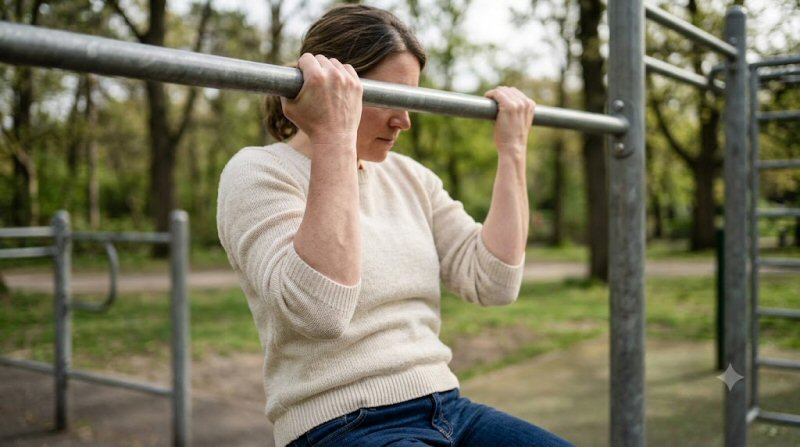
The front of the upper arm has a job that almost never shows up on a desk day. The biceps is not mainly a mirror muscle. It is a hanger, a puller, and a supinator: the muscle that helps you hold your own weight from a branch or a bar, draw the body up, and carry a load with the palm turned a little upward so the forearm clears the hip. For most of human history those were ordinary tasks. Climbing, hanging, hauling, and carrying were how the arm earned its shape. A keyboard, a phone, and a chair keep the elbow bent near a right angle and the hand almost weightless. The biceps stays quiet. Then a heavy suitcase, a child who asks to be lifted, or a first set of pull-ups makes the front of the arm burn, cramp, or ache into the next day.
That is not a sign that the muscle “gave up.” It is a flexor-supinator still built for body-weight tension, asked instead to hover. The mismatch is ordinary. It is also easy to nudge back, as long as a sudden pop and a new bulge in the arm are not waved off.
What a Quiet Biceps Feels Like
People rarely say the biceps is detrained. They say the front of the arm looks softer, tires when they hold a pan of water, or shakes when they try to chin themselves on a playground bar. Carrying grocery bags with the elbows a little bent leaves a deep ache where the muscle meets the shoulder. Opening a stuck jar feels weaker than it used to, even if the grip itself is fine. A weekend of painting a ceiling, or one session of curls after months of none, leaves the upper arm sore in a line from the front of the shoulder to the elbow crease.
Some notice a dull click or a tender cord at the front of the shoulder when they reach into the back seat. Others only meet the muscle when they start hanging and the long head cramps near the armpit. None of that, by itself, means a tear. It usually means the two heads have not been asked to hold real weight in months.
Two Heads, and a Job That Is Not Just Bending
The biceps brachii has a long head from the top of the shoulder socket and a short head from the coracoid, the small hook on the front of the shoulder blade. Both join a tendon on the radial tuberosity, with a flat sheet, the bicipital aponeurosis, fanning into the forearm fascia. Because the tendon wraps the radius, the muscle is a powerful supinator when the elbow is bent: it turns the palm up. Elbow flexion is the famous action. It is not the only one, and it is not even the main unloaded one.
Electromyography published by John V. Basmajian and A. Latif in the 1950s, later summarized in Basmajian’s Muscles Alive, showed a detail gym posters skip. Slow, unloaded bending of the elbow can happen with surprisingly little biceps activity. The brachialis, sitting underneath, is the workhorse flexor in every forearm position. The biceps joins in earnest when the forearm is supinated, when the movement is fast, or when there is a real load. Donald A. Neumann’s kinesiology accounts make the same point: a life of light, mid-prone typing never asks the biceps to do the job it is built for.
Bernard F. Morrey and colleagues mapped how the biceps moment arm changes with elbow angle. Mid-flexion is where it can turn the joint hardest. A desk pose parks you near that angle, but without load and without supination. The capacity sits idle. The long head also runs through the bicipital groove on the front of the humerus. It is irritated less by a short, easy hang than by hours of a rolled-forward shoulder plus a sudden overhead pull. Some texts call the long head a depressor of the humeral head. Electromyography from groups including those of Ken Yamaguchi has made that role look smaller than older drawings suggested. The practical point survives the debate: the tendon likes glide and gradual tension, not a shrug-and-reach life followed by a max effort.
The Arm Evolution Still Treats as a Suspension Tool
Apes do not live in chairs. Gibbons brachiate. Chimpanzees and gorillas climb, hang, and haul. Holger Preuschoft’s biomechanical work and Sharon Swartz’s studies of brachiation treat the arm as a tension member: the body hangs from the hand, and the elbow flexors and shoulder muscles share that load. Jack T. Stern Jr. and Randall L. Susman mapped the muscle pattern of ape locomotion and argued that early hominins still climbed as well as walked. Susan G. Larson’s work on the hominin shoulder describes a joint that stayed mobile overhead long after a full-time life in the trees was over.
Humans stopped brachiating. We did not stop hanging, pulling, and carrying. Daniel E. Lieberman has pointed out how much of the modern arm’s daily menu is missing compared with foraging life: no loads, no climbs, no repeated hoist of body weight. Mary W. Marzke’s studies of the forearm tie supination to tool use and carrying, not only to curls. David R. Carrier’s work on arm swing adds a smaller daily dose: the arms are meant to move while you walk, not to freeze on a desk. A latissimus that still expects a pull-up and a shoulder blade that still expects a hang are the neighbors of this same pattern. The biceps is the elbow’s share of it.
The carrying angle, that slight outward set of the forearm when the palm faces forward, lets a carried load clear the pelvis. It is a structural hint, not a workout plan. The hint is still readable: the front of the arm expects tension with the palm turned, not a weightless hover with the thumb on a trackpad.
What Desk Life Does Instead
Typing holds the elbow near ninety degrees, the forearm half-pronated, the hand light. The brachialis may tick over. The biceps often does not. Phone scrolling adds a little elbow flexion and a lot of stillness. Driving parks the hands on a wheel at the same bend. None of these are injuries. They are an absence.
The absence shows up in three ordinary ways. Endurance goes first: the arm shakes on a hang long before it looks small. The long-head tendon gets cranky when a detrained shoulder is asked to pull overhead. And the supination half of the job fades, so jars and doorknobs feel harder even when grip strength is decent. The triceps on the other side of the arm is usually just as quiet, which is why a first week of hangs and floor presses can leave both sides of the upper arm talking.
Less Common, but Not the Same Thing
A quiet, achy biceps after a new hang is one story. A sudden pop while lifting, a ball of muscle sitting lower in the arm, and a bruise near the elbow crease is another. That Popeye shape is usually a tear of the long-head tendon. In middle age and later it often follows fraying more than a single heroic lift. Elbow flexion is frequently still possible, because the short head and the brachialis remain. Supination is the action people miss. It deserves an exam, not a panic, and not a promise that it will sort itself unnoticed.
Front-of-shoulder pain with night waking, pain that runs past the elbow with numbness into the hand, a hot swollen elbow, or weakness after a fall is also outside the “detrained hang muscle” story. Distal biceps rupture, where the tendon leaves the radius, is less common and more urgent: supination and flexion both drop, and early repair is often discussed. Those are clinic problems. A sore arm the day after a first short hang is not.
Myths vs Facts
Myth: If you can bend your elbow, the biceps is trained.
Fact: Unloaded bending can be mostly brachialis. The biceps shows up for load, speed, and supination. Basmajian’s EMG made that split clear decades ago.
Myth: Heavy curls are the ancestral pattern.
Fact: Curls can load the muscle. Hanging, pulling the body up, and carrying with the palm partly up are closer to the job the tendon and the shoulder evolved around. A curl with no hang still leaves the closed-chain pattern out.
Myth: Dead hangs wreck shoulders.
Fact: A short hang with the feet near the ground, shoulders relaxed rather than shrugged to the ears, is a graded load, not a stunt. Pain at the front of the shoulder is the stop signal. Forcing a max hang on day one is the part that irritates a quiet tendon.
Myth: A Popeye bulge always needs surgery.
Fact: Long-head ruptures in older adults are often managed without repair when pain settles and flexion remains useful. Distal ruptures are a different decision. The shape of the bulge does not settle that by itself.
How to Give the Biceps the Hang It Expects
Start smaller than pride wants. A bar, a sturdy tree limb, or the edge of a secure overhead beam is enough. Keep the feet on the ground or on a low step so you can take some weight off. Hang for ten to twenty seconds, shoulders long rather than pinched to the ears, two or three times. Stop if the front of the shoulder bites. Do this most days before you chase pull-ups.
Add a carry. Hold a bag or a light dumbbell at your side on a short walk, and on some trips turn the palm a little forward so the biceps actually joins. Rows and assisted pull-ups, done smoothly, restore the pull without a sudden max load. A few slow supinations against a light resistance band, elbow bent, train the half of the job jars require. Pair it with an easy push off the floor or a wall so the elbow extensors are not left behind.
Walking with a real arm swing is the daily background dose, not a full replacement for a hang. Skip the all-out curl session on a tendon that has been quiet for years. Soreness in the belly of the muscle the next day is normal. Sharp pain in the groove at the front of the shoulder is a cue to shorten the hang and skip overhead pulling until it calms.
When to See a Doctor
Get the arm checked if you felt a pop and can see a new bulge, if you cannot turn the palm up, if bruising tracks into the elbow crease, or if flexion is clearly weaker than the other side after an injury. Night pain that wakes you, numbness or tingling into the hand, swelling and warmth at the elbow, or pain after a fall also deserves a visit. A first-week ache after short hangs, without a pop or a bulge, can be managed by doing less and building slowly.
FAQs
Is a dead hang safe if I have never done one?
A partial hang, with the feet taking some weight, is a reasonable start for most people without a fresh shoulder injury. Full body-weight hangs can wait until ten or twenty seconds feel ordinary. Pain at the front of the shoulder means shorten the time, not push through.
Why does the front of my shoulder ache after pull-ups?
The long head of the biceps runs through a groove at the front of the shoulder. A detrained tendon plus a shrugged, rolled-forward scapula is a common reason the ache sits there rather than in the muscle belly. Easier hangs, scapular control, and fewer max reps usually settle it. A pop with a bulge is a different problem.
Do I need heavy curls?
No. Load matters, and body weight on a hang or a pull is already a serious load. Light carries and slow supination cover the rest. Heavy curls are optional, and a poor first choice for a tendon that has been quiet.
Why can I still bend my elbow if the long head tears?
The short head and the brachialis still cross the elbow. Flexion often remains useful. Supination is the action more likely to feel weak. That split is why a Popeye arm can look dramatic and still lift a cup, and why it should still be examined.
How long until a quiet biceps feels useful again?
Many people notice a steadier hang within two to four weeks of short, frequent practice. Tendon irritability can take longer if you started with max pull-ups. Consistency beats a single hard session.
Is arm swing while walking enough?
It is the background the shoulder expects, and it is better than pinned elbows. It does not replace a hang or a carry. The biceps joins when tension and supination show up, not when the arm simply pendulums.
Conclusion
The biceps still expects to hang, to pull, and to carry with the palm turned. Desks give it a bent elbow and an empty hand. The softness, the shake on a playground bar, and the ache after a suitcase are what that absence feels like. Short hangs with the feet nearby, a few loaded carries, and the patience not to max out a quiet tendon put the old job back on the calendar. A pop and a new bulge are the exception worth showing someone. Everything else is a muscle waiting for a branch.


