
The triceps still expects to press your weight off the ground and carry a load. Chairs and keyboards rarely ask. A quiet elbow extensor is why the back of the arm feels soft and shaky.
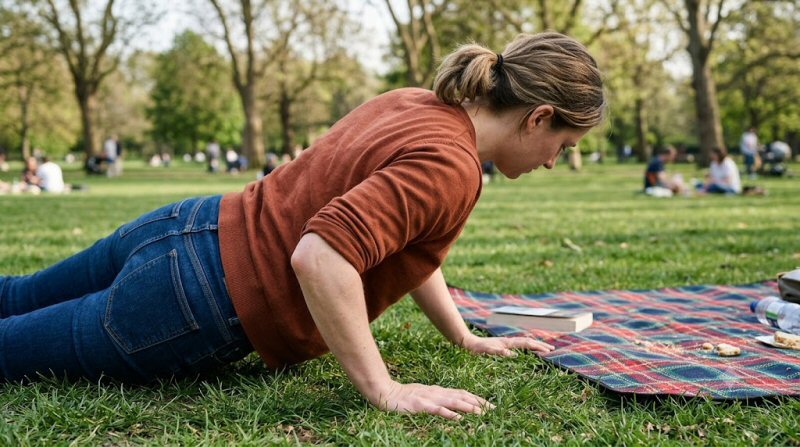
The back of the upper arm has a job most desk days never give it. The triceps is the muscle that straightens the elbow and, through its long head, helps the arm push the body away from a surface. For most of human history that meant getting up off the ground, bracing on a branch, pressing a load, or lowering yourself with control. A chair, a keyboard, and a phone keep the elbow bent and the hand light. The muscle stays quiet. Then a weekend push-up, a heavy box, or the simple act of rising from a picnic blanket makes the back of the arm shake, burn, or ache the next day.
That is not a sign that the triceps “gave up.” It is a muscle still built for closed-chain pushing, asked instead to hover in slight bend for hours. The mismatch is ordinary. It is also easy to reverse, as long as pain that stops you extending the elbow is not ignored.
What This Quiet Triceps Feels Like
People rarely say “my triceps is detrained.” They say the back of the arm looks softer than it used to, jiggles when they wave, or tires when they hold a cast-iron pan out from the body. Getting up from the floor using the hands feels awkward. A few push-ups from the knees leave a deep ache behind the arm that peaks a day or two later. Reaching to close a high window, or pressing yourself up in bed with one arm, feels weaker on one side.
Some notice a dull line of tightness from the shoulder blade down the back of the arm after a long typing day, even though the elbow never fully straightened. Others only meet the muscle when they start a gym program and the long head cramps near the armpit. None of that, by itself, means a tear. It usually means the three heads have not been asked to take body weight in months.
Three Heads, One Everyday Job
The triceps brachii has a long head from the shoulder blade, and lateral and medial heads from the back of the humerus. All three join a tendon onto the olecranon, the point of the elbow. Electromyography work associated with John V. Basmajian showed that the medial head is the workhorse of ordinary extension. It turns on for light, unresisted straightening. The lateral and long heads join when the load or the speed rises. You do not need a gym to recruit them. You need a push that actually weighs something.
Bernard F. Morrey and colleagues mapped how the triceps moment arm changes with elbow angle. The muscle is not equally effective at every bend. Mid-range is where it can produce the most turning force at the joint. A life spent at ninety degrees of elbow flexion, never passing through a loaded mid-range press, leaves that capacity idle. Donald A. Neumann’s kinesiology descriptions add the long-head detail people miss: because it crosses the shoulder, it also helps extend and adduct the arm. A push off the ground uses both jobs at once. An isolation kickback on a light cable does not.
Muscle-architecture work by Wendy M. Murray, Scott L. Delp, and others put numbers on what coaches already see. The heads differ in fiber length and pennation. The medial head is built for sustained force. The long head can contribute across two joints. A desk day uses almost none of that range.
What the Arm Was Built to Push Against
Human upper limbs are not only for fine finger work. Daniel E. Lieberman and other evolutionary anatomists have stressed that hominin arms still carry a climbing and carrying legacy even after we became walkers. Getting down from a height, bracing during a stumble, pushing a branch aside, and rising from the ground all load elbow extension. Anthropologist Gordon W. Hewes documented how widely people once sat and rose from the floor. A deep squat or a side-sit ends with a hand on the ground and a triceps press. Chairs deleted that repetition.
The same pattern shows up in the rest of the push chain. The chest still expects a closed-chain press, which is why the pectorals were built to push off the ground, not to round over a laptop. The elbow still expects hanging and an occasional throw, covered in why the elbows still expect hanging and throwing. The triceps is the extensor partner in that system. Hang loads it in a lengthened position. A push loads it as it shortens. Modern life often supplies neither.
Floor living also couples the arm to the leg. Rising from the ground is a whole-body skill, which is why the quads still expect the floor. When the legs do all the work and the hands never press, the triceps loses the repetitions it was counting on.
Why a Keyboard Day Leaves It Quiet
Typing holds the elbow near a right angle and the wrist slightly extended. The load is the weight of the hand, not the weight of the body. Basmajian’s split still applies: the medial head may flicker, the long and lateral heads mostly do not. Hours of that posture do not “stretch the triceps into weakness” in a dramatic way. They simply never reach the threshold that keeps a postural extensor honest.
Phone use is worse for the long head’s shoulder role. The arm stays forward and slightly lifted, the elbow bent, the shoulder blade drifted around the rib cage. The long head can feel tight near the armpit even though it has not worked hard, because it has been held in a shortened shoulder position while the elbow stayed flexed. Tight and underloaded can coexist. Janet Travell described triceps trigger points that refer ache to the back of the arm and the outer elbow. Desk workers often meet that referral pattern and call it tennis elbow, even when the forearm extensors are only part of the story.
Leaning on the elbows is a different local stress. Pressure on the olecranon bursa can swell the tip of the elbow without the muscle having done any pushing at all. A soft bump on the point of the elbow after a week of propped video calls is bursal irritation, not a triceps workout.
Hidden Triggers That Make the Back of the Arm Complain
- A sudden return to push-ups, bench pressing, or yoga chaturanga after months of no loaded extension. Delayed soreness in the belly of the muscle is common. A pop at the tip of the elbow is not.
- Overhead pressing with the elbow flared and the long head already tight from desk posture.
- Carrying a heavy bag with the elbow locked straight for a long walk. The medial head holds an isometric, then aches.
- Sleeping with the arm overhead, long head shortened, then reaching back for an alarm.
- Steroid injections around the elbow or oral anabolic steroid use, both linked in clinical series to a higher chance of triceps tendon trouble.
- A forwarded shoulder that makes the long head work at a poor length whenever you do try to push.
Myths vs Facts
Myth: Softness on the back of the arm is only fat, and muscle work will not change it.
Fact: Subcutaneous fat is real there, especially in women, and spot reduction is not how fat loss works. Under it, unused triceps still loses tone and endurance. Loaded pushing changes the muscle even when the tape measure moves slowly.
Myth: Kickbacks with a light dumbbell are the ancestral movement.
Fact: The muscle expects to push the body away from the ground or to control a heavy lower. Small isolation moves can teach elbow extension. They do not replace a wall push, a knee push-up, or a press-up from the floor.
Myth: You should lock the elbow hard at the end of every push.
Fact: Full extension is normal. Snapping into a bony lock under load, especially if the elbow hyperextends, is optional and sometimes irritating. A controlled straightening is enough.
Myth: Elbow ache after pushing always means tendon tear.
Fact: Most next-day ache is ordinary delayed soreness in muscle. A tear is uncommon and has a clearer signature, described below.
When to Worry
Seek care promptly if you felt a pop at the back of the elbow, the tip looks different from the other side, or you cannot straighten the elbow against gravity. Triceps tendon rupture is uncommon, but Morrey’s elbow literature and later surgical series describe it in middle-aged adults after a fall, a heavy eccentric load, or in people with prior steroid exposure. Bruising and a gap above the olecranon are late clues. Waiting weeks makes repair harder.
Also get checked for elbow swelling with fever, a hot joint, numbness in the ring and little fingers that does not settle, or night pain that is not explained by a new workout. Posterior elbow pain with locking can be a joint problem, not a fitness gap. Ordinary shake and next-day muscle ache after a first push session can be watched for a week while you reduce the load.
How to Give the Triceps the Push It Expects
You do not need a program named after the muscle. You need a few pushes that use body weight, spread through the week, plus fewer unbroken hours of a bent elbow.
- Once or twice a day, stand and press your palms into a wall at chest height. Step back until the back of the arm works, keep the body in a line, and straighten the elbows without slamming them. Ten slow reps is a real dose.
- A few times a week, get onto the floor and press up from hands and knees, or from the toes if that is easy. Lower for two counts, press for one. The floor is the load the muscle recognizes.
- Practice rising from a low seat or the ground using one hand on the floor or a stable chair. Alternate sides. This is the Hewes pattern, not a stunt.
- Hang from a bar or a sturdy playground rail for short bouts if the shoulders allow. Length under body weight balances the desk bend and pairs with the push.
- Break keyboard time. Straighten the elbows, reach the hands behind the hips, and open the chest for twenty seconds. The long head gets a change of length even before strength work.
- Progress by slowing the lower, not by adding a sloppy heavy bench on day one. Tendon likes gradual load, the same rule that governs the rest of the arm.
Soreness in the muscle belly that fades in two or three days is a tolerable signal. Sharp pain at the tendon insertion, swelling at the point of the elbow, or a sudden loss of power is a stop sign.
When to See a Doctor
See a clinician if you cannot extend the elbow against gravity, if a gap or bruise appears after a pop, if swelling follows a steroid injection, or if numbness and weakness persist after the ache should have settled. People on fluoroquinolone antibiotics or with a history of tendon rupture deserve a lower threshold for assessment. A physiotherapist can also separate triceps tendon pain from referred neck pain and from lateral elbow tendinopathy if the picture is muddy.
FAQs
Why does the back of my arm shake during push-ups?
The lateral and long heads are being asked for force they rarely produce. Shaking is usually motor-unit recruitment under a new load, not nerve damage. Shorter sets, a higher hand position, or knees-down pressing reduces the demand while the muscle adapts.
Is a bent-elbow desk day actually stretching the triceps?
It holds the elbow flexed, so the muscle is lengthened across the elbow and, if the arm is forward, shortened across the shoulder at the long head. That is a static posture, not a strengthening stretch. Without a push, endurance still declines.
Do women “store fat” on the triceps because of the muscle?
Hormones influence where subcutaneous fat sits, and the back of the upper arm is a common site. The muscle underneath still atrophies with disuse in every sex. Pushing changes tone. It does not selectively delete the fat layer.
Can leaning on my desk injure the triceps?
Leaning usually irritates the olecranon bursa or the ulnar nerve in the cubital tunnel, not the muscle belly. A swollen tip of the elbow needs pressure relief. Triceps trouble is more often a tendon story after a sudden load.
How often should I press if I only want to stay able to get off the floor?
Two or three short sessions a week of wall or floor pushes, plus actually getting up from the ground now and then, is enough for capacity. Daily wall presses of a minute are reasonable if they do not provoke tendon pain.
Why does the long head cramp near the armpit?
That head crosses the shoulder. Overhead reaching or a dip can cramp it if it is both tight from desk posture and suddenly loaded. Ease the range, then build pushing and hanging gradually. A cramp that comes with chest pressure or severe shortness of breath is a different problem and needs urgent care.
Conclusion
The triceps still expects a push off the ground, a controlled lower, and the occasional carry with a straighter elbow. Basmajian’s medial head, Morrey’s moment arm, and the long head’s shoulder attachment are all built for that mix. Chairs and keyboards never assemble it. The back of the arm gets softer, then complains when a real push returns. Give it wall presses, floor presses, and a reason to help you stand up. Save the urgent visit for a pop, a gap, or an elbow that will not straighten.


