
Your outer hamstring evolved for sideways steps and turning on uneven ground. Modern flat paths and sitting leave it underused—here’s what that means.
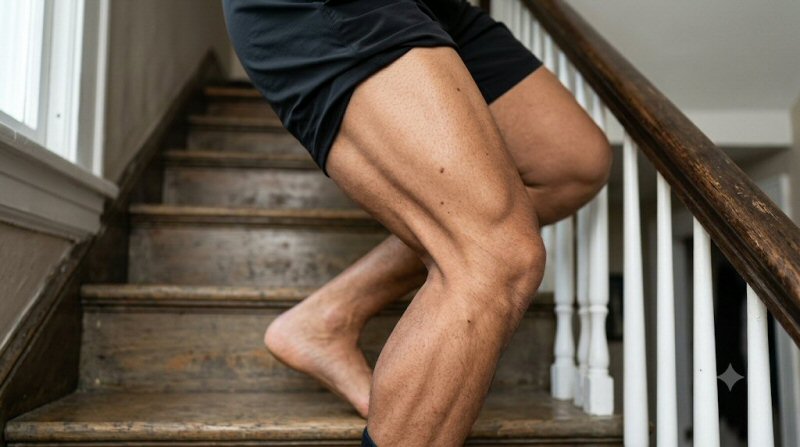
You stand up from your desk, take a few steps to the kitchen, and notice a tight band running down the outer back of one thigh. Or you step sideways to dodge a puddle and feel the same area catch and complain. That sensation often comes from the biceps femoris—the lateral hamstring that still expects the occasional sideways step and turning motion that modern floors and straight paths rarely demand.
What the Biceps Femoris Actually Does
The biceps femoris sits on the outer half of the back of your thigh. It has two heads: a long head that starts at the ischial tuberosity (the bone you sit on) and a short head that starts lower on the femur. Both insert on the head of the fibula just below the outer knee. Classic electromyography work by researchers such as John Basmajian showed that this muscle is highly active during knee flexion and during hip extension when the trunk is bent forward. More recent studies confirm it also externally rotates the lower leg when the knee is slightly bent and helps stabilize the pelvis during weight shifts.
In short, it is not only a knee bender. It is a lateral stabilizer and a rotator that keeps the knee from collapsing inward or outward when you change direction. Ancestral locomotion involved exactly that kind of work: stepping over roots, turning on slopes, climbing, and shifting weight while carrying loads on uneven ground. The muscle’s architecture still reflects those demands.
Why Modern Life Leaves It Underused
Most of us now walk in straight lines on hard, level surfaces. Elevators, cars, and office chairs replace the repeated lateral steps and rotational control that once filled a day. Sitting keeps the long head in a shortened position for hours, reducing the need for the deep hip-extension work it evolved to perform. Even regular forward walking or treadmill running loads the medial hamstrings and the calf more than the outer rotational fibers of the biceps femoris.
The result is a muscle that stays relatively quiet until a sudden side step, a quick turn, or a deeper bend under load asks it to work. That is when the familiar outer-thigh tightness or a brief catch appears. Research on hamstring activation shows that pure knee-flexion tasks recruit the biceps femoris less effectively than movements that combine hip extension with rotation or lateral weight shift—precisely the patterns modern environments minimize.
Common Everyday Triggers
- Hours of sitting followed by a quick sideways reach or step off a curb
- Standing on one leg while putting on shoes or reaching into a low cabinet
- Changing direction suddenly while walking the dog or navigating a crowded sidewalk
- Deep squats or lunges performed mostly in the forward plane without any lateral component
- Driving long distances with the outer thigh pressed against the seat edge
None of these are dangerous on their own. They simply ask a muscle that has been relatively idle to perform a task it was built for but no longer practices regularly.
When the Tightness Is Just a Mismatch—and When It Isn’t
Most of the time the outer-thigh tightness after a side step or after rising from a chair is ordinary under-use. It eases with a few gentle movements and does not limit ordinary walking. Red flags are different: sharp pain that appears with minimal effort, swelling, bruising, or a sudden “pop” during a sprint or jump. Those warrant a check, especially if you have a history of hamstring strain. Persistent pain that radiates below the knee or is accompanied by numbness is also worth evaluating, as it can occasionally involve the sciatic nerve rather than the muscle itself.
Myths Versus Facts
Myth: Outer-thigh tightness always means the muscle is “too short” and needs aggressive stretching.
Fact: The biceps femoris is often under-loaded rather than chronically shortened. Gentle lengthening helps, but the bigger need is occasional loaded lateral and rotational work so the muscle stays ready.
Myth: Only athletes who sprint or cut need to care about the outer hamstring.
Fact: Everyday balance, turning, and rising from low positions all rely on it. Desk workers and older adults notice the mismatch just as clearly when a simple side step feels stiff.
Myth: Strengthening the hamstrings with only straight-leg deadlifts or Nordic curls covers everything.
Fact: Those exercises are useful, yet they emphasize forward-plane flexion and extension. Lateral steps and controlled turns add the rotational component the biceps femoris also expects.
How to Give It What It Still Expects
You do not need a gym or special equipment. Small, frequent doses of lateral and rotational movement restore the missing stimulus without adding much time.
- Side steps and lateral lunges. Take five to eight controlled steps sideways in each direction once or twice a day, or do a few shallow lateral lunges while waiting for coffee. Keep the movement slow and steady so the outer thigh does the work.
- Standing knee-to-opposite-elbow or gentle hip openers. These combine the rotation the long head contributes to with ordinary standing.
- Rise from a low seat with a slight turn. Instead of always standing straight forward, angle your body a little to one side as you stand. Alternate sides.
- Walk on varied surfaces when possible. A grassy verge, a gentle slope, or even the edge of a sidewalk gives the foot and the outer thigh small corrective adjustments that flat pavement omits. Related ideas appear in pieces on why your ankles still expect uneven ground and why your knees still expect varied terrain.
- Short loaded bends. A few single-leg Romanian deadlift variations or simply bending to pick something up while keeping a soft knee trains the hip-extension role without heavy weights.
If the area feels particularly tight after sitting, a brief walk that includes a couple of sideways steps usually clears it faster than prolonged static stretching alone. Pairing this with attention to the medial side—covered in the article on why your semitendinosus still expects occasional knee bends—keeps both halves of the hamstring group balanced.
When to See a Doctor
See a clinician if the outer thigh pain is sudden and severe, if you cannot bear weight, if swelling or bruising develops, or if the discomfort persists for more than a week despite ordinary movement. Also seek advice if you notice progressive weakness, night pain, or symptoms that travel down the leg. Most everyday stiffness does not require imaging or treatment beyond restoring a bit of the lateral work the muscle expects.
Frequently Asked Questions
Is outer-thigh tightness after sitting normal?
Yes for many people. Prolonged sitting reduces the demand on the long head of the biceps femoris; when you finally stand and take a side step the muscle can feel tight simply because it has been relatively quiet. A few lateral steps usually ease it.
Can weak outer hamstrings affect knee stability?
They can. The biceps femoris helps control tibial rotation and lateral stability at the knee. When it is under-conditioned, quick direction changes or single-leg balance may feel less secure. Regular sideways and turning movements help maintain that control.
Do I need to stretch the biceps femoris every day?
Not necessarily. Occasional gentle lengthening is useful, especially after long sitting, but the primary need is loaded use in the lateral and rotational directions. Over-stretching a muscle that mainly lacks strength and coordination can sometimes increase the sense of tightness.
Why does one side feel tighter than the other?
Most people favor one leg when standing or turning. Driving position, how you cross your legs, or a slight difference in hip mobility can load one biceps femoris more than the other. Alternating sides in lateral steps and rises helps even the demand.
Will adding lateral steps reduce the chance of a hamstring strain?
Varied loading, including lateral and rotational work, supports tissue resilience. Purely forward-plane training leaves the outer fibers relatively less prepared for the sudden turns or side steps that sometimes produce strains. Consistency matters more than intensity.
Conclusion
The biceps femoris still expects the occasional lateral step, the quick turn, and the weight shift on uneven ground that once filled ordinary days. Modern floors, cars, and chairs have removed most of those small demands, so the muscle can feel tight or unprepared when they finally appear. Restoring a few sideways steps, gentle turns, and varied rises gives it the stimulus it was built for—without requiring a special routine or equipment. Most of the everyday outer-thigh tightness that follows is simply the body noticing the difference between the life it evolved for and the one it now leads.


