
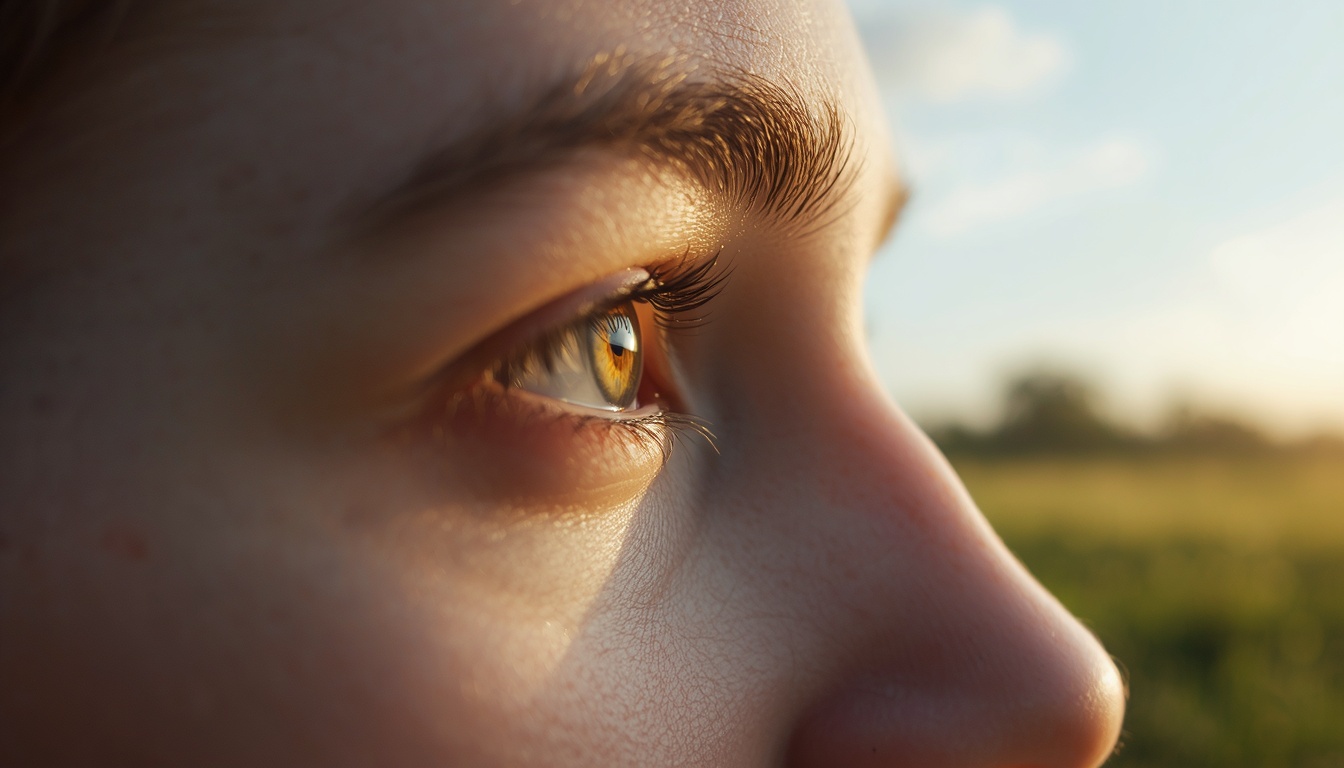
For most of human history, clear distance vision was not a luxury. It was survival. Spotting movement across open ground, tracking animals, reading the weather on the horizon, or noticing a threat approaching from afar shaped the way our eyes developed. The visual system that carried our ancestors through hundreds of thousands of years expected long hours of outdoor light and mostly distant focus.
Today that system is being asked to do something almost completely different. Children and adults spend long stretches indoors, under relatively dim artificial light, focused on books, phones, tablets, and screens held close to the face. The result is one of the most striking health shifts of the modern era: a sharp rise in myopia, or nearsightedness.
This is not primarily a story of broken genes. It is a story of an ancient eye meeting a brand-new visual environment.
What Myopia Actually Feels Like
Myopia means the eye focuses images in front of the retina instead of directly on it when looking at distant objects. Nearby objects remain clear; distant ones appear blurry.
Many people first notice it as difficulty reading the board at school, recognizing faces across a room, or seeing road signs clearly while driving. Some describe a constant soft haze in the distance that glasses or contact lenses suddenly make sharp. Others only realize how much detail they were missing once their vision is corrected.
In higher degrees of myopia the blur becomes more pronounced, and the risk of later eye complications rises. But even mild to moderate myopia is far more common now than it was a few generations ago, especially among young people who have spent their formative years in intensive near-work environments.
The Evolutionary Mismatch
Human eyes evolved under conditions that look very different from modern indoor life. For the vast majority of our species’ history, people lived outdoors for much of the day. Light levels were high—often tens of thousands of lux in bright daylight—compared with the few hundred lux typical of classrooms or living rooms. Visual attention was directed toward the middle and far distance far more often than toward objects held close to the face for hours at a time.
Under those ancestral conditions, the developing eye received strong signals that helped guide its growth so that images focused accurately on the retina. When those signals are reduced or altered, the eye can continue elongating past the point of clear distance focus. That elongation is the structural basis of most common myopia.
Researchers describe this as an evolutionary mismatch: traits that worked well in the environments that shaped them become problematic when the environment changes faster than biology can adapt. Myopia fits the pattern closely. Genetic differences in susceptibility exist, but the rapid rise in prevalence across entire populations in a single generation or two cannot be explained by genes alone. The change has been environmental.
Why Rates Have Soared, Especially in East Asia
In many urban areas of East Asia, the numbers are striking. Studies of young adults who have completed secondary schooling often show myopia rates of 80 to 90 percent. High myopia (stronger degrees that carry greater long-term risk) has also increased. Similar upward trends appear in other regions as education intensifies and outdoor time declines, though the East Asian figures remain among the highest documented.
The rise tracks closely with two intertwined shifts: more years of intensive schooling that demand prolonged near work, and less time spent outdoors during daylight hours. Urban living, competitive academic pressure, and the spread of digital devices have amplified both factors. When children spend most of their daylight hours indoors focusing at close range, the developmental signals that once kept eye growth in check are weakened.
Historical observations support the environmental view. When groups living more traditional outdoor lifestyles adopted formal schooling and indoor near work, myopia rates rose within a generation. Rural–urban differences within the same populations further illustrate the point: higher near-work demands and lower outdoor exposure consistently associate with higher myopia prevalence.
How the Eye Responds: Light, Dopamine, and Growth Signals
One of the clearest protective factors identified in research is time spent outdoors. Multiple observational studies and school-based intervention trials show that children who spend more time outdoors are less likely to develop myopia. The benefit appears linked more to the bright light and visual characteristics of outdoor environments than to physical activity itself.
Bright outdoor light stimulates the release of dopamine in the retina. Dopamine acts as a signal that helps restrain excessive elongation of the eyeball. Indoor lighting is typically far dimmer and does not trigger the same robust response. Prolonged near focus can also create patterns of retinal defocus—especially relative hyperopic defocus in the peripheral retina—that further encourage the eye to grow longer.
In short, the modern indoor, near-work environment tends to remove the natural “stop growing” signals that outdoor daylight and distance viewing once provided. The eye responds by continuing to lengthen, producing myopia.
Common Drivers and Hidden Triggers
Several everyday factors converge:
- Sustained near work: Reading, writing, and screen use at close distances for long periods. The total time and the working distance both matter.
- Limited outdoor time: Especially during the years when the eye is still growing (roughly ages 5–15, with earlier onset becoming more common).
- Indoor light levels: Typical classroom or home lighting is orders of magnitude dimmer than outdoor daylight.
- Educational intensity: Early and prolonged formal schooling correlates strongly with higher rates, independent of simple measures of “hours of reading.”
- Urban living: Less access to open outdoor space and higher academic demands often travel together.
Less obvious contributors can include very close working distances (holding devices or books closer than roughly 30 cm), continuous near focus without breaks to look into the distance, and reduced exposure to the richer spatial frequencies and varying focus demands of outdoor scenes.
Genetics influence individual susceptibility. Children with two myopic parents have higher risk. Yet the same genetic background produces very different outcomes depending on lifestyle. The environment largely determines whether the predisposition is expressed.
When to Pay Closer Attention
Most childhood myopia progresses gradually and is manageable with glasses, contact lenses, or other optical corrections. Certain patterns deserve prompt professional evaluation:
- Rapid change in prescription, especially in younger children
- Difficulty seeing the board or distant objects that interferes with school or daily life
- Frequent headaches or eye strain associated with visual tasks
- Family history of high myopia combined with early onset
- Any sudden vision changes, flashes, floaters, or visual field loss (these can signal more serious issues and require urgent care)
High myopia increases lifelong risk of conditions such as retinal detachment, myopic maculopathy, and certain types of glaucoma. Early detection and monitoring matter.
Myths vs Facts
Myth: Myopia is almost entirely genetic, so lifestyle changes make little difference.
Fact: Genetics set susceptibility, but the dramatic rise in prevalence is driven by environmental change. Outdoor time and visual habits measurably influence onset.
Myth: Screens are uniquely harmful compared with books.
Fact: Both involve prolonged near focus. Screens often encourage closer working distances and longer continuous sessions, but the core issue is sustained near work plus low outdoor light exposure, not the device itself.
Myth: Once myopia starts, outdoor time no longer helps.
Fact: Increased outdoor time is most effective at reducing the onset of myopia. Evidence for slowing progression in eyes that are already myopic is weaker and less consistent, though good visual habits remain beneficial overall.
Myth: Children will “grow out of” needing stronger prescriptions if they just rest their eyes.
Fact: The structural elongation of the eye does not reverse on its own. Correction and monitoring are needed; prevention of further progression is the realistic goal.
Myth: Only very high academic pressure causes the problem.
Fact: Any combination of high near-work demand and low outdoor light exposure raises risk. Academic intensity is a powerful amplifier in some societies, but the underlying mismatch is broader.
Practical Ways to Support Healthier Eye Development
Complete avoidance of near work is neither realistic nor desirable. Education and literacy matter. The goal is better balance.
- Aim for regular outdoor time during daylight hours. Many studies and public-health programs target around two hours a day when possible. Even intermittent bright-light exposure helps.
- Encourage looking into the distance periodically during near work—every 20–30 minutes, focus on something far away for a short break.
- Keep working distances reasonable. Avoid holding books or devices extremely close for long periods.
- Prioritize outdoor play and activities in natural light over purely indoor recreation when feasible.
- Ensure adequate overall lighting for reading and homework, though outdoor daylight remains uniquely protective.
- For children already showing signs of myopia, discuss evidence-based options with an eye-care professional. These may include specialized spectacle lenses, contact lenses designed to slow progression, or low-dose atropine in some cases. Outdoor time remains a foundational recommendation.
Parents and schools can make meaningful differences by protecting outdoor recess, reducing unnecessary indoor confinement, and modeling balanced visual habits.
When to See an Eye-Care Professional
Schedule a comprehensive eye examination if a child struggles with distant vision, if there is a strong family history of myopia, or simply as part of routine pediatric care. Early detection allows timely correction and discussion of strategies that may slow progression. Adults who notice new or worsening distance blur should also seek evaluation rather than relying solely on over-the-counter readers.
Regular monitoring is especially important once myopia is present, both to update prescriptions and to watch for higher-risk changes.
Frequently Asked Questions
Is myopia becoming more common worldwide?
Yes. Prevalence has risen substantially in many regions over recent decades. The highest rates are reported among young people in urban East Asia, but upward trends appear wherever intensive near work and reduced outdoor time have become the norm.
Does more outdoor time really help even if a child still does a lot of studying?
Evidence indicates that outdoor time retains a protective effect against the onset of myopia even among children with high near-work demands. The two factors are not simply opposites of each other.
Are blue-light glasses or special screen filters the solution?
Current evidence does not support them as primary tools for preventing myopia. The stronger signals involve overall light intensity (especially outdoor daylight) and the pattern of near versus distance focus.
Can adults develop myopia from near work?
Most progressive myopia begins in childhood or adolescence while the eye is still growing. Adult-onset myopia can occur but is less common. Significant new blur in adulthood should be evaluated to rule out other causes.
Will reducing screen time alone fix the problem?
Reducing continuous near focus is helpful, but replacing indoor screen time with outdoor time in natural light is more aligned with the protective mechanisms identified in research.
Is there a “safe” amount of near work?
No precise threshold applies to every child. Risk rises with greater total near-work time, closer working distances, and less outdoor exposure. Balance and regular distance viewing breaks are practical goals.
Conclusion
The modern epidemic of myopia is not a mysterious genetic failure. It is the predictable outcome of asking eyes that evolved for distant outdoor vision to spend their developmental years focused on nearby objects under relatively dim indoor light. Understanding this mismatch removes unnecessary blame and points toward practical responses: more time outdoors in daylight, thoughtful visual habits during near work, and early professional care when needed.
Our visual system is remarkably adaptable, yet it still carries the imprint of the open landscapes that shaped it. Giving developing eyes more of the light and distance viewing they were built to expect is one of the clearest steps we can take to support clearer vision in a near-work world.