Yawning when you are wide awake is common and usually harmless. It often reflects a brain state change, mild boredom, or a simple cooling response rather than true sleepiness.
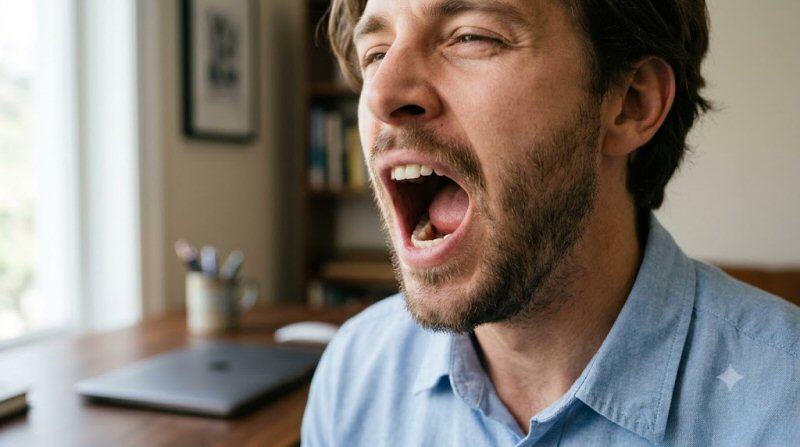
You are sitting in a meeting, scrolling on your phone, or just waiting in line, fully awake, and suddenly a big yawn forces its way out. No real tiredness, no late night behind it, just an unexpected stretch of the jaw. It can feel slightly embarrassing or make you wonder if something is off. For most people this is ordinary. Yawning is less a pure sleep signal and more a flexible brain-and-body reset that shows up in several everyday situations.
What This Feels Like
The classic yawn is hard to miss: a deep, slow inhale through a widely opened mouth, a brief hold, then a longer exhale, often with a stretch of the jaw, neck, or even the arms. When it happens while you are not sleepy, it can arrive without warning during quiet moments, after sitting still, or right as you switch from one task to another. Some people notice watery eyes or a slight ear rumble along with it. The whole sequence usually lasts only a few seconds and leaves a mild sense of having “reset” something.
Why You Can Yawn Without Being Tired
Sleepiness is only one trigger. Researchers have shown that yawning clusters around transitions: the hour after waking, the hour before bed, and any shift from one behavioral state to another. Psychologist Robert Provine, who studied yawning for decades, described it as a way the body helps move between states—sleep to wakefulness, boredom to alertness, or even mild anxiety toward calm. Olympic athletes, concert musicians, and people about to give a talk sometimes yawn right before the high-stakes moment. The yawn is not announcing that they are sleepy; it is helping them change gears.
Boredom is another reliable trigger. In lab tests where people watched a dull test pattern versus engaging videos, yawning increased markedly during the unstimulating condition. When attention drifts, a yawn can act like a small internal nudge. Mild stress or the need to suppress an urge (trying not to yawn in a quiet room) can also bring one on. In short, the system is sensitive to any drop or shift in alertness or arousal, not only to the need for sleep.
The Science Behind the Stretch
The old idea that yawning is mainly about bringing in extra oxygen or blowing off carbon dioxide was tested and set aside by Provine and colleagues in the 1980s. Changing the oxygen and carbon-dioxide levels in the air people breathed altered ordinary breathing but did not change how often they yawned. So the “low oxygen” explanation does not hold up.
A more current view combines state-change and brain-temperature ideas. Andrew Gallup and others have proposed that the deep inhale and the strong jaw stretch help cool the brain. Cooler air moves across moist surfaces in the mouth and nose, and the muscular action may increase blood flow in ways that remove a bit of heat. Experiments that warm or cool the neck area change how readily people yawn, which fits a thermoregulatory role. At the same time, Olivier Walusinski has pointed out that yawning may help the brain shift between networks—moving out of the default-mode (daydreaming, mind-wandering) pattern and into more focused attention, possibly by supporting cerebrospinal-fluid movement. Both ideas can coexist: a brief cooling and circulatory boost that also aids an arousal reset.
Contagious yawning is a separate but related phenomenon. Seeing or hearing someone else yawn can set one off even when you are not tired; that version appears linked to social and empathic processing and is more common among people we know well. If you have ever caught a yawn just by reading about yawning, you have experienced the contagious form. For more on that social side, see our piece on whether it is normal to yawn when someone else yawns.
Common Everyday Triggers
- Quiet, low-stimulation moments (waiting, long meetings, passive scrolling)
- Transitions between activities or mental states
- Mild boredom or a temporary drop in attention
- Temperature shifts or a slightly warm room
- The sight or thought of someone else yawning
- Stretching or the urge to move after sitting still
These are the same situations in which the ancestral brain might have needed a quick way to re-engage after a period of lower activity. Modern life simply multiplies the quiet, seated stretches of time. Related reading on how the brain handles unfilled time appears in why your default mode still expects unfilled time.
When to Pay Closer Attention
Occasional yawns while you are otherwise alert are normal. Patterns worth noting include:
- Very frequent yawning that continues for hours and is not explained by boredom, temperature, or contagion
- Yawning paired with new dizziness, chest discomfort, or shortness of breath
- Sudden increase in yawning along with other neurological symptoms (unusual weakness, speech changes, severe headache)
- Yawning that is extreme enough to disrupt work or driving and does not improve with ordinary rest or a short walk
Excessive yawning can occasionally appear with certain medications, migraine, or other conditions that affect temperature regulation or arousal circuits, but these are uncommon. Most of the time a few unexpected yawns are simply the system doing its ordinary job.
Myths Versus Facts
Myth: Yawning always means you need more sleep.
Fact: Sleepiness raises the chance of yawning, but so do boredom, state changes, and temperature. You can yawn while fully rested.
Myth: Yawning mainly brings in extra oxygen.
Fact: Controlled studies showed no link between oxygen or carbon-dioxide levels and yawning rate.
Myth: You can fully suppress a yawn once it starts.
Fact: Once the motor pattern begins it tends to run to completion, much like a sneeze. Trying hard to stop it often just makes the next one stronger.
Simple Ways to Handle It
If the yawns feel inconvenient:
- Stand up and move for a minute—walking or light stretching often resets attention more effectively than staying seated.
- Cool the room slightly or step into fresher air; the thermoregulatory data suggest temperature can influence the urge.
- Shift your gaze or task briefly to interrupt the low-stimulation loop.
- If you are in a situation where a yawn would be awkward, looking away from others and taking a slow, deliberate breath can sometimes reduce the contagion effect.
None of these are medical treatments; they are just practical ways to work with a normal reflex. For the stretch-related version of the same reflex, see whether it is normal to yawn when you stretch.
Frequently Asked Questions
Why do I yawn more in boring meetings even though I slept well?
Low stimulation drops arousal. The yawn appears to help the brain re-engage, which is why it shows up reliably in dull conditions even when sleep is adequate.
Can thinking about yawning make me yawn?
Yes. Contagious yawning can be triggered by seeing, hearing, or even reading about yawns. It is a normal social reflex and does not indicate tiredness.
Is it bad to stifle a yawn?
Stifling is usually harmless, though the urge often returns. There is no evidence that holding a yawn in causes damage.
Why do athletes and performers yawn before they start?
Provine and others have noted that yawning can mark the transition into a high-arousal state. It is a preparatory reset rather than a sign of fatigue.
Does yawning cool the brain?
Several studies support a thermoregulatory contribution: warming the neck increases yawning while cooling reduces it, and yawning frequency follows a thermal window. Cooling is likely one of several functions rather than the only one.
When should I mention frequent yawning to a doctor?
If it is sudden, extreme, and accompanied by other new symptoms (neurological, cardiac, or respiratory), or if it interferes with daily function despite ordinary rest and movement, it is reasonable to check in. Isolated, occasional yawns while awake do not require medical attention.
Conclusion
Yawning when you are not tired is a normal, widely shared behavior. It reflects the brain’s habit of using a brief, whole-body stretch to mark or assist a shift in alertness, and it may also help manage local temperature. The oxygen myth has been set aside by direct experiments; the state-change and thermoregulatory accounts fit the observations better. Unless the pattern is extreme or paired with other symptoms, an unexpected yawn is simply one more ordinary signal from a system that still expects occasional changes in pace and attention.