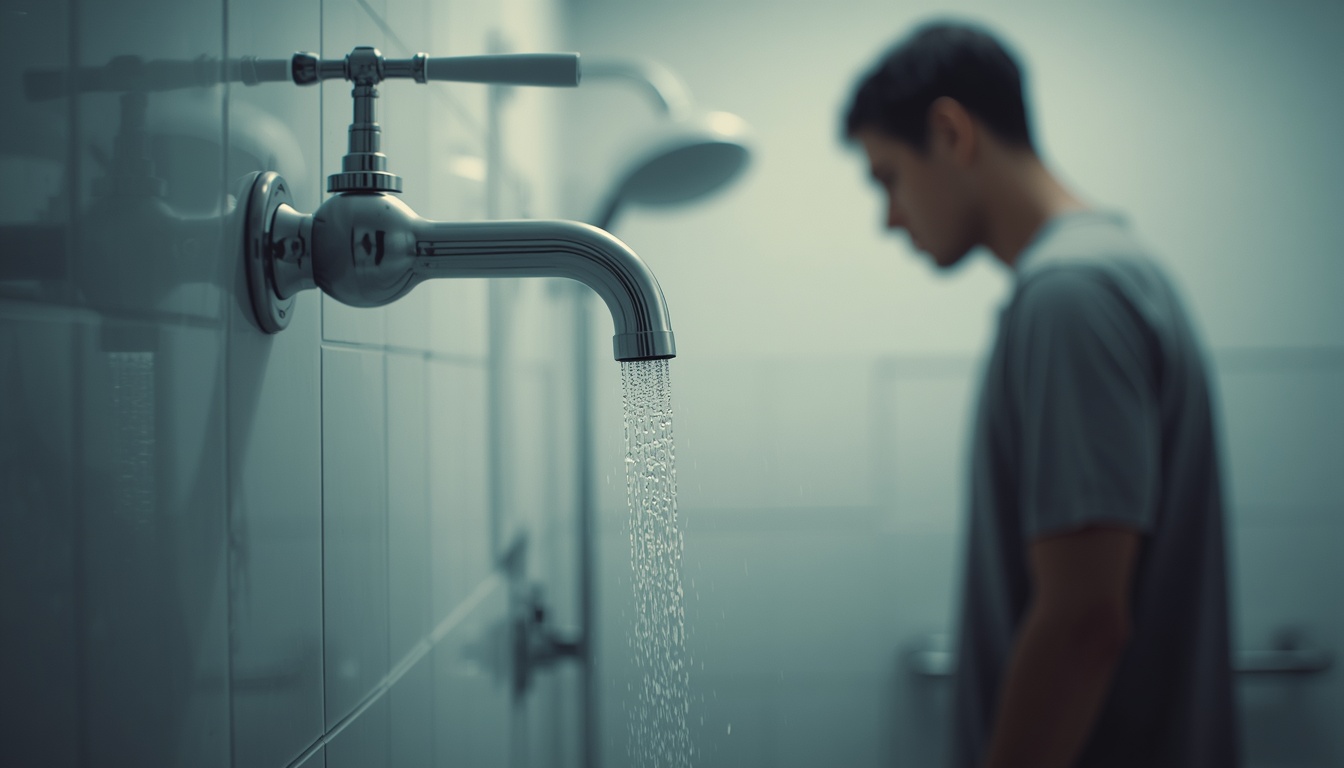
You were fine in the hallway. Then someone turns on the bathroom tap, or you step into a shower stall still wet from the last guest, or a nature video puts a stream on the speaker. Within seconds the bladder that had been quietly storing announces itself. The urge is specific, slightly embarrassing, and oddly reliable. It is also one of the oldest classroom examples of a body that can be trained.
The reflex is not the bladder “hearing.” It is a pairing. For years, the sound of running water has arrived in the same seconds as privacy, unbuttoning, and the first splash into a bowl. The brainstem circuit that actually starts voiding does not care whether the cue was stretch receptors in the detrusor or a faucet two rooms away. Once the pairing is in place, a half-full bladder can be talked into feeling full.
What This Sensation Feels Like
The classic report is sudden and situational. Hearing a tap, a shower, rain on a metal roof, or even a recorded waterfall produces a clear desire to void that was not there a moment earlier. The sensation is usually urgency rather than pain: a pressure, a warmth, a “now” signal behind the pubic bone. If you are already somewhat full, the cue can feel almost commanding. If the bladder is nearly empty, it may be only a flicker.
Some people notice it most when they are trying not to go — in a meeting, on a long car ride, during a film. Others notice the opposite: the same sound helps them start a stream when they are shy or tense at a urinal. Both faces of the phenomenon use the same circuitry. One is a start signal. The other is a permission signal. Context decides which one you feel.
A related social version exists. Seeing or hearing someone else begin to urinate can nudge your own urge. In 2025, work on captive chimpanzees documented socially contagious urination — a reminder that synchronizing elimination is not only a human bathroom joke. Humans just happen to have indoor plumbing that makes the sound of water a daily, high-fidelity cue.
Common Causes
A spinobulbospinal switch that can be cued. Storage and voiding are not a slow dimmer. William C. de Groat and colleagues described them as switch-like. While the bladder fills, spinal sympathetic and pudendal pathways keep the detrusor quiet and the external sphincter closed — a “guarding reflex.” When the brain decides the time and place are right, that suppression lifts. The pontine micturition center, also called Barrington’s nucleus after F.J.F. Barrington’s 1920s cat work, fires. Descending commands relax the sphincter and contract the detrusor in sequence. Clare J. Fowler, Derek Griffiths, and de Groat later mapped how the midbrain periaqueductal gray sits between bladder afferents and that pontine switch, and how prefrontal and insular cortex vote on whether the moment is socially acceptable.
A learned sound does not have to stretch the bladder wall to join that vote. It only has to arrive often enough, in the right context, that the same networks treat it as relevant.
Pavlovian pairing with the act itself. In 2015, Jae Young Kwon’s group had men void with and without a smartphone recording of running water. Peak flow rate rose with the sound. The authors pointed to two compatible explanations: a modest parasympathetic nudge, and classical conditioning. The splash you have heard at the start of nearly every successful void is a superb conditioned stimulus. Water on tile sounds like urine hitting porcelain. The nervous system is not being poetic. It is being associative.
Toilet-training and the sink trick. Generations of parents have used a running tap to help a toddler start. The trick works often enough to become family lore because it stacks cues: privacy, permission, the sound of liquid, and sometimes cool water on the hands that adds a small parasympathetic tilt. Adulthood does not delete the pairing. It just hides it until a hotel shower or a public restroom brings the soundtrack back.
A partly full bladder looking for a reason. Stretch afferents in the bladder wall fire in proportion to volume. At low volumes the cortex easily vetoes them. Nearer to the person’s usual voided volume, the veto is more expensive. A water sound arriving at that moment does not create urine. It lowers the threshold at which existing stretch is labeled “urgent.” That is why the same faucet is a non-event after you have just emptied, and a crisis after two coffees.
Why This Happens
Barrington showed that a small region of the dorsolateral pons is necessary for coordinated voiding. Gert Holstege later distinguished a medial “M-region” that drives micturition from a more lateral storage-promoting zone. Modern work has added molecular detail: corticotropin-releasing hormone–positive neurons in Barrington’s nucleus can act as a command output to the sacral cord. Upstream of that command sit the periaqueductal gray, hypothalamus, and prefrontal cortex — the last of which is why you can usually wait until the next exit.
Conditioning plugs into this hierarchy rather than replacing it. A sound associated with successful voiding can:
- increase the salience of whatever stretch signal is already climbing toward the periaqueductal gray
- slightly tilt autonomic balance toward sacral parasympathetic outflow to the detrusor
- reduce the social “not now” veto if the setting already looks like a bathroom
None of that requires a disease. It requires repetition. Most people have had thousands of pairings of water-sound plus voiding by the time they are twenty.
There is a urethral-to-bladder facilitatory loop as well, noted since Barrington: flow through the urethra itself reinforces detrusor contraction. The sound of flow is a cheap proxy for that loop. The brain does not wait to confirm that the liquid is yours.
Anxiety cuts both ways. In a safe bathroom, a water cue can ease hesitancy by lowering sympathetic sphincter tone. In a crowded restroom, the same cue arriving while you are trying to stay continent can feel like a threat. Michael J. Boschen’s cognitive-behavioral account of paruresis — “shy bladder” — sits on this same switch: the prefrontal veto slams shut when the setting feels observed, even if the bladder is full and the faucet is running.
Less Common but Serious Causes
A water-sound urge that is new, violent, or paired with leakage is no longer just a party trick.
Overactive bladder. If ordinary cues — water, keys in the door, standing up — trigger urgency with or without urge incontinence, the detrusor may be firing with too little provocation. The sound is then an aggravating cue on a hypersensitive storage system, not the whole diagnosis.
Urge incontinence. Hearing a tap and leaking before you reach the toilet is different from hearing a tap and walking, in control, to the toilet. Leakage with a cue deserves evaluation, especially if it is new after childbirth, prostate treatment, or neurologic illness.
Neurologic disease. Spinal cord injury, multiple sclerosis, stroke, and Parkinson disease can disconnect the pontine switch from its cortical brakes. Cues may then trigger reflex emptying that the person cannot veto. That pattern is not “being dramatic about faucets.”
Infection and stones. A suddenly irritable bladder from cystitis can make every cue feel louder. Burning, fever, blood, or flank pain take the story out of the conditioning column.
Polyuria. If you are making a large volume of urine — uncontrolled diabetes, diuretics, evening alcohol — the bladder is honestly full more often. Water sounds will “work” because the tank is already near the line.
Hidden Triggers
Caffeine and cold. Both increase urine production and bladder sensation. A latte plus a winter tap is a stronger pairing than either alone.
Holding too long, then hearing water. A delayed void puts the system near its usual switch point. The first sink you pass becomes the last straw.
Public restrooms. The combination of other people’s streams, automatic flushers, and social evaluation is a dense cue package. Some people void more easily there. Others freeze. Same sound, opposite prefrontal vote.
Recorded water. Rain apps, white-noise machines, and spa videos are enough for some listeners. The nervous system does not require a real pipe.
Hand washing and temperature. Cool water on the hands is a mild parasympathetic and startle-adjacent stimulus. It is not the main actor, but it often arrives with the sound, so the pairing thickens.
Pregnancy and pelvic-floor load. A uterus that reduces functional bladder capacity makes every cue more effective. The reflex is the same; the margin is smaller.
When to Worry
Seek care rather than folklore if:
- the cue causes actual leakage
- urgency is new, escalating, or present without any water sound
- you have blood in the urine, fever, or pain
- night-time voids have suddenly multiplied
- a neurologic diagnosis is already in the chart and bladder control is changing
- you cannot start a stream in any public setting and it is shrinking your life
- a child who was dry is soaking again with no obvious training context
A lifelong, leak-free “I always need to go when I hear the shower” is usually a trained switch, not a crisis.
Myths vs Facts
Myth: The sound physically puts water into your bladder. Fact: Urine volume is set by the kidneys. The sound changes labeling and timing, not production.
Myth: Only anxious people have this. Fact: Anxiety can amplify it, and shy bladder can invert it, but the pairing exists in calm people who simply grew up with indoor plumbing.
Myth: If water helps you start, your sphincter is weak. Fact: A facilitatory cue that raises peak flow, as in Kwon’s recording study, is consistent with better coordination, not a damaged outlet.
Myth: Ignoring the urge will damage the kidneys. Fact: A healthy adult bladder is built to wait. Repeated desperate holding is uncomfortable and can irritate storage over years, but a few minutes of “not yet” after a faucet is not a renal emergency. Persistent pain, fever, or inability to void is a different problem.
Myth: Children who respond to a running tap have a medical bladder problem. Fact: The tap trick is a teaching cue. Trouble starts when urgency, infection signs, or daytime soaking persist after training.
How to Manage It
If the cue is only annoying. Empty on a reasonable schedule so the bladder is less often sitting near the switch point. You do not need to void “just in case” every hour; you do need to avoid arriving at a two-hour meeting already at capacity.
If you leak with the cue. That is pelvic-floor and bladder training territory, sometimes with an overactive-bladder workup. Urgency suppression — stay still, breathe, gently lift the pelvic floor, wait for the wave to crest — is a skill, not a character test.
If you cannot start without water. Use the cue on purpose in private: a tap, a recording, a running shower. Pair it with unhurried exhalation rather than straining. Over weeks, fade the sound so initiation does not become dependent on a prop. For true paruresis, the evidence-based path is graded exposure, not more willpower at a busy urinal.
If you are training a child. A tap can help start. It should not become the only way the child can go. Fade it as control appears.
Everyday context. Evening fluids, caffeine timing, and alcohol still dominate how often you need a toilet. The faucet is a trigger. It is rarely the tank.
The same respect for bladder timing shows up in other ordinary mismatches between modern life and an older circuit — including why nights get busier in Why You Need to Pee More at Night, and why emptying can send a brief autonomic shiver in Is It Normal to Shiver After You Pee?. Further upstream, concentrating ability and thirst still follow rules written for scarce water, which is the subject of Why Your Kidneys Still Expect a Drought.
When to See a Doctor
See a clinician if leakage, pain, blood, fever, a sudden change in frequency, or neurologic symptoms accompany the water-sound urge. Mention medicines that increase urine or irritate the bladder. A basic visit may include a urine test, a voiding diary, and, if needed, a post-void residual check. Urodynamics is not the first step for a lifelong faucet reflex with a dry pad.
Pelvic-floor physiotherapy helps when urgency and weak timing travel together. Behavioral therapy helps when the problem is inhibition in public rather than too much detrusor. Those are different switches. Mixing them wastes months.
FAQs
Why does a waterfall video do this when I am not even near a toilet? Because the conditioned stimulus is the sound, not the porcelain. If the pairing is strong and the bladder is not empty, context can be optional.
Why can the same sound help one person start and make another desperate to hold? The pontine switch can be invited or vetoed. In a locked stall the sound is permission. In a meeting it is a threat to continence. Prefrontal cortex writes the caption.
Is this more common in women? Women report tap-triggered urgency often, in part because shorter urethras and pelvic-floor load after pregnancy make small volume changes more noticeable. Men notice the cue more as hesitancy at a urinal. The brainstem hardware is shared.
Can I untrain it? Partly. Avoid pairing every void with a running tap. Practice waiting out a small wave after a faucet. Do not try to extinguish a useful start cue if shy bladder is your actual problem; train initiation first, then fade the prop.
Does holding after I hear water harm me? A brief, comfortable delay does not. Pain, leakage, or an inability to void later are the stop signs.
My child only pees if the sink is on. Is that a problem? It is a training wheel. Keep using it if it prevents accidents, and gradually let silence be enough. Persistent daytime wetting, pain, or infection signs need a pediatric look, not a louder faucet.
Conclusion
Running water does not fill the bladder. It reminds a well-practiced circuit that emptying has often followed that soundtrack. Barrington’s nucleus, the periaqueductal gray, and a lifetime of bathrooms do the rest. For most people the result is a smirk and a short walk down the hall. When the same cue causes leakage, pain, or a life built around avoiding sinks, the story has left conditioning and entered the clinic. Until then, the faucet is not a diagnosis. It is a very loud habit.