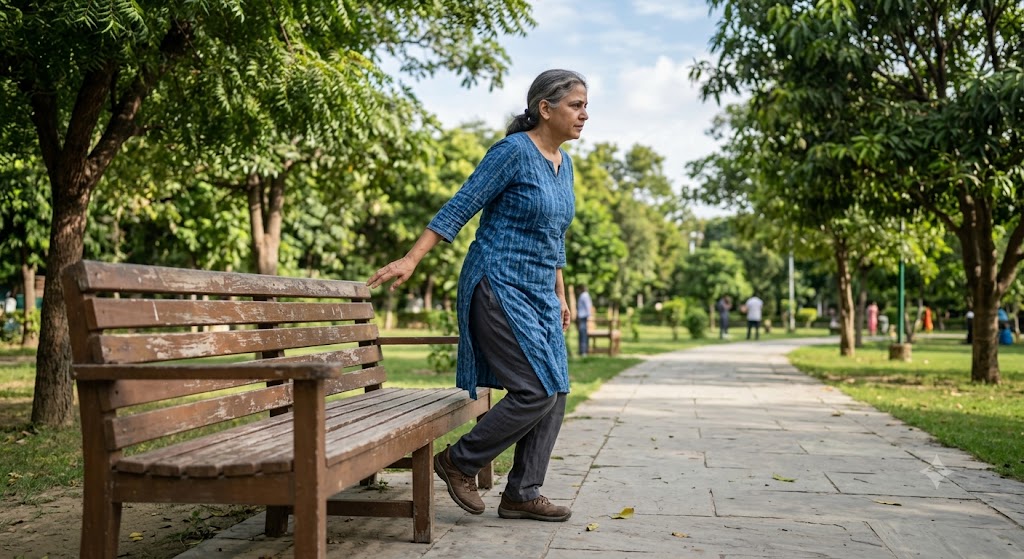
A brief metallic or blood taste at the end of a hard run is often capillary stress in the lung or iron from dry mouth and gums — not automatically a hemorrhage. How West, Hopkins and Eldridge mapped pulmonary capillary limits, and when the taste is a red flag.
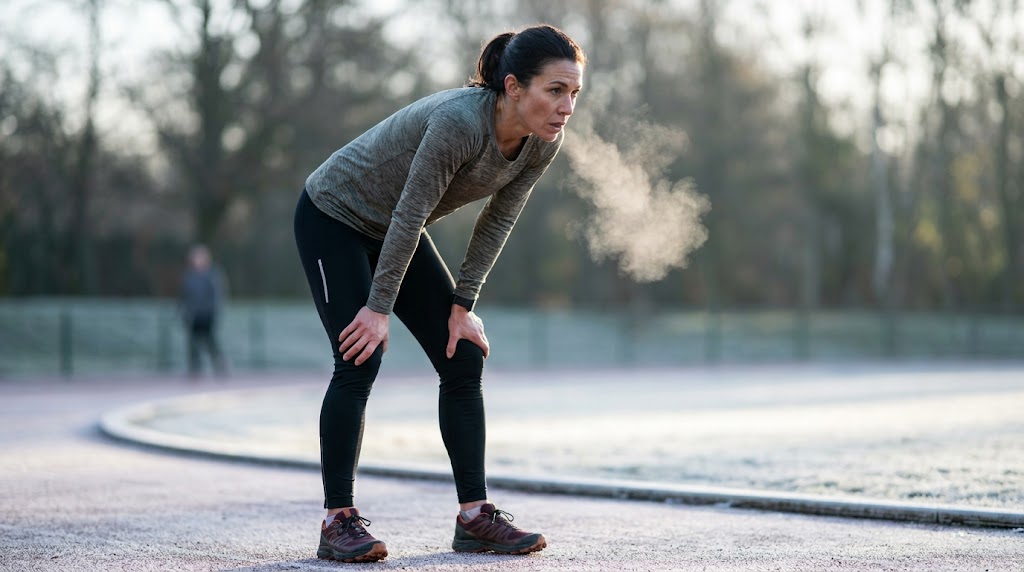
You finish a hill, a track repeat, or a race kick and suddenly your mouth tastes like a coin. Sometimes it is only metal. Sometimes it is the unmistakable iron of blood. You check your spit. It looks pink, or it looks fine, and the taste is gone by the time you walk to the water fountain. The mind jumps to the worst picture: a lung bleed, a torn vessel, something you should not have pushed through.
A brief blood or metallic taste at peak effort is common enough among runners, cyclists, and rowers that sports physicians hear it every season. Most of the time it is not a hemorrhage you can see on a scan. It is a crowded set of capillaries in the lung doing a job they were built to do at the edge of their mechanical limit, plus a dry mouth that makes iron and protein easier to taste. The physiology is real. So are the rare cases that are not normal. The useful skill is telling them apart.
What this taste actually is
Taste is a poor camera. Blood has iron in heme. Iron tastes metallic. So do many other things that are not blood: a dry tongue, a little gum bleeding, refluxed acid, zinc from a lozenge, or the aftertaste of a hard effort when ventilation is high and saliva is low. People use “I tasted blood” for all of those. The body does not label the source.
When the source really is a trace of blood, it can come from more than one place. The gums and the lining of a dry nose bleed easily when air is cold and you mouth-breathe on a hard run — the same winter-dry pattern described for anterior nosebleeds in why noses bleed in dry air. A small split in the lip or a bitten cheek during a grimace can do the same. Those sources are local and usually obvious if you look.
The source that worries people is the lung. Pulmonary capillaries sit in the thinnest possible wall so oxygen can cross in a fraction of a second. At rest the pressure inside them is modest. At a hard effort, cardiac output can rise fivefold or more. The right ventricle pushes that volume through the same capillary bed. Pressure in the pulmonary artery and in the capillaries themselves climbs. John B. West and colleagues at the University of California San Diego described what happens when that pressure exceeds the strength of the wall: stress failure. Tiny disruptions appear in the endothelium and sometimes the alveolar epithelium. A few red cells and protein leak into the air space. You do not drown. You may taste iron, cough once, or notice pink-tinged sputum that clears.
The lung’s thin wall was built for rest, then asked to sprint
West’s group measured the numbers. In the dog and the horse, pulmonary capillary transmural pressures in the mid-30s to 40s of millimeters of mercury already produce ultrastructural breaks. Thoroughbreds after a race often show frank blood in the airways — exercise-induced pulmonary hemorrhage, documented for decades by veterinarians and later tied to the same capillary-stress model. Humans do not bleed like racehorses. Our pulmonary pressures are lower and our alveoli are differently built. But they are not infinitely strong.
Susan Hopkins, Marlowe Eldridge, and collaborators used bronchoalveolar lavage after short, very hard cycling in fit humans. They found more red cells and more protein in the wash after maximal effort than after rest, even in people who never coughed blood. The leak was small. It was not a clinical hemorrhage. It was evidence that the human blood-gas barrier can be strained at the top of the intensity range. Later work with athletes at altitude and with people who have high pulmonary pressures made the same point: the barrier is elegant and thin, and thin things have a breaking strain.
That does not mean every metallic taste is a leak. Most hard efforts never reach the pressures West mapped. Recreational runners who taste metal after a 5K kick are often tasting dry mucosa, a little nasal drip, or the general iron-and-protein flavor of a mouth that has been panting cold air. The lung explanation is reserved for the upper end: all-out intervals, racing at altitude, very cold dry air plus maximum ventilation, or a heart and pulmonary circuit that already run at higher pressure.
Why a metallic taste is so easy to get without a bleed
Saliva is a solvent. When you breathe hard through the mouth, airflow evaporates it. A dry tongue is a better detector of trace metals than a wet one. Gums that would not bleed at the sink can leave a faint pink film when you clench and pant. Cold air dries the nose; a little blood from Kiesselbach’s plexus can slide back and be tasted rather than seen. Reflux that you barely notice at rest can rise when the abdomen is braced and the diaphragm slams — a cousin of the evening heartburn pattern in why heartburn shows up after dinner.
There is also a sensory trick. High ventilation changes how odors and tastes reach the back of the nose. Effort itself raises attention to the mouth. A flavor that would be ignored at the desk becomes a story at the finish line. Metallic taste is also a known feature of some migraines, of pregnancy, of certain supplements, and of zinc deficiency — the same dysgeusia family discussed in metallic taste in the mouth. If the taste appears on easy days as well as hard ones, look there first.
Who notices it more
People who race or interval-train at high intensity notice it more than people who jog. Cold, dry air makes it more common because the upper airway dries and the pulmonary vascular resistance can rise. Altitude raises pulmonary artery pressure; the same effort at 2,000 meters is a different load on the capillary than the same effort at sea level. Unusually high left-atrial pressure — from a very high cardiac output into a stiff left heart, or from undiagnosed mitral or ventricular problems — raises capillary pressure from the downstream side. That is why a new blood taste in a master athlete who used to tolerate the same workouts deserves a quieter look at the heart, not just a shrug.
Asthma and vocal-cord irritation can add a coppery taste after a hard session because the airway is inflamed and mucus is blood-tinged at a microscopic level. Anticoagulants, a recent nosebleed, and aggressive nasal steroid sprays change the odds of a visible source. None of those make the taste “all in the head.” They change where the iron came from.
When it is not just a hard interval
A single metallic flash that vanishes with a drink of water after a maximal effort, with no cough, no pink sputum, no chest pain, and no unusual breathlessness, is usually in the common bucket. Treat the next few sessions as data. If it never repeats, it was a dry mouth or a one-off strain. If it repeats only at the same intensity and clears in minutes, it is still usually the barrier-plus-dry-air story Hopkins documented, not an emergency.
The pattern that is not normal is different. Coughing up frank blood, even a teaspoon, is hemoptysis and needs same-day medical care. Pink froth, chest tightness that does not ease when you stop, fainting, a racing irregular pulse, or breathlessness out of proportion to the workout are not “I tasted metal.” They are reasons to stop and get examined. A blood taste that starts at easy paces, lasts hours, or arrives with swelling in the legs, night breathlessness, or a new wheeze is a heart-or-lung problem until someone qualified says otherwise. First-time thunderclap chest pain on effort is never a training note.
Myths vs facts
Myth: Tasting blood means you tore a vessel in the lung and should never run hard again.
Fact: In healthy people the usual finding, when anyone looks, is a tiny transient leak or no leak at all. West’s stress-failure work explains a mechanism. It does not mean the barrier is ruined.
Myth: If you cannot see pink spit, it cannot be blood.
Fact: A few red cells are enough to taste iron and not enough to color saliva. Absence of color does not prove absence of a trace leak — and presence of a metallic taste does not prove a leak either.
Myth: Only unfit people get this.
Fact: The lavage studies were done in fit cyclists. High cardiac output is the load. Fit people generate that load more easily.
Myth: Salt tablets or beet juice will stop it.
Fact: There is no good evidence that a supplement seals pulmonary capillaries. Hydration, warming the air you breathe, and not stacking all-out efforts in cold dry air are more honest tools.
How to manage a brief post-run metallic taste
Slow the last interval enough that you can finish with nasal breathing if the air is cold. A buff or light mask in winter warms and humidifies inspired air and is kinder to both the nose and the lower airway. Drink water as soon as you stop; a wet mouth often erases a taste that felt dramatic twenty seconds earlier. Check your gums and the inside of your lips. If you use a nasal steroid, spray it correctly and not immediately before a cold outdoor session.
Space true maximal efforts. The barrier recovers; stacking repeated all-out work in dry air is the setting where Hopkins saw more red cells in lavage fluid. If you race at altitude, build a few easier days first so pulmonary pressures and ventilation are not both new on race morning. Treat reflux if you have it. Treat obvious dry-air nosebleeds as nosebleeds, not as lung events.
Do not use the taste as a training metric. “I tasted blood, so it was a good session” is folklore. Intensity has better markers: pace, heart rate, how long you can speak, how fast you recover. The mouth is not a lactate analyzer.
When to see a doctor
See someone promptly if you cough blood, if the taste comes with chest pain, unusual breathlessness, fainting, or palpitations, or if it appears at modest effort when it never used to. Mention altitude, cold air, new medications that affect clotting, and any family history of pulmonary hypertension or unexplained sudden effort intolerance. A clinician can listen to the chest, look at the nose and throat, and decide whether you need a chest film, a heart ultrasound, or simply a plan for dry air and intensity. You do not need an emergency department for a one-second coin taste after a personal-best 400. You do need care for blood you can see or symptoms that do not match the workout.
FAQs
Is a metallic taste after running the same as coughing up blood?
No. Hemoptysis is blood you can see coming from below the larynx. A metallic taste can be gums, nose, reflux, dryness, or a microscopic leak. Visible blood is a different category.
Can this happen on a bike or rower, or only on a run?
It can happen in any mode that drives cardiac output and ventilation very high. Running adds more upper-body bounce and more mouth breathing in cold air, so runners report it more. The capillary story is about pressure, not footstrike.
Does altitude make it more likely?
Yes. Hypoxia raises pulmonary artery pressure. The same interval at altitude loads the capillary more than it does at sea level. That is one reason unacclimatized hard efforts in the mountains feel harsher in the chest and the mouth.
Should I stop the workout the moment I taste metal?
If it is only taste, you are otherwise fine, and you were already at the end of a hard effort, stopping to walk and drink is enough. If the taste arrives with pain, real breathlessness, dizziness, or pink sputum, stop and get checked. Do not use toughness as a diagnostic test.
Will it damage my lungs over a season?
Occasional trace leak after rare maximal efforts is not the same as chronic lung injury. Repeated hemoptysis, unexplained decline in performance, or symptoms at easy pace are the patterns that need investigation. Training at a sustainable intensity is still the main protection.
Why does water make the taste vanish so fast?
Because much of what you tasted was a thin film on a dry tongue. Diluting and swallowing it removes the stimulus. That rapid fade is one reason a dry mouth is a better first explanation than a hidden bleed for most recreational efforts.
Conclusion
The blood-gas barrier is one of the thinnest load-bearing structures in the body. West, Hopkins, and Eldridge showed that it can leak a few red cells when cardiac output and pulmonary pressure peak. That is a mechanical fact, not a moral one. It is also not the usual explanation for a coin taste after a neighborhood tempo. Dry air, a working nose that you abandoned for the mouth, gums, and a tongue that suddenly has no saliva do most of the everyday work.
Finish hard if the session calls for it. Warm the air you inhale when the weather is sharp. Treat visible blood and mismatched breathlessness as medicine, not folklore. The taste is information. It is rarely a verdict.