
Brief sparkles after a hard sneeze or cough are usually pressure phosphenes plus a short Valsalva dip in ocular and cerebral blood flow — a mechanical and vascular flicker, not a detached retina.
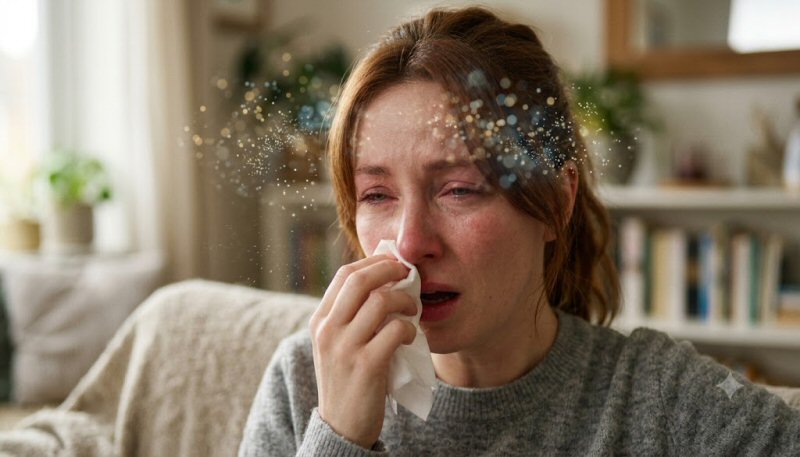
The sneeze arrives like a slammed door. For a fraction of a second the world goes white at the edges — pinpricks, a sprinkle of sparks, sometimes a brief grey dimming — and then the room is ordinary again. A hard coughing fit can do the same. So can a strained lift, a blocked nose-blow, or a laugh that empties the chest.
The sparks are not stars in the sky and they are not, in the ordinary case, the retina coming loose. They are phosphenes: light the visual system invents when something other than photons tickles it. A sneeze and a cough are unusually efficient ticklers because they combine two insults at once. The eyelids clamp. Intrathoracic pressure spikes against a closed glottis. Venous blood is briefly bottled in the head. Intraocular pressure jumps. Retinal ganglion cells fire as if a lamp had flashed, and a short dip in ocular or cerebral perfusion can add a grey wash behind the sparkle.
Johannes Evangelista Purkinje mapped pressure phosphenes in the early nineteenth century. Otto-Joachim Grüsser later showed, with microelectrodes, that indenting an eye in the dark drives on-center retinal ganglion cells and inhibits off-center cells — the same polarity a real light would produce. A sneeze is a cruder, whole-body version of that experiment.
What This Sensation Feels Like
The classic report is bilateral and instantaneous. Sparks, speckles, or a brief “static” field appear as the sneeze or cough peaks, last less than a second or two, and vanish without a residue. Some people see them against closed lids; some see them over the room when the eyes reopen. Color is optional — white, pale gold, or a faint blue pointillism.
A dimming or “grey-out” can ride along with the sparkle, especially after a prolonged coughing fit or a held strain. That dimming is closer to a brief under-perfusion of retina or visual cortex than to a geometric phosphene. It should clear as soon as breathing and venous return resume.
This is not the same as rubbing the eyes and seeing sparks, though the retinal language is related. Rubbing is a local mechanical indent. A sneeze is a pressure wave plus a vascular pause. It is also not the same as vitreous floaters, which drift slowly, persist for minutes to years, and move when the eye moves.
Common Causes
A Valsalva-like pressure spike. Antonio Maria Valsalva described forced expiration against a closed glottis in 1704. Edward Sharpey-Schafer later mapped the four hemodynamic phases: a brief arterial-pressure rise as the chest squeezes the aorta, a fall in venous return and stroke volume while the strain is held, a further dip when the strain releases, then an overshoot as blood floods back. A sneeze is a very short, very sharp version of the same maneuver. Vinod Kumar Gupta has argued that sneezing is powerful enough to raise intraocular pressure, congest episcleral veins, and alter ocular blood flow in predisposed people.
Eyelid squeeze. Forcible orbicularis contraction can raise intraocular pressure by tens of millimeters of mercury on its own. The globe is a fluid-filled sphere. A sudden extra squeeze deforms the retina just enough for ganglion cells to fire.
Transient venous congestion in the head. Head and neck veins have limited valves. A sudden rise in intrathoracic pressure is transmitted upward. Episcleral venous pressure climbs, intraocular venous pressure climbs, and capillary perfusion across the retina can wobble for a beat.
A brief perfusion dip. If the strain lasts longer — a coughing jag rather than a single sneeze — stroke volume falls and cerebral perfusion pressure can sag. The visual cortex and the retina are both greedy for oxygen. A short grey-out or sparkle is the cheapest way the system reports the dip. The same family of events, pushed further, is why some people feel lightheaded after standing or after a long cough, a cousin of orthostatic lightheadedness.
Laughing hard, straining on the toilet, lifting a heavy box with a held breath, and blowing a brass instrument sit on the same continuum.
Why This Happens
Photoreceptors and retinal ganglion cells do not wait politely for light. Mechanical stretch, ischemia, and electrical current all change their membrane voltage. The brain has no separate channel labeled “this was pressure, not a photon.” Whatever makes the ganglion cell spike is painted as light.
Grüsser, Ursula Grüsser-Cornehls, Michael Hagner, and Andrzej Przybyszewski recorded that polarity in the cat optic tract: on-center cells activate, off-center cells hush, with latencies of a few hundred milliseconds. Dark adaptation barely changed the response. That is why the sneeze-sparkle still works in a dim hallway.
The vascular half is a plumbing story. Raised intrathoracic pressure reduces the gradient that drains jugular and vertebral veins. Intracranial venous pressure rises because the skull is a closed box; veins cannot simply balloon. Cerebral perfusion pressure is mean arterial pressure minus intracranial pressure. A cough that lifts intracranial pressure for a second therefore steals a second of driving force. Most brains absorb that theft without losing consciousness. A few, especially in older men with chronic cough and vascular stiffness, do not — that is cough syncope, a different and more serious neighbor of the same physics.
Thomas Duane described Valsalva retinopathy in 1972: a sudden preretinal bleed under the internal limiting membrane after a strain. The ordinary sneeze-sparkle is not that bleed. It is the reversible mechanical and ischemic flicker that sits one step short of capillary rupture.
Less Common but Serious Causes
Valsalva retinopathy. Sudden, painless blur or a central red or dark blot after a cough, sneeze, vomit, or lift. Vision does not clear in a second. An eye exam shows a well-circumscribed preretinal hemorrhage, often at the macula. Most cases resolve over weeks to months; a dense central clot sometimes needs laser or vitrectomy.
Posterior vitreous detachment or retinal tear. New flashes that persist, a shower of new floaters, or a curtain across part of the field are not sneeze phosphenes. They need same-day dilated examination.
Cough syncope or near-syncope. Sparkles plus true fading of the room, ringing in the ears, and a slump after a coughing fit point to a larger drop in cerebral blood flow. That pattern deserves a medical look, especially if it is new or clustered.
Embolic or vascular events coinciding with a sneeze. Rare case reports describe retinal arterial occlusion after a sneezing fit in people with atrial fibrillation or atherosclerotic risk. The sneeze is not the clot; it may be the jolt that moved one. Persistent monocular vision loss after a sneeze is an emergency, not a phosphene.
Raised intracranial pressure. Recurrent strain-related visual grey-outs, morning headaches, and pulsatile tinnitus together change the story.
Hidden Triggers
Holding a sneeze with the mouth and nose clamped raises the pressure peak. So does a “closed-glottis” lift in the gym. Antihistamine dryness and winter air make sneezes more explosive. Chronic cough from post-nasal drip, ACE inhibitors, or reflux multiplies the number of daily Valsalva events. Dehydration and a skipped meal make a perfusion dip easier to feel. Tight collars and a forward-flexed neck add a little extra jugular resistance.
People who already notice unmasked ringing in a quiet room sometimes report that a sneeze briefly brightens the tinnitus as well. Both systems are reporting a short intracranial-pressure bump.
When to Worry
See an eye doctor the same day if sparks after a sneeze or cough:
- Last more than a few seconds or leave a lasting blur, smudge, or missing patch
- Come with a sudden swarm of new floaters or a shadow like a curtain
- Affect only one eye and do not clear
- Follow a head blow
Seek urgent medical care if the sparkle comes with chest pain, a severe thunderclap headache, weakness, speech change, or a faint.
Recurrent near-fainting after coughing fits, especially in middle-aged or older adults with lung disease, is not “just stars.” It is worth a work-up for cough syncope and for the cough itself.
Myths vs Facts
Myth: Seeing stars means the retina is tearing. Fact: Ordinary sneeze phosphenes last a blink and leave vision unchanged. Tears announce themselves with persistent flashes, new floaters, or a field cut.
Myth: The sparks are real light generated inside the eye. Fact: Descartes and Newton already argued that pressure stimulates the retina; Grüsser’s recordings confirmed that ganglion cells fire as they would for light. No lamp turns on in the vitreous.
Myth: Holding a sneeze is safer than letting it out. Fact: Clamping the airway raises the pressure peak. Let the sneeze happen with an open mouth when you can.
Myth: Only people with eye disease see this. Fact: Healthy retinas sparkle under sudden pressure. Disease changes the duration and aftermath, not the existence of the flicker.
Myth: If you grey out after a cough you must have a brain tumor. Fact: Cough syncope is usually a hemodynamic event in people with stiff vessels and violent coughs. Tumors are a rare alternative, not the default.
How to Manage It
You do not need to treat a one-second sparkle. You can make it rarer.
Breathe out through the effort when you lift. Do not lock the glottis for a grocery-bag deadlift. Treat the cough if it is daily — not because phosphenes are dangerous, but because repeated Valsalva events are a blunt instrument. Stay hydrated enough that a short drop in venous return has a buffer. If winter sneezes are explosive, humidify the bedroom and keep the nasal lining less raw.
If you wear contact lenses and notice more sparkle, blink and rewet; a dry lens can add its own mechanical tug, though it is not the main sneeze mechanism.
Do not rub the eyes hard on top of a sneeze. That stacks two pressure stimuli.
When to See a Doctor
Book a routine eye exam if you are over forty, highly myopic, or have never had a dilated retinal check — not because sneeze stars require it, but because those groups have a higher baseline rate of vitreous detachment. Go promptly for any lasting visual change after a strain. Mention cough-related near-fainting to a physician; the interesting problem is often the cough and the vessels, not the sparkle.
FAQs
Why do I see stars when I sneeze but not when I cough gently? A single polite cough barely moves intrathoracic pressure. An explosive sneeze clamps the lids and spikes the chest in the same instant. The retina notices the combination.
Can this damage my eyes over time? Ordinary brief phosphenes have no evidence of cumulative harm. Repeated violent Valsalva events can, in rare people, rupture a superficial retinal capillary. That is Valsalva retinopathy, not “too many stars.”
Why is it sometimes followed by a brief dimming? The strain cuts venous return. For a beat, less blood leaves the heart and a little less reaches the eye and brain. The dimming is the perfusion dip; the sparkle is the mechanical and ischemic flicker. Both should reverse when you inhale.
Is this the same as migraine aura? No. Aura builds over minutes, often as a zigzag fortification spectrum, and lasts far longer. Sneeze stars are over before you can describe them.
Should I stop exercising if I see sparks when I lift? Change the breath, not necessarily the lift. Exhale through the hard part. If sparks come with lasting blur, stop and get the retina checked.
Do children get this too? Yes. Their sneezes are smaller, but the wiring is the same. Persistent one-sided vision change in a child after a strain still needs an exam.
Conclusion
A hard sneeze is a full-body pressure experiment that Purkinje and Grüsser would recognize. The retina treats a sudden squeeze and a brief vascular hitch the way it treats a flash of light, and the brain draws stars because that is the only language it has. When the sparks last a heartbeat and the room returns, the system has done something ordinary. When they stay, blot, or take a piece of the field with them, the experiment has gone one step further — and that is the moment the story stops being a curiosity and becomes an eye exam.