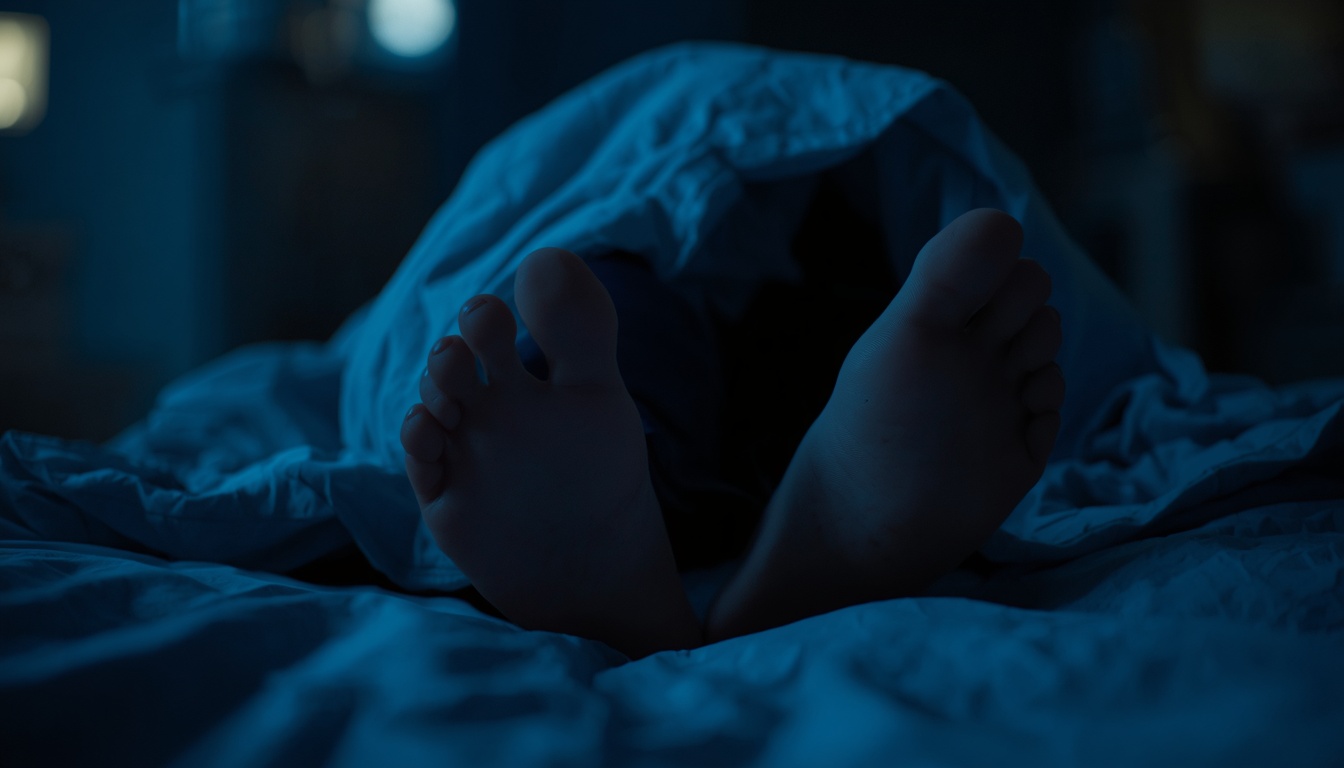

You sit down after dinner. The room is quiet. Then your legs start a campaign you did not vote for: a crawl, a buzz, an inner itch that is not quite an itch, a feeling that the only honest response is to kick, stretch, or get up and walk. Standing helps. Walking helps. Lying still makes it worse. By the time you get into bed the urge has a schedule.
That pattern is common. Many people describe it as “restless legs in the evening,” and a large share of those descriptions match what clinicians call restless legs syndrome — also known as Willis–Ekbom disease. It is not a personality quirk, and it is not usually a muscle problem. It is a sensory and motor urge with a clock.
If nights already feel fragmented, the same evening biology that drives restless legs can also leave you groggy after a badly timed nap — a pattern we unpack in why some naps make you feel worse instead of better.
What This Sensation Feels Like
People rarely describe evening restless legs as ordinary muscle tightness. The words that come up again and again are stranger than a cramp:
- A crawl, tingle, or “soda bubbles” under the skin
- An ache or pull that is hard to point to with one finger
- An urge to move that feels almost moral — sitting still feels wrong
- Relief within seconds of standing, walking, stretching, or rubbing
- A rebound the moment you sit or lie down again
- Worse after dusk, often peaking in the hours before sleep
- Sometimes a brief twitch or kick once you finally doze
The relief with movement is the signature. A true cramp locks a muscle into a hard knot and does not politely vanish when you stroll to the kitchen. Restless legs usually do.
Is It Normal?
A mild, occasional evening fidget after a long sit is extremely common and does not by itself mean you have a disorder. Many people stretch, change position, and forget it.
Restless legs syndrome, as defined in criteria refined by neurologist Richard P. Allen and colleagues for the International Restless Legs Syndrome Study Group, is more specific. It is an urge to move the legs, usually with an uncomfortable sensation, that:
- Begins or worsens during rest
- Is partly or totally relieved by movement
- Is worse in the evening or night than during the day
- Is not better explained by another condition such as leg cramps, positional discomfort, or swelling
Population studies led by groups including Wayne A. Hening, Arthur S. Walters, and Claudia Trenkwalder suggest that clinically meaningful restless legs affect a substantial minority of adults, with women reporting it more often than men, and that milder evening restlessness is even more widespread. So: an occasional evening urge after sitting is normal human sensory noise. A nightly, sleep-wrecking version is common enough to have a name, and it deserves a proper look rather than a shrug.
Why Evening Makes It Worse
Restless legs has a circadian personality. The same legs that behaved at noon become theatrical after sunset. That is not only because you finally sit down. Work by Christopher J. Earley, Richard P. Allen, and colleagues at Johns Hopkins showed that the urge tracks clock time as well as rest: even if you lie still at 10 a.m., symptoms are usually milder than the same stillness at 10 p.m.
Several overlapping systems line up at night:
Dopamine timing. Brain circuits that help select and quiet movement run on a daily rhythm. In restless legs, evening dopamine signaling in sensorimotor networks appears mistimed rather than simply “too low,” which is why a small evening dose of a dopaminergic drug can help some people — and why the same class of drugs can later worsen symptoms if used carelessly.
Iron in the brain, not just the blood. Iron is a cofactor for tyrosine hydroxylase, the rate-limiting enzyme in dopamine synthesis. Earley’s group and others have found that some people with restless legs have low iron in spinal fluid or on brain imaging even when a routine blood count looks fine. Ferritin at the low end of the “normal” lab range can still be relevant.
Spinal excitability. After a day of sitting, the spinal circuits that generate rhythmic leg movement are easier to set off. Periodic leg movements in sleep — brief stereotyped flexions that a bed partner may notice — often travel with restless legs and share some of the same circuitry.
The sitting tax. Evening is when modern life finally goes still: couch, screens, long dinner. Rest is the trigger. A body that walked most of the day has less stored stillness to discharge at 9 p.m.
Common Everyday Triggers
You do not need a rare disease for evening legs to act up. Familiar amplifiers include:
- Sitting through a movie, flight, or long dinner
- A late heavy meal and then immediate stillness
- Caffeine late in the day in people who are sensitive to it
- Alcohol in the evening, which can fragment sleep and rebound the urge
- Antihistamines in some cold or sleep products
- Certain antidepressants and anti-nausea medicines, in susceptible people
- Pregnancy, especially the third trimester
- Iron drain from heavy periods, frequent blood donation, or a low-iron diet
- Kidney disease and some neuropathies, which raise the baseline
- Sleep loss itself, which makes the next evening louder
A related night-leg complaint is a true cramp — a sudden hard knot, often when the foot points — which is a different motor lock than the restless urge. That pattern is covered in why calves sometimes seize after dark.
Hidden Triggers People Miss
A few quieter contributors show up in clinic again and again:
“Normal” ferritin that is not enough for this condition. Guidelines discussed by the IRLSSG and by groups including Michael H. Silber often treat a ferritin under about 75 µg/L as a reason to consider iron repletion in restless legs, even if a standard anemia workup looks unremarkable. That number is a clinical judgment call, not a license to self-dose high-iron supplements.
Evening inactivity stacked on a desk day. A day of sitting plus an evening of sitting is a double rest cue. A walk after dinner is not a wellness slogan here. It is a timed input to the same circuits that are about to complain.
Sleep schedule drift. Going to bed later and later slides your worst symptom window onto the hours you are trying to fall asleep. Social jet lag and weekend lie-ins can make Monday nights feel inexplicably worse.
Focusing on the sensation. Unlike an itch you can see, restless legs live in interoception. Quiet rooms and phones in the dark leave the feeling with no competition. That does not mean it is “all in your head.” It means attention is part of the volume knob.
When to Worry
See a clinician promptly if evening restlessness comes with:
- Weakness, numbness in a clear nerve pattern, or a foot that slaps when you walk
- One-sided symptoms that are steadily worsening
- Swelling, redness, or heat in a calf
- Chest pain, breathlessness, or a known clotting risk plus a hot swollen leg
- Symptoms that begin after a new medicine and escalate quickly
- Iron-deficiency clues such as unusual fatigue, heavy periods, black stools, or frequent blood donation
- Sleep so broken that you cannot drive or work safely
- Painful, rigid cramps that do not ease with walking and leave a sore knot
Most evening restless legs are not an emergency. The red flags above are how you tell a sensory urge from a nerve, vessel, or systemic problem that needs a different workup.
Myths vs Facts
Myth: Restless legs means you did not stretch enough. Fact: Stretching can help in the moment because movement is the treatment the circuit asked for. Lack of yoga is not the cause.
Myth: It is always a magnesium deficiency. Fact: Magnesium helps some people with cramps or sleep, but restless legs has a stronger documented link to brain iron and circadian dopamine than to a single mineral slogan.
Myth: If bloodwork is “normal,” iron cannot be involved. Fact: Serum ferritin can sit in the reference range while brain iron is still low enough to matter. That is why specialists look at ferritin with this diagnosis in mind.
Myth: The only options are strong prescription drugs. Fact: Iron when indicated, evening movement, caffeine and alcohol timing, medicine review, and sleep regularity help many people. Medicines are reserved for symptoms that still wreck sleep, and some dopamine agonists can cause augmentation — symptoms that start earlier and spread — if used as a casual nightly fix.
Myth: Children cannot have this. Fact: Kids can, and it is sometimes mistaken for “growing pains” or bedtime stalling. The evening-plus-relief-with-movement pattern still matters.
How to Manage Evening Restless Legs
None of this replaces a clinician if sleep is falling apart. It is the practical layer most people can try first.
Walk the urge instead of arguing with it. A 10–20 minute easy walk after dinner, or a few laps when the crawl starts, is often more effective than another minute of clenched stillness.
Front-load movement in the day. Legs that carried you on errands, stairs, or a stand-and-stretch office rhythm have less unspent rest to dump at 9 p.m.
Check the evening chemistry. Move caffeine earlier. Be honest about alcohol as a sleep fragmenter. Ask a pharmacist or clinician whether a current antihistamine, anti-nausea drug, or antidepressant is a known amplifier.
Ask about ferritin, not only “anemia.” If the pattern is frequent, a clinician can interpret ferritin, transferrin saturation, and whether oral or intravenous iron is appropriate. Do not start high-dose iron on a hunch if you have no deficiency and no supervision.
Warm or cool the legs on purpose. A warm bath, a cool pack, or a brief contrast can change sensory input enough to let sleep start. People differ; keep the trick that works.
Protect the sleep window. Same wind-down time most nights. Dimmer light. Less late scrolling. Restless legs already want the last hours of the day. Do not also hand them a delayed clock.
Do not chase every twitch in bed. Periodic kicks during light sleep are common companions. Fighting each one with full wake-ups trains insomnia on top of the urge.
Morning nerve complaints are a different geography — wrists and hands after a flexed sleep posture rather than an evening dopamine-iron pattern — as in waking with tingling hands.
When to See a Doctor
Book a visit if the evening urge happens most nights, delays sleep, wakes you repeatedly, or shows up with the red flags above. Bring a simple diary: when it starts, what helps, caffeine and alcohol timing, medicines, and whether a bed partner notices kicks.
A primary-care clinician can often start with history, ferritin, and a medicine review. Sleep or neurology referral is reasonable when symptoms are severe, when iron is not the issue, or when treatment needs more than the first pass. Pregnancy-related restless legs often eases after delivery but still deserves iron and sleep support in the meantime.
FAQ
Is evening restless legs the same as nighttime leg cramps? No. Cramps are a sudden, painful muscle lock, often in the calf or foot, that you can feel as a hard knot. Restless legs is an urge plus a hard-to-localize crawl or ache that eases when you move.
Can I have this only at night and be fine all day? Yes. The circadian pattern is part of the definition. Daytime rest can bring milder symptoms, especially on long flights, but evening is the classic peak.
Does this mean I have Parkinson’s disease? No. The conditions share some dopamine-related language, which confuses internet searches. Restless legs is far more common and does not mean you are on a path to Parkinson’s.
Will cutting out sugar fix it? There is no strong evidence that sugar is the switch. Iron status, medicines, pregnancy, kidney disease, and evening stillness explain more cases than dessert does.
Why does walking help immediately? Movement is the relief the diagnostic criteria require. It changes sensory input and motor-circuit occupancy faster than any supplement can. The problem is that the relief lasts only while you keep moving — which is why a planned evening walk beats a night of on-and-off pacing.
Should I take iron tonight? Not on your own if you have not had iron studies and a reason to treat. Extra iron is not harmless when stores are already full. Ask for ferritin to be interpreted in the restless-legs range, not only against a generic lab footnote.
Conclusion
An evening crawl in the legs that gets quieter when you stand is a common, clock-linked sensory pattern, not a moral failing and not proof that your muscles are “weak.” Mild versions after a long sit are ordinary. Nightly versions that steal sleep are still common, and they have a paper trail: circadian timing, brain iron, dopamine circuits, and too many hours of stillness stacked onto a desk day.
Treat the urge as information. Move earlier. Walk when it starts. Look at evening habits and iron with a clinician if the nights keep losing. The legs are not asking for a new personality. They are asking for a different last two hours of the day.