Brief finger numbness while holding a phone is often pressure on the median or ulnar nerve from a flexed wrist, bent elbow or tight grip — not instant nerve damage.
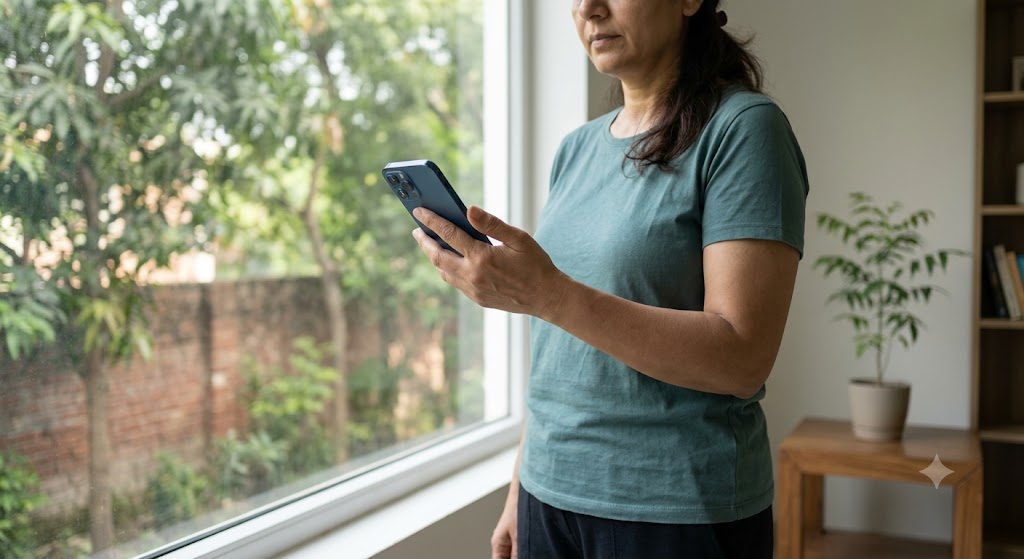
You settle into a scroll. Five minutes later your ring finger feels fizzy. Ten minutes later the pinky is half asleep. You switch hands, shake the dead one, and the feeling floods back as a warm prickle. The phone did not injure you in that moment. It held a joint and a nerve in a position those tissues were never meant to keep for a whole chapter of a feed.
A brief numb or tingling finger while you hold a phone is common. Which fingers go quiet tells you which nerve was squeezed. How fast the feeling returns when you change posture tells you how urgent the story is.
What This Symptom Feels Like
Most people describe one of two maps.
The first is the pinky and the outer half of the ring finger — sometimes the outer edge of the palm as well. That is the ulnar nerve’s territory. It often starts during a long call with the elbow bent, or when the phone is propped on a flexed pinky.
The second is the thumb, index, middle finger and the inner half of the ring finger, sometimes with a dull ache in the palm or wrist. That is the median nerve’s map, the same territory as classic carpal tunnel symptoms. A tight pinch grip, a cocked wrist, and a phone that never leaves the dominant hand all load that tunnel.
The feeling is usually pins and needles, cotton-wool deadness, or a warm buzz that fades within a minute or two of putting the phone down and opening the wrist or elbow. Pain is optional. Weakness of pinch or a finger that will not spread is not part of the ordinary brief version.
Common Causes
A phone is a small, heavy rectangle that you hold with a flexed wrist, a bent elbow, or both. Those two joints are the two most common choke points for the nerves that supply your fingers.
Cubital tunnel at the elbow. The ulnar nerve runs behind the medial epicondyle in a shallow groove. When you bend the elbow past about 90 degrees — the classic “phone to the ear” or “phone in front of the chest while you lie on the sofa” posture — the tunnel narrows and the nerve is both stretched and compressed. Researchers mapping this pathway, including Feindel and Osborne’s early descriptions of the cubital tunnel, showed how flexion raises pressure around the nerve. Later clinical series on “cell-phone elbow” found that posture during use mattered more than raw hours: people who held the elbow flexed were far more likely to report pinky-side tingling than people who propped the arm.
Carpal tunnel at the wrist. The median nerve shares a tight space under the transverse carpal ligament with nine flexor tendons. Holding a phone often parks the wrist in extension or ulnar deviation and keeps the finger flexors lightly contracted. George Phalen’s wrist-flexion test and Richard Gelberman’s pressure measurements inside the carpal tunnel showed how sustained flexion or extension raises tunnel pressure and drops nerve blood flow. A 2015 ultrasound study by Esra Erkol İnal and colleagues found larger median-nerve cross-sectional area in the dominant hands of high smartphone users, along with more thumb pain and weaker pinch — a structural hint that the tunnel is not indifferent to all-day gripping.
Local pressure from the grip itself. Resting the phone’s weight on the pinky (so-called smartphone pinky) or clamping the device in a tight fist can irritate digital nerves or the ulnar nerve at Guyon’s canal in the heel of the hand. This is usually a shorter, more local buzz than true cubital or carpal tunnel symptoms.
Shared desk and sleep habits. The same nerves already spend the night flexed if you sleep with bent elbows or tucked wrists, and they spend the workday extended on a mouse. The phone is often the last straw in a 24-hour flexion budget, not the only cause. That is why numbness that starts on the phone sometimes continues when you wake up, a pattern covered in morning hand tingling.
Why This Happens
Peripheral nerves are living cables. They need blood flow, a little slack, and the ability to glide through tunnels as joints move. Sustained bend does three unhelpful things at once.
First, it raises pressure in the tunnel. Gelberman’s group measured carpal-tunnel pressure climbing well above the threshold that impairs nerve perfusion once the wrist left neutral. The same physics applies at the elbow: flexion tightens Osborne’s ligament over the ulnar nerve.
Second, it stretches the nerve. A nerve can tolerate brief stretch. Minutes of stretch flatten the vessels inside it. Sensation fails before strength does, which is why you feel buzzing long before the hand looks weak.
Third, it reduces glide. Göran Lundborg’s work on nerve microcirculation and Susan Mackinnon’s later surgical anatomy both underline that nerves are meant to slide. A phone grip that never changes angle turns a sliding structure into a pinned one.
None of this requires a “pinched nerve” in the dramatic sense. It is a temporary traffic jam. When you open the joint, blood returns and the axons start firing normally again. That is why shaking the hand works.
Human hands also still expect varied texture and tool use rather than a single glass slab. A related mismatch — fingers built for tools, not only screens — is explored in why your fingers still expect texture and tools.
Less Common but Serious Causes
Most phone-triggered numbness is positional and reversible. A smaller group of people have a true entrapment that the phone merely unmasks.
Cubital tunnel syndrome can progress from intermittent pinky buzz to constant numbness, clawing of the ring and little fingers, and wasting of the first web space. Carpal tunnel syndrome can progress from night tingling to daytime drop of small objects. Cervical radiculopathy from the neck can send a similar map down the arm, usually with neck stiffness or symptoms that do not respect a single nerve’s territory.
Systemic conditions change the threshold. Diabetes, hypothyroidism, rheumatoid swelling, and pregnancy fluid can make a modest phone posture enough to set the fingers off. A sudden numb hand with face or speech change is a different emergency and is not a phone problem.
Hidden Triggers
A few everyday details make the same grip worse.
Speaker-off calls. Holding the phone to the ear keeps the elbow fully flexed. Speaker, earbuds, or a short stand remove that angle.
Sofa and bed scrolling. Lying back with the phone on your chest or forehead often parks both elbows past 90 degrees and both wrists in extension.
Large phones in small hands. A wide device forces ulnar deviation and a harder pinch. Two-hand hold or a light case with a grip ridge spreads the load.
Cold rooms and tight sleeves. Cold slows nerve conduction. A tight watch or sleeve at the wrist adds a second compression point.
Already irritated mouse wrist. A day of pointing leaves the median nerve less tolerant of evening scrolling. Wrist ache after a mouse session is a close cousin, described in wrist ache after using a mouse. Leaning on the elbow during calls stacks a second classic squeeze, the same pattern as pinky tingling when you lean on your elbow.
When to Worry
See a clinician if any of the following show up:
- Numbness that stays after you put the phone down and open the joint for more than a few minutes, or that is present most of the day
- Weakness of pinch, drop of objects, or a finger that will not spread (Wartenberg’s sign on the pinky side)
- Night symptoms that wake you even when you are not holding a phone
- Neck pain, arm pain in a stripe, or symptoms in both the thumb side and the pinky side at once
- Wasting of the fleshy part of the thumb or the web between thumb and index
- Numbness after a fall onto the elbow or wrist
Brief fizz that clears when you switch hands or rest the phone on a table is almost always a posture story.
Myths vs Facts
Myth: Phone numbness means you are giving yourself permanent nerve damage in one sitting.
Fact: Minutes of compression cause a reversible conduction block. Damage that lasts is a months-long, high-pressure, or already-narrowed-tunnel problem — not a single scroll session.
Myth: Only the pinky “smartphone pinky” pose is risky.
Fact: Elbow flexion, wrist extension, and a tight pinch can each irritate a different nerve. The finger map tells you which.
Myth: If Phalen’s test is negative, the phone is harmless.
Fact: Phalen’s test screens for carpal tunnel. It says nothing about the elbow. Many phone-numb hands fail an elbow-flexion test and pass a wrist-flexion test.
Myth: A pop socket or ring holder fixes the nerve.
Fact: A grip aid can reduce pinky load. It does not open a flexed elbow or a cocked wrist. Posture still matters.
Myth: You need a nerve test the first time it happens.
Fact: Electrodiagnosis is for symptoms that persist, progress, or come with weakness — not for a hand that wakes up as soon as you put the phone down.
How to Manage It
Change the angle more often than you change the app.
Keep the elbow closer to open than right-angled on calls. Earbuds or speakerphone are the simplest ulnar-nerve gift you can give yourself. On the sofa, rest the forearm on a cushion so the elbow is not hanging in deep flexion.
Keep the wrist nearer neutral. Two hands, a pillow in your lap, or a cheap stand on the table all beat a single cocked wrist. Set the phone down between bursts of typing.
Loosen the pinch. You do not need a death grip to keep a 200-gram rectangle from falling. Let the fingers rest rather than claw.
Switch sides on a timer. Nerves like variety more than heroics. A two-minute swap is enough to restore blood flow.
Give the tunnels a daily open. Gentle elbow-extension reaches, wrist-neutral tendon glides, and a few hangs or rows for the shoulder girdle keep the cable from living in one groove. If night symptoms have already started, a neutral wrist splint for sleep is a well-studied, low-drama step from the carpal-tunnel literature.
Cold, swelling, and long static days lower the threshold. Warm hands, a looser watch strap, and walking breaks help more than another stretch you will not keep.
When to See a Doctor
Book a visit if numbness is no longer strictly positional, if it wakes you, or if strength is slipping. A hand clinic or neurologist can sort cubital tunnel from carpal tunnel from a neck source with a map of the fingers, a few bedside tests, and, when needed, nerve conduction or ultrasound. Most early cases still respond to posture change, night positioning, and time. Surgery is a later tool for a nerve that has stopped gliding, not a first response to a fizzy scroll.
FAQs
Why is it always my pinky and ring finger?
Those two digits are the ulnar nerve’s patch. The usual culprit is a bent elbow, not the wrist. Straighten the arm and see if the buzz fades.
Why is it my thumb and first two fingers instead?
That is median-nerve territory. Look at your wrist angle and how hard you are pinching the phone. Night symptoms in the same fingers point more toward carpal tunnel than toward one evening of scrolling.
Can a phone actually enlarge the median nerve?
Ultrasound studies in high smartphone users, including İnal’s student cohort, have shown a larger cross-sectional area in the dominant wrist. That is an association with heavy use, not proof that one evening of messages remodeled the nerve.
Does shaking my hand help because I “wake the circulation”?
Yes, in a local sense. Opening the joint drops tunnel pressure and lets blood back into the nerve. The relief is real. It is also a hint to change the posture that created the jam.
Is a pop socket enough?
It can spare the pinky from being a kickstand. It will not protect an elbow held at 120 degrees for a 40-minute call.
Should I stop using my phone?
No. Change how you hold it, how long each hold lasts, and whether the elbow and wrist stay parked. The device is not the enemy. The frozen angle is.
Conclusion
Fingers that go numb on a phone are usually sending a simple message: a nerve is folded, pressed, or both. The ulnar nerve hates a bent elbow. The median nerve hates a cocked, gripping wrist. Neither needs a crisis response the first time the feeling appears. Put the phone down, open the joint, and notice which fingers woke up. If the map is brief and positional, treat it as a posture cue. If it stays, spreads, or steals strength, have the tunnel examined. Your hands were built for tools that change angle. A glass rectangle can still be one of those tools — as long as it does not own the same bend all evening.