A scratchy, dry throat in flight is usually desert-dry cabin air meeting a thin pharyngeal film and some mouth breathing—not a sudden infection from recycled air. Here is when it is ordinary and when it is not.
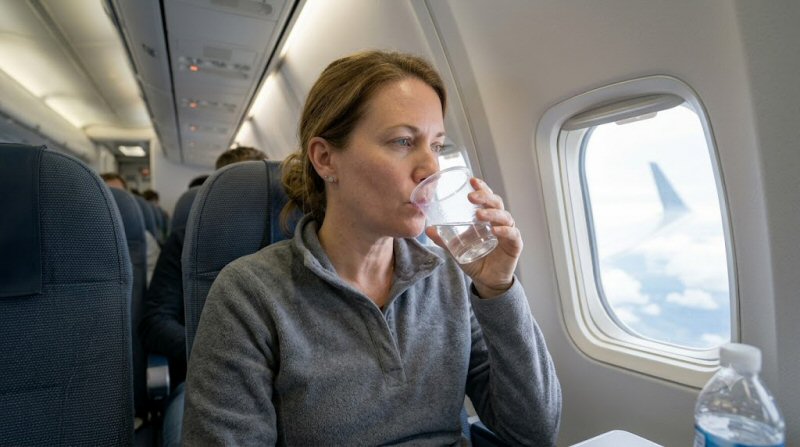
You boarded with an ordinary swallow. An hour later the back of the throat feels tight and papery. Talking over engine noise scratches. Water helps for a few minutes, then the dryness returns. By descent you keep clearing your throat as if something is stuck there that is not.
For most healthy adults, a dry throat on a plane is a moisture problem, not proof that recycled cabin air “gave you a cold in real time.” Cabin humidity is often lower than a winter living room. A quiet seat, a slightly open mouth, a stuffy nose, and a thin mucous coat on the pharynx let that air evaporate the film you usually never notice. It belongs with a sticky mouth in flight, a dry nose at altitude, and an indoor scratchy throat.
What This Symptom Feels Like
Typical in-flight throat dryness is:
- A scratchy, tight, or “sandpaper” feeling at the back of the mouth rather than sharp pain on swallowing food
- Frequent throat-clearing that does not bring up much mucus
- A swallow that wants a sip first
- Voice that sounds a little husky after talking
- Often worse after a nap with the mouth open, on a long-haul sector, or if the nose was already blocked
- Relief that starts within hours of leaving the cabin, especially after a meal and ordinary indoor humidity
It is not usually fever, swollen glands, or pain that makes liquids hard to swallow.
Common Causes
Several ordinary cabin factors stack.
Very dry cabin air. Outside air at cruise is bitterly cold and holds almost no water. Once it is compressed and conditioned, cabin relative humidity commonly sits around 10–20 percent. Environmental work on aircraft cabins by Niren Nagda and colleagues has long listed dry throat, dry nose, dry eyes, and dry mouth among the most consistent passenger complaints.
A thin pharyngeal film. The throat is not waterproof skin. It stays comfortable under a thin mucus coat moved by cilia and refreshed by saliva that drips back from the mouth. Donald Proctor mapped how airway lining water and mucociliary clearance depend on inspired humidity. In desert-dry air that film evaporates faster than it is replaced.
Mouth breathing. A stuffed nose, a dropped jaw during sleep, or talking across the aisle sends unhumidified air straight over the pharynx. The nose is supposed to warm and moisten inspired air first. When it is bypassed, the throat does the job poorly. Ronald Eccles and colleagues have described how nasal lining and downstream airway comfort rise and fall together with humidity and airflow route.
Less saliva while you sit still. Colin Dawes showed that unstimulated salivary flow is only a thin trickle compared with chewing. Hours without a real meal mean less fluid arriving at the back of the mouth to coat the throat.
Vents, talking, and caffeine. A gasper jet aimed at the face speeds evaporation. Long conversations over engine noise dry the mucosa the way a lecture hall does. Coffee and alcohol do not empty you in one cup, but they do not replace the watery saliva food would have produced.
Why This Happens
The pharynx expects air that has already been humidified by a working nose, not aircraft-cabin air taken in through an open mouth.
Inspired air should leave the nose near body temperature and close to saturation. Philip Cole’s work on nasal air-conditioning showed how much of that job is finished before air reaches the throat. Cabin air starts far below that target. Every breath then pulls water from the lining. Over a long-haul flight the deficit is small for whole-body water and large for a surface film a fraction of a millimeter thick.
Swallowing and saliva normally re-wet the same surface. In a seat you swallow less often during a movie or a doze. Mucus thickens. Nerve endings in the pharynx read that thickness as “something to clear,” so you hawk or sip. The sensation is similar to waking with a dry throat after mouth-breathing in a heated room—only the cabin is drier still.
Pressurization itself does not scrape the throat. What it does is deliver air that can accept a lot of water vapor. Recirculation filters particles; it does not add moisture. That is why the same dryness shows up in eyes, lips, nose, and mouth on the same flight.
Less Common but Serious Causes
Most in-flight scratchiness is environmental. A few patterns deserve a different look after you land:
- Painful swallowing, fever, or swollen neck glands that were not there at takeoff and worsen over a day or two (infection timed with travel, not “cabin air as a virus factory”)
- Voice that disappears, stridor, or trouble breathing
- One-sided ear pain with a very sore throat after a flight (sometimes an ear or tonsil problem, not simple dryness)
- Heartburn, sour taste, and a raw throat that is already a nightly pattern on the ground—laryngopharyngeal reflux described in clinical work by Jamie Koufman can feel worse when you recline and the air is dry
- Known Sjögren’s syndrome, radiation to the neck, or medications that flatten saliva making the cabin unbearable
- A foreign-body feeling that does not ease with water and is paired with unexplained weight loss or a lump you can feel
Those are reasons the cabin unmasks a baseline problem, not a new disease created at 35,000 feet.
Hidden Triggers
Small choices make the same cabin feel much harsher:
- Sleeping with the mouth open and the overhead vent on
- Boarding already congested from a cold, allergy, or dry hotel air
- Antihistamines taken for flight ears or hay fever
- Several coffees or drinks with little water between them
- Talking for hours without sips
- A mask that dries the lips while you still mouth-breathe around it
- Salt-heavy snacks that raise thirst without adding chewing time
- Reclining after a large, late meal if reflux already irritates the larynx
When to Worry
Seek care rather than another bottle of water if:
- Swallowing liquids becomes truly painful or you drool because you cannot swallow
- Breathing feels noisy, tight, or suddenly difficult
- High fever, a stiff neck, or a rapidly swelling throat appears
- Hoarseness lasts more than two or three weeks after the trip
- You cough blood, or a lump in the neck is new and growing
- Dryness on the ground is already severe and the flight only proves how little saliva you have
Ordinary cabin scratchiness should fade after humidity, food, and a night’s sleep. It should not escalate into an emergency-sounding airway.
Myths vs Facts
Myth: Recycled cabin air is why your throat is dry and why you “always get sick after flying.”
Fact: The dryness is low humidity. Infection risk on board is more about close seating and shared surfaces than the filters themselves. A scratchy throat at landing is usually the film, not a virus that incubated in two hours.
Myth: If your throat is dry you must already be badly dehydrated.
Fact: Surface water loss can feel dramatic while total body water has barely moved. Puffy ankles and a dry throat can coexist on the same flight.
Myth: Only water fixes it, and you must drink a liter an hour.
Fact: Sips help the film. Overdrinking mainly sends you to a tiny lavatory. Chewing, nasal breathing, and turning the vent away help as much as volume.
Myth: A dry throat means the plane “stole moisture from your cells.”
Fact: Cabin air accepts evaporated water from wet surfaces. It does not vacuum fluid out of muscle and organs.
How to Manage It
You cannot humidify the whole cabin. You can protect the film.
- Keep the gasper vent off your face.
- Sip water regularly rather than saving it for descent.
- Chew sugar-free gum or a snack that actually requires chewing—Dawes’ point about stimulated saliva applies at altitude too.
- Breathe through the nose when you can. A simple saline spray before and during the flight can keep the humidifier online.
- Limit back-to-back coffee and alcohol if your throat is already raw.
- If you doze, a slight chin-up posture or a travel pillow that keeps the jaw from dropping can reduce mouth breathing.
- After landing, a humid room, a meal, and ordinary talking usually finish the reset.
- People with known reflux can avoid a large reclining meal in the last hours of the flight.
None of this requires a special “aviation throat tonic.” It is the same logic as winter indoor air, applied to a drier room that happens to fly.
When to See a Doctor
Book a visit if cabin dryness is only the loudest version of a throat that is already scratchy most days, if hoarseness persists, if reflux symptoms dominate, or if medications and autoimmune disease are already thinning saliva. Bring a simple timeline: when it starts in flight, what helps, whether the nose is blocked, and whether the same pattern happens in heated hotel rooms. That history sorts environment from baseline faster than another lozenge.
FAQs
Is a dry throat on a plane a sign I am getting a cold?
Not by itself. Dry air can mimic the first day of a cold. Fever, body aches, and symptoms that bloom a day or two later are more informative than scratchiness at landing.
Why does water help for only a few minutes?
Water wets the surface and is then swallowed or evaporated. Until humidity and saliva recover, the film thins again.
Do lozenges work?
A lozenge that makes you swallow and saliva-flow can help briefly. Menthol-heavy types can feel cooling and then more raw. Use them as a temporary coat, not a cure.
Should I wear a mask the whole flight to protect my throat?
A mask can reduce some particle exposure. It does not humidify cabin air. If you mouth-breathe around it, the throat can still dry.
Why is it worse when I sleep on the plane?
The jaw drops, the nose may clog, and swallowing slows. Dry air then has a straight path to the pharynx—the same pattern as a dry heated bedroom.
Will a humidifier at the hotel fix it overnight?
Often yes, together with a meal and nasal breathing. If you wake equally raw in a humid room, look at reflux, medications, or a lingering infection.
Conclusion
A dry, scratchy throat at cruising altitude is usually a wet lining asked to work in air that holds almost no moisture, often through a mouth that was never meant to be the main humidifier. It is uncomfortable and very common. It is not, by itself, proof of dehydration, a new infection, or damaged vocal cords. Protect the film with sips, chewing, nasal breathing, and a vent that is not aimed at your face. Let ordinary humidity finish the job after you land. Save extra concern for pain, fever, breathing trouble, or a throat that is already a daily problem on the ground.