
An itchy scalp right after shampoo is usually a stripped barrier, leftover surfactant, or a dry-air rebound—not automatically lice or a serious disease. Learn why washing can make itch worse, and when flakes need a check.
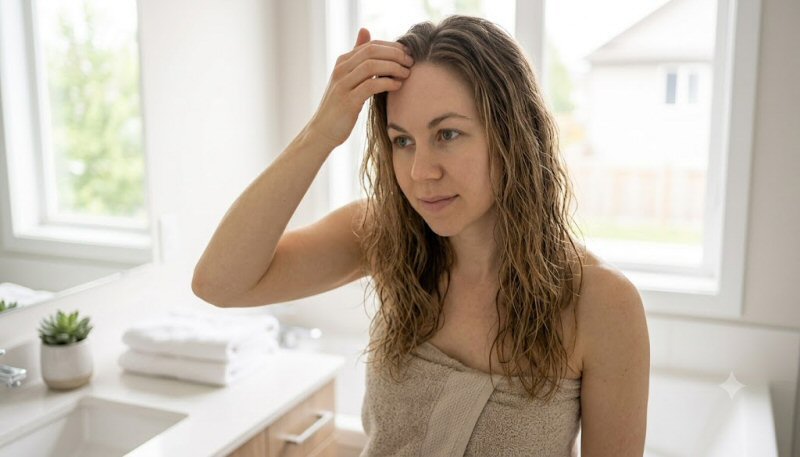
You rinse the last of the shampoo, towel the hair, and within minutes the scalp starts to crawl. Not a full rash. Just a tight, prickly need to scratch along the part line, behind the ears, or at the nape. The skin looks clean. The itch arrived after you tried to be clean.
An itchy scalp right after washing is extremely common. For most people it is the scalp barrier losing water and oils into hot water, detergent, and dry indoor air—not proof of lice, a food allergy, or that you must wash again. The scalp is skin with hair through it. Once you treat it that way, the post-shampoo itch makes more sense.
What This Symptom Feels Like
Typical post-wash scalp itch is a surface problem that starts as the hair dries.
People describe:
- Tightness or prickling along the part and hairline after the towel
- An urge to scratch that peaks as the hair goes from wet to damp
- Fine white flakes that look worse under bathroom light than they feel
- Stinging if a second shampoo or a strong conditioner touches a raw spot
- Itch that eases after a bland oil or a cooler, shorter wash, then returns with the next hot shower
- More itch in winter heating and after a very foamy “clarifying” shampoo
It is usually milder on humid days, after you skip a day of washing, and when you rinse cooler. It often settles within a week of gentler product and less heat. It is not the same as crawling that you can see, sudden patches of hair loss, or thick yellow crust that will not lift.
Common Causes
The scalp is not a separate organ. Work associated with researchers such as Peter Elias and Ehrhardt Proksch on the stratum corneum, Gil Yosipovitch on itch pathways, and Ralph Trüeb on scalp barrier and hair-care irritation all point the same way. The outer layer is a brick-and-mortar wall: dead cells packed with water-binding proteins, sealed by ceramides, cholesterol, and fatty acids. Hair follicles pierce that wall. Sebaceous glands feed it oil. Hot water and surfactant lift the mortar. Then dry air pulls water through the gaps.
Shampoo is designed to lift sebum and product. Anionic detergents such as sodium lauryl sulfate do that job well. They also lift some of your own lipids. For a minute the scalp feels “squeaky.” That squeak is a thinned seal. As the hair dries, transepidermal water loss rises. Nerve endings that sit just under the barrier fire as tightness and itch—the same family of signals Yosipovitch’s group mapped in dry, inflamed skin.
Residue can itch too. Incomplete rinse leaves surfactant on the follicle openings. Hard water can leave a film that feels tight. A heavy conditioner that sits on the scalp instead of the lengths can occlude and itch as it warms. None of that requires an infection.
The same barrier physics shows up on the rest of you after heat and detergent. If skin feels tight after a hot shower, the scalp often shares the evening: heat and soap thinned the seal, then dry room air finished the job. Nighttime itch uses some of the same water-loss and cortisol-trough timing; skin that itches more at night is the clock version of a post-wash scalp.
Why This Happens
Human scalp skin evolved for outdoor weather, sebum, and occasional river water—not a daily hot shower with a high-foam bottle. The scalp has more sebaceous glands than the forearm, which is why it can look oily by day two. It still has a thin barrier between those glands. Strip the oil faster than the glands replace it, and you get a rebound: tight and itchy at hour one, greasy at hour twelve, which tempts another wash.
A few everyday conditions stack:
- Hot water that raises blood flow and lifts lipids.
- A foaming detergent left on too long or rinsed too little.
- Indoor air well below 40 percent relative humidity while the hair dries.
- Scratching that micro-tears the barrier and invites more itch.
- A second wash “to be sure,” which repeats the strip.
Seborrheic dermatitis and mild psoriasis can sit underneath and flare after a harsh wash. They are common, not rare disasters. They still start with a barrier that does not like heat and detergent. Dry winter air and frequent washing can look like “dandruff” when the main problem is water loss, the same leak that cracks hands in dry weather.
Less Common but Serious
Most post-wash itch is barrier and product. A smaller list deserves a clinician.
See someone promptly if you have:
- Crawling you can confirm with nits stuck to hair shafts, not loose flakes
- Sudden coin-shaped bald patches, broken hairs, or scalp pain with swelling
- Thick greasy yellow scale with redness that spreads onto the face
- Honey-colored crust, pus, fever, or rapidly spreading tenderness
- Itch plus unexplained weight loss, night sweats, or swollen nodes
- Open sores that will not close after you stop scratching
Lice, tinea capitis, contact allergy to a new dye or fragrance, and uncommon inflammatory diseases exist. They do not look like a brief prickle that started the minute the towel went on and faded with cooler water.
Hidden Triggers
A few modern habits make a normal scalp itch after every wash.
Very hot showers feel relaxing and raise scalp blood flow. The extra heat lifts more lipid than a lukewarm rinse. Long “self-care” washes keep detergent on the barrier longer than a two-minute clean.
Daily shampoo in winter heating strips faster than glands refill. Skipping a day often reduces itch more than a new anti-dandruff bottle.
Clarifying and anti-residue formulas are useful after heavy product. Used every wash, they leave the part line tight.
Dry brushing or vigorous towel wringing at the roots scrapes a wet barrier. A soft squeeze and air-dry at the scalp is kinder.
Fragrance, essential oils, and leave-in mists on the scalp add allergens some people only notice after heat opens the skin.
When to Worry
Worry less when itch starts as the hair dries, there is no fever, hair density looks the same, and a week of cooler water plus a milder wash calms it.
Worry more when:
- Itch is one-sided, waking, or paired with hair coming out in clumps
- You see nits, pustules, or a spreading ring of scale
- A new permanent dye, relaxer, or perfume was the last product before the itch
- You have a known immune or scalp disease that is suddenly louder
- Home changes fail for two to three weeks
Itch alone, right after a wash, is a weak reason to assume cancer or a systemic crisis.
Myths vs Facts
Myth: Post-wash itch means you did not wash well enough.
Fact: Over-washing is one of the common causes. A second shampoo often makes the prickle worse.
Myth: White flakes after a wash are always yeast that must be killed.
Fact: Dry barrier flakes and seborrheic scale can look similar. Not every flake needs an antifungal on day one.
Myth: An itchy scalp after shampoo is usually lice.
Fact: Lice leave nits glued to the shaft. Loose specks on the towel after a wash are more often skin or product.
Myth: You should scratch to “stimulate oil.”
Fact: Scratching tears a wet barrier and feeds the itch cycle Yosipovitch’s work describes.
Myth: If it itches, the product is too natural or not natural enough.
Fact: Both harsh detergents and heavy oils can itch. The scalp wants a short wash, a full rinse, and less heat.
How to Manage It
Cool the water. Lukewarm at the scalp lifts less lipid than a steamy rinse.
Shorten contact. Massage shampoo on the scalp for under a minute, then rinse until the hair feels slippery, not squeaky.
Wash less often if the hair type allows. Many scalps do better every two or three days in dry seasons.
Keep conditioner off the scalp if lengths are the dry part. Rinse the roots extra well.
Pat, do not rub, at the crown. Let the scalp air while you dry the ends.
Use a bland, unscented moisturizer or a few drops of a simple oil on the part if the skin looks tight after drying—not a leave-in cocktail of fragrance.
A zinc pyrithione, ketoconazole, or salicylic wash a few times a week can help if true seborrheic scale is present. It is not required for a one-off post-rinse prickle.
Humidify the room while hair dries if winter air is desert-dry. The barrier loses less water.
Stop the scratch. A cool cloth on the nape beats nails on wet skin.
When to See a Doctor
See a primary clinician or dermatologist if itch lasts beyond a few weeks of gentler washing, if hair is thinning in patches, if scale is thick and greasy despite an antifungal wash, or if you need to rule out lice, fungus, contact allergy, or psoriasis. Bring the bottle list. What you put on the scalp is often the first useful clue.
Seek urgent care for fever with a swollen, painful scalp, rapidly spreading redness, or an outbreak of blisters.
FAQs
Is it normal for the scalp to itch only after I wash, not the next day?
Yes. That timing points to heat, detergent, and drying air more than to a constant infestation.
Can switching shampoo make itch worse at first?
Yes. A new surfactant or fragrance can irritate for several washes. A true allergy usually builds with repeat use, not one rinse.
Does dry shampoo stop the itch?
Sometimes it delays a wash, which helps. Spray buildup on the part can also itch. It is a bridge, not a seal.
Why does my scalp itch more in winter after every shower?
Heated indoor air is drier. The same wash that was fine in humid weather leaves a leakier wall in January.
Should I use apple cider vinegar or lemon as a rinse?
Acid rinses can help some people with residue. They can sting a cracked barrier. They are not a treatment for infection.
Can stress make a washed scalp itch more?
Yes. Stress changes scratch behavior and skin immune tone. It does not create lice.
Conclusion
An itchy scalp after you wash your hair is usually a thin barrier meeting hot water, detergent, and dry air—not a verdict on hygiene or a hidden epidemic on your head. Cool the rinse, shorten the wash, rinse until the squeak is gone, and give the glands a day off when you can. See a clinician if flakes turn to crust, hair falls in patches, or the itch will not quiet with kinder water. Most post-shampoo prickle is your scalp asking for less strip, not another bottle.