Thigh or calf shaking in a squat is often motor-unit tremor from fatigue, depth, or a long sit — not automatically weak knees. Learn when the wobble is benign and when to get it checked.
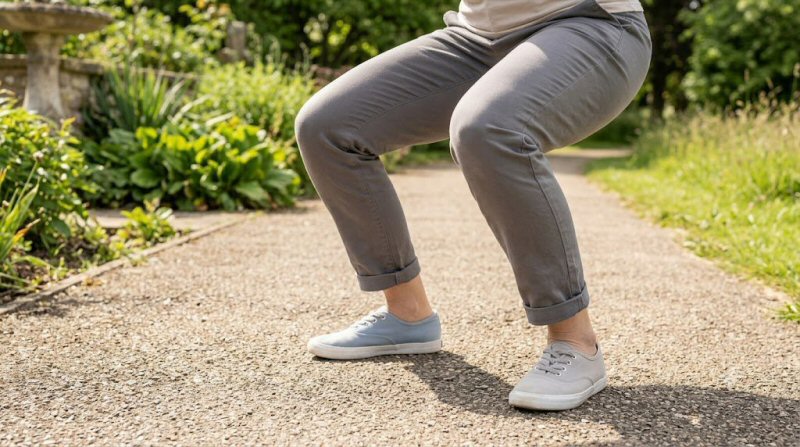
You drop into a squat to pick something up, hover over a low chair, or hold the bottom of a bodyweight squat, and the thighs start to flutter. Sometimes the shake is only in one quad. Sometimes both calves join in. There is no sharp knee pain and you can stand back up. Still, a shaking leg is hard to ignore — it looks like the joint is about to give way.
A painless wobble in a squat is common. The muscles that hold you there are a large team of motor units firing in a slightly uneven rhythm. After sitting, after a first set, or at a depth you rarely use, that rhythm becomes visible as a tremor. The shake is not, by itself, proof of weak cartilage or a failing ACL. What matters is whether the wobble comes with true giving way, sharp joint pain, locking, or a sudden loss of strength that does not recover with rest.
What This Symptom Feels Like
People describe it in a few overlapping ways:
- Quads fluttering when you hover just above a chair or toilet
- A fine ripple through the front of the thigh in the last few seconds of a hold
- One leg shaking more than the other on a split squat or a step-down
- Calves quivering when the heels stay down in a deep squat
- A wobble that fades after a few warm-up reps and returns when you linger at the bottom
The motion is usually small and fast — more of a buzz than a collapse. Many people can keep the squat if they breathe and shift a little. That already argues against a structural “the knee is coming apart” event. Unstable joints and torn ligaments usually announce themselves with a pop, swelling, and a leg that will not take weight.
A related pattern is knee ache going down stairs, where the same quads work eccentrically. Shake without pain is a control and fatigue story. Pain plus swelling is a different one.
Common Causes
Most everyday squat shakes fall into a short list.
Physiologic tremor made visible. All contracting muscle has a small tremor, classically near 8–12 Hz. Work associated with Olof Lippold on the stretch-reflex loop, and later reviews by Rodger Elble and Günther Deuschl, describe this as normal motor-unit firing plus a little reflex oscillation. In a quiet arm it is tiny. In a loaded squat it is easy to see.
Motor-unit dropout as you fatigue. As a hold goes on, some units drop out and others fire in bigger, less smooth bursts. Fatigue-tremor work associated with Roger Enoka and Brenda Bigland-Ritchie shows that the force signal gets noisier before it actually fails. The thigh looks like it is shivering even while it is still producing plenty of force.
Depth you rarely use. A chair-height sit uses a modest knee and hip angle. A deep squat asks the quads, glutes, and adductors to share load in a range many desk days never visit. New motor units come online in a less practiced pattern. The first few deep holds often shake; practiced ones often do not.
Long sit before the first squat. Sitting shortens the hip flexors and leaves the quads under-recruited. The first sit-to-stand or pick-up squat then asks cold muscle to produce a smooth isometric. A brief flutter is common until blood flow and firing rate catch up. This sits in the same family as quads that still expect the floor.
Caffeine, low sleep, or a hard previous session. Enhanced physiologic tremor is louder after coffee, after a short night, or when delayed soreness is still in the muscle. The squat did not suddenly become unsafe. The nervous system is a little more oscillatory.
Asymmetry after a favored side. Most people load one leg more on stairs and when they stand from a chair. The less-used side may flutter first. That is a practice gap, not automatically a hidden tear.
Why This Happens
A squat is not one muscle. It is a long chain: feet, calves, quads, hamstrings, glutes, and the small muscles that keep the knee tracking over the foot. Smooth force needs those units to stagger their firing so peaks and troughs cancel. When the demand is new, deep, or held, the stagger becomes less perfect and the leftover ripple shows up as a shake.
Modern days make that mismatch easy. Hours in a chair train the legs for a narrow angle. Then a deep squat, a long hover while you search a low shelf, or a slow descent on stairs asks for a range and a duration the day’s “training” never practiced. The tremor is the control system hunting for a steady output.
The shake is also not the same as collapse. Collapse is a sudden loss of force. Tremor is force that is still there, just less smooth. You can usually keep the position, adjust stance, or stand up in control. That distinction is what keeps most squat wobbles in the benign column.
Less Common but Serious Causes
A minority of shaking squats need a closer look:
- True giving way — the knee buckles and you cannot catch it
- A pop at the start of the episode followed by swelling within hours
- Locking or a block that stops you from straightening the knee
- Weakness that is there even when you are fresh, not only at the end of a hold
- Shaking plus numbness, foot drop, or pain that shoots below the knee
- Tremor that is present at rest, not only under load
- Rapid muscle wasting on one thigh
Those patterns can point to a ligament or meniscus injury, an unstable kneecap, nerve root irritation, or a neurologic tremor that is not just fatigue. They are the exception, not the default reading of a fluttering quad after a long sit.
Hidden Triggers
A few everyday habits make squat tremor louder:
- First squat of the day with no walk or stand-up warm-up
- Hovering in a “half sit” while you tie a shoe or look in a low cupboard
- Narrow stance on a slick floor so the hips cannot share the load
- Heels that lift because ankle range is limited, dumping extra work onto the quads
- A hard walking or stair day still sitting in the muscle as delayed soreness
- Extra coffee on a short night, which can also show up as hand tremor after coffee
- Holding the breath at the bottom, which spikes effort and makes the force signal noisier
When to Worry
Treat the shake as a reason to get checked if you notice:
- Buckling that makes you grab a wall or fall
- One knee that swells, locks, or will not fully straighten
- Pain under the kneecap or along the joint line that worsens with each squat
- Weakness climbing stairs even when you are not tired
- Tremor that appears at rest or in the hands and head as well
- Night pain, fever, or a thigh that looks suddenly smaller
Painless flutter that eases after a few reps, a short walk, or a day of ordinary use is in a different category.
Myths vs Facts
Myth: Shaking means the squat is wrecking your knees.
Fact: Visible tremor is usually a control and fatigue signal. Joint injury announces itself with pain, swelling, and giving way, not only a ripple.
Myth: If one leg shakes, that knee is “weaker forever.”
Fact: Sides differ with habit. The less-practiced side often flutters first and quiets with even, pain-free practice.
Myth: You should never squat again if your legs shake.
Fact: Avoiding the pattern usually makes the next attempt shakier. Short, controlled ranges that do not hurt are how the firing pattern smooths out.
Myth: Only “out of shape” people shake.
Fact: Strong lifters shake on a last hard hold. The difference is that they expect it and stop before form collapses.
How to Manage It Naturally
You do not need a special machine to make squat tremor less dramatic.
Warm the pattern before you linger. Stand up and sit down a few times, walk a short hall, or do a shallow squat pulse before you hover at the bottom.
Use a range you can control. A box or chair behind you lets you squat to a known height and stand without hunting for the floor. Lower the target slowly across days if you want more depth.
Widen the stance a little. A slightly wider foot position and a small toe-out often lets the hips share load so the quads are not doing the whole job.
Keep the heels honest. If the heels pop up, elevate them a little on a book or choose shoes with a modest heel-to-toe drop until ankle range improves. The shake often drops when the foot is stable.
Breathe. A long exhale in the hold reduces the panic brace that makes tremor look worse.
Stop at ripple, not at collapse. End the hold when the shake is visible but the knee still tracks. That is training control, not “pushing through failure.”
Even up the sides. Step-downs, split squats, or sit-to-stands that start with the quieter leg help close the habit gap.
Sleep and caffeine are levers. A short night plus extra coffee makes every physiologic tremor louder. Fix those before you assume the knee is the problem.
When to See a Doctor
See a clinician if the squat shake comes with buckling, a new pop and swelling, locking, or weakness that does not match simple fatigue. Also seek care if tremor is present at rest, spreading, or paired with other neurologic changes. Bring notes on which range starts the flutter, whether one side is worse, and whether pain, swelling, or giving way ever join it. That history separates motor-unit noise from a joint or nerve problem that needs imaging or targeted rehab.
FAQs
Is it normal for my legs to shake when I squat?
Yes, if the shake is a fine flutter without sharp pain, swelling, or true collapse. It is usually motor-unit tremor from fatigue, depth, or a cold start after sitting.
Does shaking mean I am too weak to squat?
Not by itself. Weakness shows up as an inability to stand or a knee that caves and stays painful. Tremor can appear in strong muscle that is simply tired or unpracticed at that angle.
Why does only one leg shake?
Most people have a preferred side for stairs and sit-to-stand. The less-used side recruits less smoothly. Even, pain-free practice usually narrows the gap.
Should I push through the shake?
Stay in a range you can control and stand when form starts to wander. Training past collapse is how a wobble becomes a twist.
Can coffee make squat tremor worse?
Yes. Caffeine can enhance physiologic tremor. If the flutter is much louder on high-coffee days, that is a useful clue.
When is shaking a medical problem?
When it comes with giving way, locking, swelling, rest tremor, or weakness that is there even when you are fresh.
Conclusion
A shaking thigh in a squat looks dramatic and is usually ordinary. The muscle is still working. The firing pattern is just less smooth after sitting, at a new depth, or at the end of a hold. Give the legs a short warm-up, a stance they can own, and a range that does not hurt. Get the joint checked if the wobble turns into buckling, swelling, or a knee that will not straighten — but do not treat every flutter as a verdict on the joint.