
Legs that fall asleep on the toilet are usually rim pressure on the sciatic or peroneal path plus a long still sit — not automatically a damaged spine.
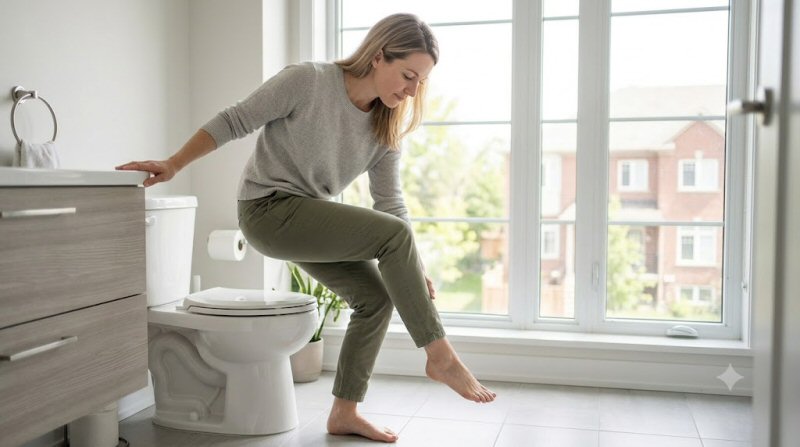
You stand up from the toilet and one foot, calf, or whole lower leg does not feel fully yours. The first step is wooden. Pins-and-needles rush in as you shake the limb. A minute later the feeling is back and the moment is already a joke you tell yourself in the hallway.
That “dead leg on the toilet” is extremely common. It is usually what happens when a hard rim, a dangling thigh, and a still sit park body weight on a nerve that was built for walking, not for a long perch on a ceramic ring.
What This Sensation Feels Like
People describe a tight cluster of clues:
- One foot or the outer lower leg feels thick, cold, or “asleep”
- A burst of pins-and-needles when you stand or uncross an ankle
- Weakness that lasts a few steps, then fades
- Numbness that started only after you had already been sitting for a while
- Feeling that returns within a minute or two of walking
It is not the same as a sharp electric zap from the low back down the back of the thigh, or numbness that stays for hours after you stand. Ordinary toilet numbness is local, position-dependent, and fades once the pressure is off.
Why the Toilet Puts a Nerve to Sleep
A modern toilet is a hard, narrow ring. Your sitting bones, hamstrings, and the back of the thighs rest on that rim. The sciatic nerve leaves the pelvis under the gluteal fold and travels down the back of the thigh. Near the outside of the knee, its common peroneal (fibular) branch winds around the neck of the fibula — a shallow groove with almost no padding.
Hold still on that geometry and three things stack:
- The rim concentrates load under the ischia and the proximal hamstrings, the same interface-pressure problem seating researchers mapped after Kosiak’s tissue-ischemia work. Small vessels in the pad close. Nearby sensory fibers go quiet.
- If one ankle is crossed, a foot is tucked, or a thigh hangs off the front of the bowl, the common peroneal nerve can be pressed against the fibular neck. Classic compression studies in the tradition of Sunderland and later clinical mapping by Katirji and Kimura showed how little sustained pressure that site needs before the foot feels wooden.
- Hip flexion on a standard seat also puts a mild stretch on the sciatic path. Stretch plus squeeze is a louder signal than either alone.
When you stand, blood returns and the nerve starts firing again. That rebound is the pins-and-needles. The same family of compression explains why legs fall asleep on a chair edge, why a cross-legged sit puts the foot to sleep, and why the buttocks go numb after a long sit.
A toilet was designed as a brief perch for emptying, not as a second desk chair. Phone scrolling turns that brief perch into a still load the nerve never evolved to hold.
Common, Usually Harmless Triggers
Most episodes have a boring list behind them:
- A long sit with a phone, a book, or a delayed bowel movement
- Crossing one ankle over the other so one fibular neck meets the opposite shin or the rim
- Perching forward so the back of the thighs take the whole load
- A hard, unpadded seat and a leaner frame with less gluteal cushion
- Feet that do not reach the floor, so the thighs hang and the rim becomes a sharp edge
- Standing up suddenly after the limb has already gone quiet
Warm rooms and tight waistbands do not pinch the nerve directly. They just make you less likely to shift. Shifting is the cheap pressure-relief system.
Hidden Triggers
A few less obvious habits make the same physiology louder:
- Reading or scrolling that stretches a two-minute visit into fifteen
- A seat that is too high for your leg length, so the thighs are unsupported
- Tucking both feet back under the bowl, which flexes the knees and can load the peroneal path against the rim
- Habitual leaning onto one sit-bone, the bathroom version of sitting on a wallet
- Constipation or incomplete emptying that keeps you there longer than the tissue likes — a reminder that the bowel still prefers a squat-like angle over a long sit
Rare case reports of “toilet-seat neuropathy” describe a denser peroneal or sciatic palsy after an unusually long sit, often with alcohol or deep sleep in the mix. Those are the exception. Everyday pins-and-needles after a few extra minutes are the rule.
When to Worry
See a clinician if any of these show up:
- Numbness that does not fade within a few minutes of standing
- Foot drop — the toes catch when you walk, or you cannot lift the foot
- Numbness that starts in the low back or saddle area and runs down both legs
- Loss of bowel or bladder control, or numbness between the legs that does not match a sitting posture
- Night pain, unexplained weight loss, or fever with the leg symptoms
- Repeated episodes that no longer need a toilet or a chair to appear
Those patterns can point to a radiculopathy, a true focal palsy, or something that needs imaging — not a rim. Ordinary toilet numbness does not need an MRI on the first episode.
Myths vs Facts
Myth: If your leg falls asleep on the toilet, a disc has slipped.
Fact: Most episodes are local compression at the sit-bone or the fibular neck. A disc problem usually adds back pain, a consistent dermatomal map, and symptoms that do not vanish when you stand.
Myth: Tingling means the nerve is dying.
Fact: Brief ischemia and mechanical deformation make sensory axons fire as they recover. That is why the pins-and-needles are loudest in the first seconds after you stand, then fade.
Myth: You should never sit on a toilet longer than a minute.
Fact: The bowel needs whatever time it needs. The issue is stillness plus a hard edge plus a phone, not the ceramic itself. A footstool, a shift of weight, and standing as soon as you are finished remove most of the load.
Myth: Only older people get this.
Fact: Leaner frames, crossed ankles, and long scrolling sessions produce the same geometry at any age.
How to Manage It
You do not need a new bathroom. You need less still load on a shallow nerve.
- Finish, then stand. Do not stay to finish a video.
- Keep both feet on the floor or on a low stool so the thighs are supported and the hips are not hanging on the rim.
- Uncross the ankles. A crossed shin is a convenient peroneal clamp.
- Shift side to side if you must stay longer.
- A small footstool that raises the knees — the same tool used to ease the anorectal angle — also shortens hanging-thigh time.
- After you stand, take a few easy steps before you rush down a staircase. Feeling usually returns faster than panic does.
- If constipation is what keeps you there, treat the bowel habit rather than adding minutes on the seat.
None of this requires gadgets. It is the same advice seating clinics give for any hard perch: load, then unload, then load the other side.
When to See a Doctor
Book a visit if toilet numbness becomes the default, if one foot stays weak, or if the map of the numbness no longer matches “I sat too long.” A clinician can check ankle dorsiflexion, the fibular neck, and the lumbar roots, and decide whether you need nerve testing or imaging. Bring the timing: how long you sat, which posture, how fast feeling returned. That history is more useful than a generic “my leg went numb.”
FAQs
Why is it always the same leg?
Most people lean or cross the same way every time. The nerve on that side gets the rim. Switching which ankle you cross, or placing both feet flat, often spreads the load.
Can this become permanent?
Everyday minutes-long sits almost never leave a lasting palsy. Hours of unrelieved pressure, especially if you fell asleep on the seat, are the setting for the rare documented toilet-seat neuropathies. Stand when you notice the limb going quiet.
Is this the same as restless legs?
No. Restless legs are an evening urge to move that is relieved by walking and often tied to iron and dopamine timing. Toilet numbness is a local compression that starts only after you have been still on a rim.
Does a padded seat cover fix it?
A softer interface helps the sit-bones. It does not protect a fibular neck that is pressed against the opposite shin. Uncrossing the legs still matters more than foam.
Why do I also feel it in the foot, not just the thigh?
The common peroneal nerve supplies the dorsum of the foot and the outer lower leg. Compression at the fibular neck maps there. Compression higher, under the sit-bone, can feel more like a wooden thigh or calf.
Should I stop using a phone in the bathroom?
You do not have to ban the phone. You do have to notice when the visit has become a sit. The nerve cares about minutes of stillness, not about the screen itself.
Conclusion
A leg that falls asleep on the toilet is usually a hard rim, a dangling or crossed thigh, and a longer sit than the sciatic or peroneal path likes. Feeling that returns after you stand is the nerve waking up, not proof that the spine has failed. Stand when you are finished, keep the feet supported, and treat lingering weakness or a numbness that no longer needs a seat as a reason to get checked — not as a reason to fear every ordinary bathroom visit.