
Feeling stiff knees when you stand after a long movie is common. It often comes from thickened synovial fluid, prolonged flexion pressure on the patella, and reduced joint pumping—usually easing within minutes of walking.
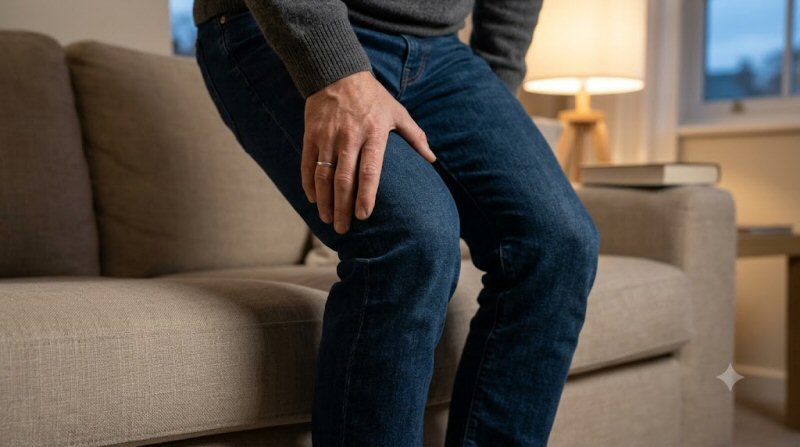
You settle into the theater seat, the lights dim, and two hours later the credits roll. When you finally stand, both knees feel oddly heavy and reluctant—like they need a few careful steps before they remember how to move smoothly. The sensation is familiar enough that orthopedic clinicians have a name for the pattern: the “theater sign” or moviegoer’s knee. For most people it is a short-lived mechanical response to prolonged stillness rather than a sign of damage.
What This Stiffness Feels Like
The classic version is a tight, sticky, or slightly painful sensation right under or around the kneecap the moment you straighten the leg and take weight. Some people describe a brief “locked” feeling or the need to rock the knee a couple of times before the first steps feel normal. The discomfort usually peaks in the first 30–60 seconds of standing and fades as you walk toward the exit. It is often worse if the seats were especially low or if you stayed completely still with knees bent near 90 degrees.
Common Causes
Several ordinary factors stack together during a long movie:
- Synovial-fluid gelling (thixotropy). Joint fluid thickens slightly when the knee is motionless; the first movements thin it again.
- Sustained patellofemoral pressure. Sitting with the knee flexed presses the kneecap firmly against the femur for the entire film.
- Reduced fluid circulation. Cartilage and the joint capsule rely on movement to distribute synovial fluid; stillness slows that pump.
- Mild soft-tissue settling. Muscles, fascia, and the joint capsule simply rest in one position and take a moment to lengthen.
- Low-level fluid pooling. Gravity lets a little extra fluid gather around the joint while the calf-muscle pump is idle.
Any of these can occur in otherwise healthy knees, especially after age 30–40 or after a day that already included a lot of sitting.
Why This Happens
Synovial fluid is thixotropic—its viscosity drops when it is stirred and rises when it sits still. Researchers studying joint lubrication have long noted that undisturbed fluid behaves more like a gel; the first few degrees of motion shear it back into a thinner lubricant. At the same time, the patella is pressed into the trochlear groove of the femur throughout the flexed posture. Studies of patellofemoral contact forces (including work by Powers and colleagues) show that prolonged 90-degree flexion elevates pressure on the cartilage surfaces under the kneecap. When you finally stand, that pressure briefly spikes further as the quadriceps engage to straighten the leg under body weight. The combination of thicker fluid plus sudden load creates the characteristic stiff, sticky feeling that clears once walking restores fluid flow and the kneecap tracks more freely.
Cartilage itself depends on cyclic loading and unloading for nutrition. Hours of static compression reduce that exchange, so the joint surface is temporarily less slippery. Small involuntary shifts or fidgeting help, but a completely still two-hour sit minimizes them. The effect is mechanical and reversible in most cases; it is not the same as inflammatory morning stiffness that lasts an hour or more.
Less Common but Serious Causes
Occasionally the same pattern can signal an underlying issue:
- Early patellofemoral pain syndrome or chondromalacia, where the cartilage under the kneecap is already irritated.
- Mild osteoarthritis, in which roughened cartilage makes the gelling effect more noticeable.
- A symptomatic plica or mild effusion that becomes more obvious after prolonged flexion.
- Less often, meniscal irritation or bursitis that is aggravated by sustained bending.
These usually bring additional clues—swelling that persists, catching or locking, pain that does not ease with walking, or stiffness that is present even after shorter sits.
Hidden Triggers
- Very low theater or airplane seats that force deeper knee flexion.
- Crossing one leg over the other for long stretches.
- Dehydration or a long day of prior sitting (desk, then movie).
- Tight quadriceps, hamstrings, or hip flexors that already limit easy extension.
- Cold theater air, which can make synovial fluid feel thicker still.
- Recent increase in body weight or a sudden return to longer sedentary periods.
When to Worry
Temporary stiffness that loosens within a few minutes of ordinary walking is expected. See a clinician if you notice:
- Swelling, warmth, or redness that lasts beyond the first steps.
- True locking (the knee will not straighten at all) or repeated giving-way.
- Stiffness that persists longer than 30 minutes after you start moving.
- Night pain or stiffness that is worse in the morning and lasts over an hour.
- The same sensation after every short sit, not just long movies.
- Recent injury, fever, or unexplained weight loss accompanying the stiffness.
Myths vs Facts
Myth: Stiffness after a movie means you are developing arthritis.
Fact: Healthy joints also gel after prolonged stillness; arthritis simply makes the sensation more frequent or prolonged.
Myth: You should avoid straightening the knee quickly.
Fact: Gentle, repeated bending and straightening is exactly what restores fluid flow and reduces the sticky feeling.
Myth: Only older adults experience this.
Fact: Anyone who sits motionless with knees flexed for 90-plus minutes can notice it; frequency tends to rise with age or prior joint irritation.
How to Manage It
Before the credits finish, try a few slow ankle circles or gentle knee bends while still seated. When you stand, pause for a moment, rock your weight, and take the first steps more deliberately rather than striding immediately. A short walk around the lobby usually finishes the warm-up.
On ordinary days, break long sits every 30–45 minutes with a brief stand or a few knee extensions. Strengthening the quadriceps and hip muscles (simple sit-to-stands or step-ups) improves the way the kneecap tracks once you do stand. Keeping generally hydrated and avoiding extreme knee flexion for hours at a time also helps. If the pattern is frequent, a light compression sleeve or simply choosing an aisle seat so you can extend the leg occasionally can reduce the intensity.
Related reading on the site includes why knees sometimes crack on standing, why knees still expect regular full extension, and morning knee stiffness.
When to See a Doctor
Book a visit if the stiffness is accompanied by swelling that does not settle, if walking does not relieve it within several minutes, or if the knee feels unstable. A clinician can distinguish simple gelling from patellofemoral irritation, early osteoarthritis, or other mechanical problems with a straightforward exam and, when needed, imaging. Most people never require more than activity adjustments and basic strengthening.
FAQs
Why do my knees feel worse after a movie than after the same amount of desk sitting?
Theater seats are often lower and more confining, locking the knee closer to 90 degrees or beyond with less chance to shift. Desk chairs usually allow small posture changes and easier partial extension.
Does the stiffness mean I should stop going to movies?
No. Occasional long sits are normal. Standing briefly mid-film, choosing an aisle seat, or doing a few seated knee bends before you rise is usually enough to blunt the effect.
Can this turn into lasting knee pain?
In most people it remains a transient sensation. If the same pattern starts appearing after shorter sits or is joined by persistent swelling or pain with stairs, it is worth having checked so any early patellofemoral or cartilage changes can be addressed.
Is it helpful to take an anti-inflammatory before a long movie?
For purely mechanical gelling, movement works better than medication. If you already have known joint irritation, discuss occasional use with your clinician; it is not required for ordinary post-movie stiffness.
Why do the first few steps feel the most unstable?
The quadriceps and surrounding muscles have been quiet; they need a moment to re-engage fully while the joint fluid thins. A deliberate, slightly slower start gives them time to coordinate.
Conclusion
Stiff knees after a long movie are a common, short-lived response to thickened synovial fluid, sustained pressure under the kneecap, and the simple absence of joint motion. The sensation almost always eases once you walk and the fluid thins again. Small habits—occasional seated movement, a deliberate stand-up, and regular lower-body strength—keep the pattern mild. When the stiffness lingers, swells, or appears after ordinary short sits, a clinical check rules out anything that needs more attention. For the typical theater exit shuffle, a few careful steps are usually all the knees require.


