Aches that arrive a day before rain are a real, common pattern. Barometric pressure, synovial fluid and sensitization help explain why some joints forecast the weather.

Plenty of people can tell you a storm is coming before the first drop hits the pavement. The signal is not a radar app. It is a familiar ache in a knee, a knuckle, an old ankle sprain or a previously quiet hip.
That claim has been around for centuries. It is also one of the most studied weather-and-pain questions in rheumatology. The short answer is yes: for many people, joint pain does rise as barometric pressure falls and humidity climbs, often a day before rain. The ache is not magic, and it is not proof that rain itself is leaking into the joint. It is a body reading a change in the air the way it reads a change in load.
What This Symptom Feels Like
The classic pattern is dull, deep and a little late to name.
Typical features:
- The ache starts hours to a day before visible rain, not only while it is pouring.
- It favors joints that already have a history: an old sprain, early osteoarthritis, a repaired meniscus, a stiff finger.
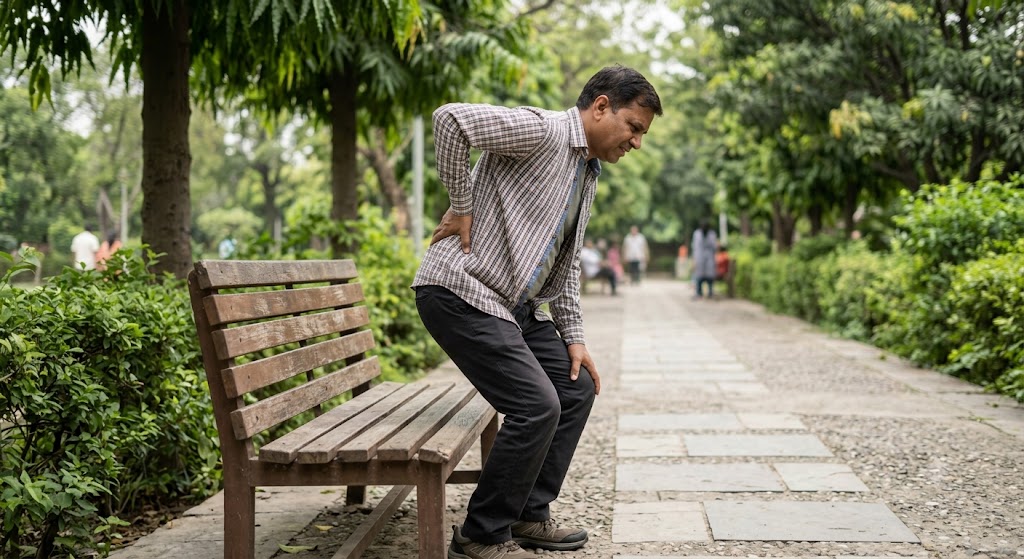
- Knees, hands, hips, ankles and the lower back are the usual reporters.
- Stiffness on first standing can arrive with the ache, then ease after a few minutes of walking.
- The pain is usually bilateral or “the usual spots,” not a brand-new single hot joint.
- Once the front has passed and pressure rises again, the extra ache often fades.
Joseph Hollander and colleagues at the University of Pennsylvania ran some of the early controlled-climate chamber studies on this. People with arthritis living in rooms where pressure, humidity and temperature could be changed independently reported more pain when barometric pressure dropped and humidity rose. The weather outside the building was not required. The air mass around the joint was.
Why a Falling Sky Can Reach a Joint
A synovial joint is a sealed, fluid-filled space. Cartilage, the joint capsule and the small blood vessels around it live in a pressure environment that is not isolated from the atmosphere.
When a low-pressure system approaches:
- External barometric pressure falls.
- Tissue that already holds extra fluid — an inflamed synovium, a slightly swollen capsule, a previously injured ligament — can expand a fraction as the squeeze from the outside air eases.
- That tiny volume change is enough to pull on mechanoreceptors in the capsule and periosteum.
- Cooler, damper air can also stiffen periarticular tissues and change how synovial fluid shears at the start of motion.
Daniel Brennan, David Felson and colleagues, looking at large osteoarthritis cohorts, found that falling barometric pressure and rising humidity tracked with modest but real increases in pain scores. The effect size is not huge for every person on every rainy Tuesday. It is consistent enough, across studies, that “my knee knows the weather” is not folklore.
Humidity and temperature travel with pressure. Cool, damp air slows warm-up, thickens the feel of morning stiffness and makes the first steps after sitting louder. That is why the forecast often arrives with theater-sign stiffness rather than a sharp new injury.
What the Better Studies Actually Show
Results look messy if you only glance at headlines. Some diary studies find a weather link. Some do not. The pattern becomes clearer when you separate groups.
- People with osteoarthritis or a prior joint injury report weather sensitivity more often than people with quiet joints.
- Barometric drop plus humidity rise is a stronger pair than rain itself. Rain is the visible event. The pressure change is the earlier cue.
- Effect sizes are usually small to moderate. A front will not turn a pain-free joint into a surgical emergency. It can nudge a 3/10 baseline to a 5/10.
- Cold alone is not the whole story. Chamber work that held temperature still and dropped pressure still changed symptoms for some participants.
- Expectation matters, but it is not the entire mechanism. People who believe in weather pain do report more of it. Blinded chamber changes still produce reports that line up with pressure, which argues for a tissue component on top of attention.
Geir Smedslund and colleagues, reviewing weather and rheumatic pain, concluded that the association is real for a subset of patients and weak as a universal law. That is the honest medical position: some joints are weather-literate. Not all joints. Not every storm.
Common Causes of Pre-Rain Aches
Most “rain knees” sit in one of these buckets.
Osteoarthritis with a thin cartilage cap. Exposed bone and a thickened synovium feel pressure shifts more than a thick, quiet joint surface. Cyclic compression still feeds cartilage; a front does not replace that need, which is why walking and glide remain the better long-term brief.
An old sprain or surgical scar. Capsule and ligament that healed a little short or a little thick have less slack. A small expansion meets a tighter wall.
Low-grade synovitis. Even without a dramatic flare, extra synovial fluid and vessel leak make the joint a better barometer.
Morning stiffness plus a cold front. Cooler air and a later warm-up stack on the usual overnight gel of unused joints.
Central sensitization. Once a joint has been noisy for months, the spinal cord and brain turn the volume up. A small mechanical change then reads as a larger ache. Weather does not create that gain by itself. It can ride it.
Hidden Triggers That Make the Forecast Louder
The sky is rarely working alone.
- A weekend of extra sitting leaves synovial fluid unstirred, so Monday’s falling pressure meets a colder joint.
- A sudden long walk in new shoes after a quiet week loads an already irritable knee just as the front arrives.
- Poor sleep the night before a storm lowers pain thresholds. Social-schedule nights and late light make this easier than people think.
- Dehydration thickens the feel of stiffness. It does not “dry out” cartilage in one afternoon, but it does change how you rate the first steps.
- A skipped warm-up before a morning commute turns a small weather nudge into a sharp start.
- High-histamine or high-salt meals the evening before can add a little tissue water. Combined with falling pressure, that extra volume is easier to feel.
When the Ache Is Not Just Weather
Most pre-rain joint pain is annoying and reversible. A few patterns are not.
See a clinician promptly if:
- One joint is hot, red, rapidly swollen and you have fever or feel systemically unwell.
- Pain is sudden, after a twist, and the joint will not take weight.
- The ache is new, night-dominant, and paired with unexplained weight loss or night sweats.
- Numbness, foot drop or bowel and bladder change travel with back pain.
- A joint that used to settle after the front now stays locked, catches or gives way.
Weather can amplify a problem. It is a poor explanation for a hot, single, febrile joint.
Myths vs Facts
Myth: Rainwater seeps into the joint and rusts it. Fact: Joints are closed spaces. The relevant change is atmospheric pressure and tissue fluid, not rain crossing skin.
Myth: If weather studies disagree, the whole idea is fake. Fact: Heterogeneous methods, mixed diagnoses and small effect sizes produce mixed papers. Chamber and cohort work still support a pressure-humidity signal in a subset of people.
Myth: Only “old” joints forecast storms. Fact: Age helps because osteoarthritis is more common with years. A twenty-eight-year-old with a reconstructed ACL can be just as weather-sensitive.
Myth: Moving less until the storm passes protects the joint. Fact: Quiet days leave synovial fluid thicker and cartilage underfed. Gentle cyclic motion is usually kinder than a full rest day.
Myth: A barometer-proof life requires moving to a desert. Fact: Stable climates help some people. Load, sleep, warm-up and weight around the joint usually move the score more than a change of latitude.
How to Manage Weather-Sensitive Joints
You cannot hold a high-pressure system in place. You can change how the joint meets it.
Warm the joint before you ask it to work. Five to ten minutes of easy cycling, walking or a warm shower before the commute is not superstition. It shear-thins synovial fluid and raises local blood flow.
Keep a little motion on the day the front arrives. Short walks, sit-to-stands and gentle range beat a cancelled-activity day. Cartilage and the joint lining still eat by compression and glide.
Watch the extras you can control. Sleep timing, a realistic first load of the morning, and shoes you have already broken in matter more on a falling-pressure day than on a quiet high.
Use heat for stiffness and brief cold for a hot flare. Neither changes the weather. Both change nerve firing and muscle guarding.
Keep the joint’s long brief intact. Strength around the knee, hip and ankle, a little extra muscle mass, and a body weight the joint can live with reduce how loudly a 4-millibar drop gets heard.
Track honestly for two or three fronts. A simple note of pain, sleep, first-hour stiffness and whether rain actually followed tells you whether you are in the weather-sensitive subset. If you are not, stop organizing the week around the forecast.
When to See a Doctor
Book a visit if weather pain is new, is climbing month to month, or is starting to cancel walks you used to tolerate. Bring the pattern: which joint, how many hours before rain, what eases it, and whether swelling or locking tags along. That history is more useful than a vague “my joints hate winter.”
A clinician can sort osteoarthritis from inflammatory arthritis, check whether an old injury needs strength rather than rest, and decide if imaging or labs would change the plan. Weather sensitivity by itself is not a diagnosis. It is a clue about a joint that already has less slack.
FAQs
Can healthy joints predict rain? Sometimes a previously injured but “fine” joint will. Completely quiet joints with no history are less likely to be accurate barometers.
Is it the cold or the pressure? Both can contribute. Controlled rooms suggest pressure drop and humidity rise are enough for some people even when temperature is held still. Cold adds stiffness on top.
Why is it worse the day before the storm, not during it? The steepest pressure fall often precedes the rain. Once the front has passed, pressure may already be rising again even while streets are still wet.
Does this mean I have arthritis? Not automatically. Weather sensitivity is more common in osteoarthritis and after injury, but a single rainy-day ache does not make the diagnosis. Persistent activity pain, stiffness after sitting and reduced range matter more.
Will a pressure-stable climate fix it? Some people feel better in drier, more stable air. Many still need the same load, sleep and strength work. Climate is one input, not a cure.
Should I take pain medicine before every forecast? Not as a standing rule. If a documented front reliably ruins a morning, a planned dose you already tolerate can be reasonable. Daily pre-emptive pills for every cloudy icon are not.
Conclusion
Joints that ache before rain are reading a real change in the air. Falling barometric pressure and rising humidity can expand an already crowded capsule by a fraction, tug on sensors and stack on cooler, stiffer tissues. The effect is modest, common in joints with a past, and easy to over-read as destiny.
You do not need to outrun the forecast. Warm the joint, keep it moving, protect sleep and treat the weather as a volume knob on a problem you already know — not as proof that the sky is the enemy of cartilage.