
Your upper trapezius still expects varied overhead reaches and shrugs from ancestral carrying and climbing, yet desk work leaves it in low sustained tension.
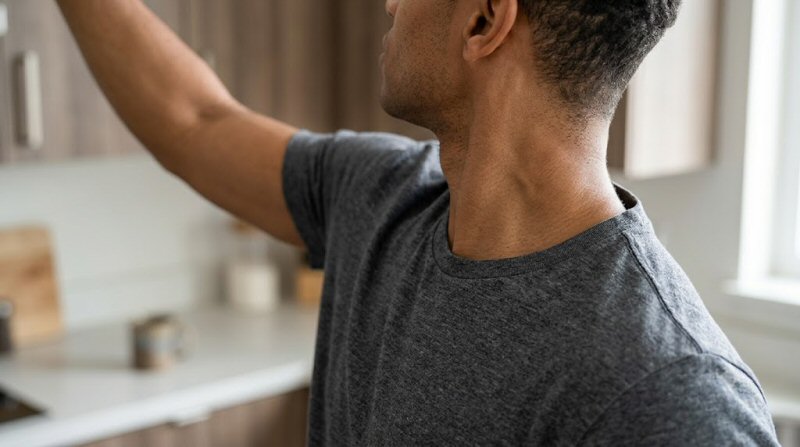
Your shoulders feel tight after a long desk day, and the muscles that run from the base of your neck out to your shoulder tips stay quietly busy even when you are not lifting anything. That low-level tightness is common, and for many people it eases once they stand up, roll their shoulders, or reach for something on a high shelf. The upper trapezius was shaped by a life that mixed steady carrying with frequent overhead reaches, shrugs, and head turns. Modern sitting keeps it in a narrow band of activity instead.
What the Upper Trapezius Actually Does
The trapezius is a large kite-shaped muscle across the upper back. Its upper fibers run from the base of the skull and upper neck down to the outer edge of the collarbone and shoulder blade. These fibers help shrug the shoulders, tilt and turn the head, and stabilize the scapula so the arm can reach overhead or carry a load. They also assist in keeping the head upright against gravity.
Electromyography studies of office workers show that the upper trapezius stays active at very low levels for most of a seated workday—often only a few percent of maximum—yet the activity is sustained with little true rest. Arm movement and posture shifts change that activity, while pure stillness does not. When the muscle is used for brief stronger efforts (a shrug against a backpack strap, a reach to a high shelf, or a head turn while walking), it gets the varied loading its fibers are built for. Long, low, unbroken tension is a different pattern.
Why Desk Life Leaves It Unsatisfied
In ancestral settings the upper trapezius regularly helped stabilize a load on the shoulders, elevated the scapula during climbing or reaching for fruit, and adjusted the shoulder girdle with each stride and glance. Those movements were intermittent: a few seconds of higher effort, then rest or a different angle. The muscle also participated in the natural counter-rotation of the arms and trunk during walking.
Today the same muscle often works for hours in a fixed seated posture with the arms held slightly forward for typing or mousing. The absolute force is small, but the lack of rest periods and the absence of full overhead elevation or strong shrugs leave the fibers in a continuous low-grade state. Researchers studying video-display terminal work (including Mats Hagberg and Gunnevi Sundelin) found that short pauses reduced the static component of upper-trapezius load and lowered discomfort ratings. Later intramuscular recordings by Mikael Forsman and colleagues showed that many of the same motor units stay active across minutes of typing, consistent with the idea of motor-unit overuse during sustained computer tasks.
The mismatch is therefore not that the muscle is never used, but that it is used in a narrow, unchanging way that never quite matches the intermittent overhead and carrying work it still expects.
Common Everyday Triggers
- Prolonged sitting with the head slightly forward or the shoulders rounded while looking at a screen.
- Working with a high monitor or laptop that forces a mild upward tilt of the head for hours (see also why looking up at a high monitor can leave the neck sore).
- Carrying a bag on one shoulder for long periods without switching sides.
- Holding a phone between the ear and shoulder.
- Cold drafts across the neck and shoulders that prompt an unconscious protective shrug.
- Stress that raises baseline muscle tone even when posture is otherwise reasonable.
Any of these can leave the upper trapezius feeling tight by late afternoon. The sensation is usually a dull ache or a sense that the shoulders are “up by the ears,” not sharp pain.
When the Tightness Is More Than a Mismatch
Most desk-related upper-trapezius tension improves with movement, posture changes, and simple breaks. See a clinician if you notice:
- Pain that radiates down the arm or into the hand with numbness or weakness.
- Headaches that start at the base of the skull and are accompanied by dizziness or visual changes.
- Sudden severe pain after a specific injury or fall.
- Persistent night pain that wakes you, or a hard lump in the muscle.
- Symptoms that continue to worsen over weeks despite ordinary movement and rest.
These patterns can point to cervical disc issues, nerve irritation, or other conditions that need proper assessment rather than more stretching alone.
Myths vs Facts
Myth: You should keep your shoulders completely relaxed and down all day.
Fact: A gentle resting position is useful, but the upper trapezius also needs occasional stronger, varied efforts—shrugs, overhead reaches, and head turns—to stay healthy. Total stillness is not the goal.
Myth: Tight upper traps mean you need only deep massage.
Fact: Massage can feel good, but the underlying pattern of sustained low activity is best addressed by changing how the muscle is used across the day. Studies on pauses during computer work showed reduced static load even without hands-on treatment.
Myth: Upper-trapezius tension is only a posture problem.
Fact: Posture matters, yet EMG data also show that stress, arm position, and lack of movement each contribute independently. Addressing only one factor often leaves residual tightness.
Practical Ways to Match What It Expects
You do not need a gym. A few short, deliberate actions throughout the day restore the intermittent pattern the muscle is built for:
- Every 30–45 minutes, stand and perform five slow shoulder shrugs (lift toward the ears, hold one second, lower fully). Then reach both arms overhead as if placing something on a high shelf, hold briefly, and lower.
- While walking between tasks, let the arms swing naturally and glance left and right a few times so the upper trapezius participates in head turning.
- If you carry a bag, switch shoulders frequently or use a backpack that distributes the load; the muscle still “expects” intermittent carrying more than constant one-sided pressure.
- Set the top of your screen at or slightly below eye level so you are not holding a mild upward head tilt for hours. Pair this with the occasional deliberate look up and reach.
- A brief walk after lunch or a set of wall slides (back against a wall, arms sliding upward) gives the scapulae and upper trapezius the elevation and depression they rarely get while seated.
These are the same kinds of intermittent loads that reduced static upper-trapezius activity in workplace studies. Consistency matters more than intensity.
Frequently Asked Questions
Is it normal for the upper trapezius to feel tight after desk work?
Yes. Low but sustained activity is common in seated computer tasks. Most people notice the tightness eases once they stand, shrug, or reach overhead.
Should I stretch it every hour?
Gentle stretches can help, but combining them with active shrugs and overhead reaches is more effective because it restores the varied loading pattern rather than only lengthening a muscle that has been under low tension.
Does stress make upper-trapezius tightness worse?
It can. Emotional stress raises baseline muscle tone, and some studies have looked at heart-rate and trapezius activity together during high- versus low-stress periods. Movement breaks still help even when stress is present.
Can sleeping position affect it?
A pillow that keeps the neck in extreme side-bend or forward flexion can leave the upper fibers feeling stiff in the morning. A neutral head position and a brief set of shrugs after waking usually clears it.
When should I see a professional?
If the tightness is accompanied by arm numbness, weakness, severe headaches, or pain that does not improve with ordinary movement over a couple of weeks, have it checked. Persistent one-sided tension that began after an injury also warrants evaluation.
Bottom Line
Your upper trapezius still expects the intermittent overhead reaches, shrugs, and load adjustments that were routine in a more mobile life. Desk work replaces those with hours of low, unbroken activity. Short, deliberate shrugs and reaches throughout the day, plus ordinary walking and bag-switching, give the muscle the pattern it was built for and usually keep the late-day tightness from settling in. The sensation is common and usually manageable; the rare red-flag symptoms are the ones that need a closer look.


