
The teres major still expects a climbing pull and a suitcase lift. Desk arms leave it quiet, then a reach overhead aches the back of the armpit.
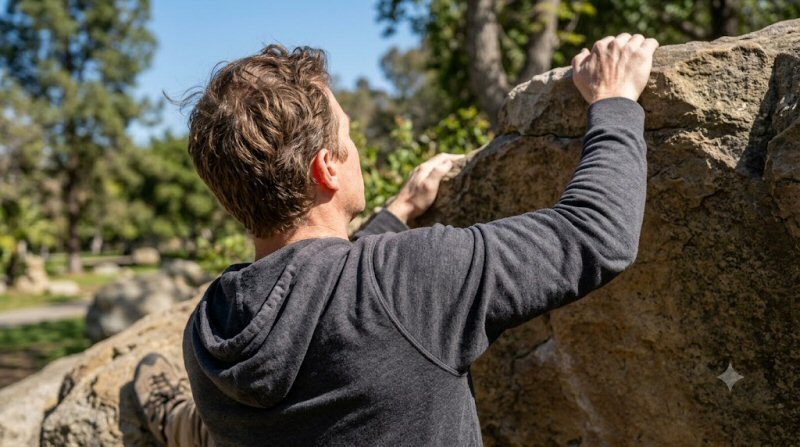
The suitcase clears the overhead bin on the second heave, and the back of the armpit lights up. The same spot complains when you haul a child onto a hip, pull a stuck window down, or reach behind to drag a heavy bag off the rear seat. Typing did not hurt. Scrolling did not hurt. The climb did.
That burn usually sits in the teres major, a thick strap on the lower edge of the shoulder blade that helps pull the arm down and in. It still expects short, loaded reaches: a branch, a ledge, a rope, a load swung from the floor to the shoulder. A day with the arms parked on a desk never asks for that pull. The muscle does not vanish. It just arrives late, and loud, the next time the hand has to drag the body or the body has to drag a weight.
What This Ache Feels Like
The teres major runs from the lower outer corner of the shoulder blade to the front of the upper arm, sharing a neighborhood with the latissimus dorsi in the back wall of the armpit. When it is unhappy, the ache is deep in the posterior armpit, sometimes a little lower along the outer edge of the shoulder blade, sometimes wrapping toward the back of the upper arm. It is not the sharp outer-shoulder pinch of a cuff irritated by a high shelf, and it is not the corded neck-to-shoulder ache of a shrugged trapezius.
People notice it on the way up a steep pull, during the last reps of a row after months away, or the morning after helping someone move a couch. Reaching into the back seat is a classic trigger because the arm is extended, slightly turned in, and then loaded. A swim after a long desk winter can do the same thing on the pull phase of freestyle. Rest usually settles a simple overload in a day or two. The keyboard still feels fine, which is part of why the spot seems to appear from nowhere.
Pain that zings into the pinky after a knock on the inner elbow is the ulnar nerve, not this muscle. A catch at the top of a reach with night pain on the outer shoulder is more often the rotator cuff or the bursa above it. Numbness that spreads down the arm after a long overhead hold can involve the nerves near the armpit, a different problem from a tired strap of muscle. Those patterns are below. A deep pull-ache that tracks the lift and fades with ordinary rest is usually the teres major doing unpaid overtime.
What the Muscle Was Built to Do
The shoulder was not built as a hinge that only lifts a phone. It was built as a reaching, hanging, pulling joint. The teres major is one of the muscles that closes that reach. It extends the arm, pulls it in toward the body, and turns it inward. Anatomy teachers call it the lat’s little helper for a reason: it joins the broad back muscle in the same kind of work, on a shorter line from the bottom corner of the scapula.
Electromyography mapped that job decades ago. John Basmajian’s recordings of shoulder muscles found the teres major recruited when the arm was adducted or extended against resistance, not during quiet posture. Charles Inman, J. B. deC. M. Saunders, and Leroy Abbott, in their classic studies of shoulder mechanics, described the coordinated pull of the axioscapular and scapulohumeral muscles during elevation and the return from a reach. Later sports-medicine work from Frank Jobe’s group, and shoulder EMG studies of swimming and rowing, kept finding the teres major active in the pull phase, when the hand is dragging the body forward or the body is dragging a load back.
The loads ancestral shoulders practiced were intermittent. A climb used the muscle hard for a few seconds, then the arm swung free on the walk between trees or ledges. A carry used it to pin a bundle against the side. A throw used the internal rotators, then the external rotators had to slow the arm down. The infraspinatus still expects that braking job. The teres major expects the opposite half of the day: the pull in, the climb, the loaded reach behind.
You do not need a cliff to meet the original brief. A low branch, a pool edge, a windowsill, a child who wants up — all of them ask the posterior armpit to work. Modern rooms mostly delete the request.
Why Desk Life Deletes the Climb
A keyboard holds the arms forward and slightly turned in, but the load is a few ounces. The shoulder blade sits protracted. The lower corner of the scapula, where the teres major begins, barely moves. Hours of that posture are not a workout. They are a long pause.
The deltoid still expects an arm swing on an ordinary walk. The teres major expects something rarer in an office day: a moment when the hand is above or behind you and the arm has to pull down. Elevators, rolling suitcases, and push-button doors remove even the small versions. When the climb finally happens — overhead bin, attic hatch, first pull-up in a year — the muscle is asked for a force it has not rehearsed.
Two mismatches stack. The first is underuse. A muscle that only works in emergencies fatigues early and soreness arrives the next morning, the same delayed pattern as any untrained eccentric pull. The second is position. Sitting with the arms forward shortens the front of the shoulder and leaves the back of the armpit in a lengthened, quiet state. A sudden reach behind to grab a bag then loads that lengthened muscle at its end range. The ache feels like a pull in the back of the armpit because that is exactly what it is.
The broader latissimus does much of the same climb. If the whole side of the back burns on a pull-up, the lats are still expecting you to pull yourself up, and the teres major is only the local assistant. A spot confined to the posterior armpit, worse when the arm comes down from overhead or reaches into the back seat, points more specifically here.
Less Common but Serious Causes
Most posterior-armpit ache after a new pull is muscle fatigue. A few patterns are not.
A pop during a heavy lift, with immediate weakness and bruising along the side of the back or armpit, can be a latissimus or teres major tendon tear. These are uncommon outside of sudden loaded pulls, water skiing, or a missed catch on a bar, but they do not behave like next-day soreness. Strength drops right away.
Pain with night waking, a painful arc on the outer shoulder, and weakness lifting the arm out to the side is more often the rotator cuff than the teres major. True scapular winging, where the shoulder blade lifts off the rib cage when you push on a wall, points to serratus or trapezius nerve problems, not a simple strap strain.
Numbness or a dead feeling in the outer shoulder after repetitive overhead work can involve the axillary nerve where it passes near the teres major in the quadrilateral space, along with the artery that circles the back of the humerus. That pattern is rare. It is not the ordinary burn of a first climb after a desk month. Fever, redness, or a hot swollen armpit is not a muscle story at all.
Hidden Triggers
A few ordinary habits make the first climb louder than it needs to be.
Phone walks pin one arm still and cancel the small swings that keep the shoulder girdle warm. A cold posterior armpit is a stiff one. The first loaded reach of the day then lands on tissue that has not moved through its range.
One-sided carries matter. A heavy bag on one shoulder shrugs the trapezius and lets the teres major on that side stay quiet, while the other arm never practices a real pull either. The next two-handed lift surprises both.
Sudden volume is the usual culprit: a weekend of swimming, a gym session of rows and pull-downs after a winter of meetings, or helping someone move. The muscle can do the work. It cannot do a month of work on a Saturday.
Sleep position contributes for some people. An arm tucked hard under the pillow, or a side-sleep posture that pins the shoulder forward all night, leaves the posterior armpit tight at dawn. The first overhead reach in the shower is then the complaint, even though the real load was hours of stillness.
When to Worry
Most of this ache is a capacity problem, not an emergency. Seek care sooner if:
- A pop, bruising, or immediate weakness follows a pull or a missed catch.
- You cannot lift the arm out to the side or overhead after the pain starts.
- Night pain wakes you and does not change when you shift position.
- Numbness, a cold hand, or a dead patch on the outer shoulder appears with the ache.
- The armpit is hot, red, or swollen, or you have a fever.
- The same spot keeps returning despite a few weeks of lighter loads and ordinary movement.
A first-day burn after an unusual climb, gone by the third morning, does not need a scan.
Myths vs Facts
Myth: Pain behind the armpit means a rotator cuff tear.
Fact: Cuff pain usually sits on the outer shoulder and complains on the way up. Posterior-armpit pain on the way down, or on a reach behind, is often the teres major or the lat.
Myth: If the desk does not hurt, the shoulder is fine.
Fact: The desk never asks for a climb. Fitness for typing is not fitness for a pull.
Myth: Stretching the chest alone fixes the back of the armpit.
Fact: A tight front of the shoulder is part of the setup. The muscle still needs a few real pulls, not only a doorway stretch.
Myth: You should avoid every overhead reach once it aches.
Fact: Total rest makes the next climb louder. Easier pulls, not zero pulls, are what the muscle was built for.
How to Give It Back a Small Climb
The goal is not a pull-up program on day one. It is to put the original job back in the week in doses the muscle can recognize.
Start with a supported hang or a hands-on-counter lean, feet on the floor, and a gentle pull of the shoulder blades down, as if you were starting to lift yourself and then changed your mind. Five slow breaths is enough. The posterior armpit should feel warm, not sharp.
Add a simple row: a band, a backpack, or a door anchor, pulling the hand toward the lower ribs rather than the neck. That line matches the teres major better than a high face-pull. Two or three short sets, two or three days a week, rebuilds the climb without imitating a move-out day.
Keep one reach behind in the day. Set a bag on a chair behind you and pick it up slowly, or reach to the back seat before the arm is cold. Small rehearsals beat one heroic lift.
Walk with the arms free for a few minutes after long desk blocks. The swing is not a teres major workout, but it stops the shoulder from spending the whole day in one shape. On the day you do have to lift a suitcase overhead, warm the pull first with two easy rows. Cold tissue and a max effort is the combination that writes the next morning’s ache.
If the front of the shoulder is visibly rounded, a brief open-chest stretch after the pulls is reasonable. Do the strength first. A muscle that can climb a few inches complains less when life asks for a few feet.
When to See a Doctor
See a clinician if weakness, bruising, true night pain, numbness, or swelling shows up, or if a simple overload is not clearly improving after two weeks of lighter pulls. Describe the motion that hurts: reach behind, pull down, or lift out to the side. That one detail separates a teres major story from a cuff story faster than a vague note that the shoulder aches.
Urgent care is for a pop with immediate loss of strength, a shoulder that will not move, or an armpit that is hot and swollen. Those are not desk-mismatch problems.
FAQs
Why does the back of my armpit hurt after an overhead bin and not after typing?
Typing never loads the pull. The teres major works when the arm has to come down against resistance. The bin is a small climb. The keyboard is not.
Is this the same as lat pain?
They share the job and the neighborhood. Lat pain tends to spread along the side of the back. Teres major pain stays closer to the posterior armpit and the lower corner of the shoulder blade. A heavy pull can irritate both.
Can sleeping on my arm cause it?
A night with the arm pinned forward can leave the muscle stiff, so the first reach of the morning hurts. The ache that starts only after a new lift is the load, not the pillow.
Should I stop rows if this spot burns?
Stop the set that is sharp. Keep easier pulls in the week. Total rest is how the muscle forgets the climb again.
How is this different from a rotator cuff problem?
Cuff irritation usually pinches on the outer shoulder as the arm lifts. Teres major ache sits in the back of the armpit and prefers the downward pull or the reach behind. Weakness lifting the arm out to the side deserves an exam either way.
Do I need to start climbing to keep it healthy?
No. A few supported hangs, low rows, and the ordinary reaches of carrying and lifting cover the original job. The muscle expects a climb now and then, not a cliff.
Conclusion
The teres major is a small climbing muscle in a life that rarely climbs. It still expects a pull from a branch, a ledge, or a heavy bag, in short bouts with the arm free between them. Desk days delete that request, then an overhead bin or a back-seat reach collects the bill in the posterior armpit. Give it a few easy rows and a supported hang, warm the pull before the heroic lift, and treat a pop, real weakness, or a numb patch as a different story. The ache after a first climb is usually the muscle remembering a job it was built to do.


