
Your outer-hip TFL still expects the sideways stability of ancestral walking on uneven ground. Sitting and flat surfaces leave it tight or under-used.
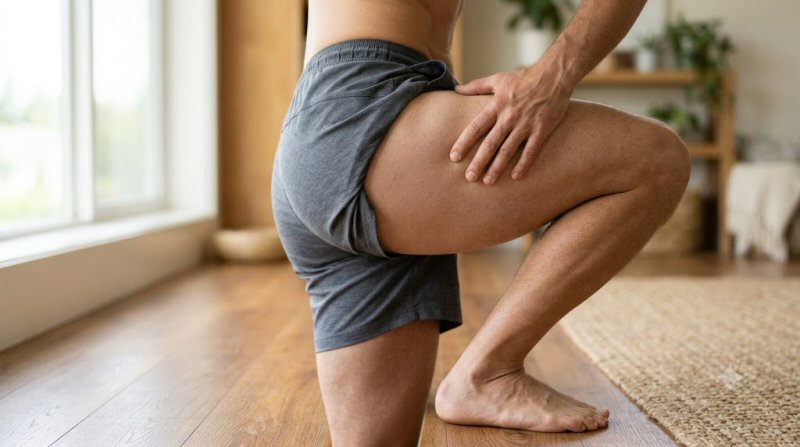
You stand up from your desk, take a few steps across the kitchen, and notice a tight, almost burning band along the outer hip that wasn’t there this morning. Or you try a single-leg balance while brushing your teeth and the same outer thigh clenches harder than it should. That small muscle on the front-outer hip—the tensor fasciae latae, or TFL—is doing extra work because modern life rarely asks it for the sideways stability it still expects.
The TFL is only a few inches long, yet it tenses the long iliotibial band that runs down the outside of the thigh to the knee. When you lift one foot, it helps keep the pelvis from dropping on the opposite side. For most of human history that job happened constantly on trails, hills, and soft ground. Today the ground is flat, the steps are even, and hours are spent sitting with the hip flexed. The muscle that once stabilized sideways balance now sits short or works overtime as a compensator.
What This Feels Like
Most people notice the TFL as a deep ache or tightness just below and in front of the bony point of the outer hip. It can feel like a taut band that doesn’t stretch out with ordinary hamstring or glute stretches. Standing on one leg for more than a few seconds may make the outer hip grip harder. After a long day of sitting, the same area can feel stiff when you first walk. Some people also feel the pull travel down the outside of the thigh toward the knee, especially if the iliotibial band is under extra tension.
The sensation is usually one-sided or stronger on one side, and it tends to ease once you start moving, then return after another long sit. It is rarely sharp or accompanied by swelling; more often it is a persistent, low-grade tightness that makes the hip feel “stuck” in a slightly flexed, inwardly rotated position.
Common Everyday Causes
Prolonged sitting keeps the TFL in a shortened position. When the hip is flexed for hours, the muscle adapts by losing some of its resting length. Flat, predictable surfaces reduce the need for quick sideways adjustments, so the muscle receives less varied loading. Weakness in the larger gluteus medius often forces the smaller TFL to take over pelvic stability, turning a helper muscle into the primary stabilizer. Tight hip flexors from chair sitting further encourage the TFL to stay active. Shoes with thick, rigid soles mute the ground feedback that once told the outer hip exactly when and how hard to stabilize.
These are not dramatic injuries. They are the quiet result of a muscle that evolved for intermittent, multi-directional demands now living in a world of straight-line walking and long sitting.
Why This Happens: The Sideways-Stability Expectation
During single-leg stance—the brief moment in every step when only one foot is on the ground—the pelvis must stay level. Classic electromyographic and biomechanical work by Verne Inman, Emanuel Kaplan, and others showed that the hip abductors, including the TFL, act as a tension band across the outer hip to counter the body’s weight. The TFL also helps with hip flexion and internal rotation, but its most consistent modern complaint comes from its stabilizing role.
Comparative anatomy adds the evolutionary layer. Carolyn Eng and colleagues modeled the human iliotibial band against the chimpanzee fascia lata and found that the human version stores substantially more elastic energy per stride during bipedal walking. The TFL is a key tensioner of that band. Ancestral humans walked on uneven terrain that constantly challenged frontal-plane balance; every side step, rock, or slope required the outer hip to stabilize and adjust. Modern sidewalks and indoor floors rarely demand that same sideways work. The muscle still “expects” the load, yet the stimulus is missing or replaced by static shortening.
When the gluteus medius is under-active, the TFL frequently increases its contribution. Fine-wire EMG studies have shown that people can shift more work onto the TFL during single-leg tasks if the larger abductors are weak. Over months this creates the familiar pattern: a short, sensitive TFL and an under-used glute medius. The same mismatch appears in related articles on why your glute med still expects a single-leg step and why your hips still expect a natural pelvic tilt.
Less Common but Serious Possibilities
True TFL strain or tear is uncommon outside of sudden athletic overload. Persistent outer-hip pain that worsens with weight-bearing or night rest can signal greater trochanteric pain syndrome, in which the TFL and nearby bursae become irritated. Iliotibial band friction at the knee is more often a consequence of proximal tension than a primary TFL problem. Rarely, nerve irritation from the superior gluteal nerve or referred pain from the lumbar spine can mimic outer-hip tightness. These are far less common than simple load mismatch, but they explain why some people do not improve with basic stretching and walking.
Hidden Triggers
Crossing the same leg for long periods shortens the TFL on one side. Sleeping on the side with the top leg dropped forward keeps the muscle under tension overnight. High-heeled shoes shift weight forward and increase the demand for hip-flexor and TFL activity. Sudden increases in hill walking or stair climbing without prior sideways loading can overload an already short muscle. Even subtle pelvic tilt changes from prolonged sitting alter the moment arms so the TFL works harder for the same stability task.
When to Worry
See a clinician if the outer-hip tightness is accompanied by true weakness (difficulty standing on one leg for more than a few seconds), numbness or tingling down the leg, night pain that wakes you, or swelling and warmth. Pain that radiates below the knee, follows a clear dermatomal pattern, or appears after trauma also warrants evaluation. Most desk-related TFL tightness improves with consistent movement and does not require imaging.
Myths vs Facts
Myth: The TFL is just a hip flexor and stretching it alone fixes the problem.
Fact: It contributes to flexion, but its main modern complaint is stabilization and shortening from sitting. Strengthening the gluteus medius and adding sideways movement usually matters more than passive stretch.
Myth: Outer-hip tightness always means the iliotibial band is “tight” and needs aggressive foam rolling.
Fact: The band itself has limited elasticity. Tension often comes from the TFL and glute maximus that feed into it. Rolling may feel temporarily relieving but does not restore the missing sideways load.
Myth: Only runners get TFL problems.
Fact: Long sitting and flat-surface walking are sufficient. Many people who never run develop the same outer-hip grip after years of desk work.
How to Give It the Sideways Work It Expects
Short, frequent doses work better than occasional intense sessions. Stand on one leg for 20–30 seconds while brushing your teeth or waiting for the kettle; let the outer hip work without gripping the toes. Add a few controlled side steps or a slow lateral lunge once or twice a day. Walk on slightly uneven ground (grass, packed dirt, a gentle slope) a few times a week so the foot and outer hip receive the small adjustments they once got constantly. Related guidance appears in the piece on why your ankles still expect uneven ground.
Break sitting every 30–40 minutes with a simple hip-flexor stretch and a few standing hip abductions. Strengthen the gluteus medius with side-lying leg lifts or banded side steps performed slowly; the goal is to let the larger muscle share the load so the TFL can relax. Avoid long periods with one leg crossed. These changes do not require a gym. They simply restore small amounts of the frontal-plane stability the muscle still anticipates.
When to See a Doctor or Physical Therapist
If the tightness persists after two to three weeks of consistent daily movement, or if single-leg balance remains difficult, a physical therapist can assess whether the gluteus medius is under-recruiting and whether pelvic alignment is contributing. Imaging is rarely needed for straightforward load-mismatch tightness. Persistent night pain, progressive weakness, or symptoms that travel into the foot should be checked to rule out other sources.
Frequently Asked Questions
Why does my outer hip feel tighter after sitting all day?
The TFL shortens when the hip stays flexed. Standing and walking after hours of sitting lengthens it under load, producing the familiar tight sensation until the tissue adapts.
Is the TFL the same as the iliotibial band?
No. The TFL is a small muscle that tenses the band. Most of the length you feel along the outer thigh is the band itself, tensioned by the TFL and parts of the gluteus maximus.
Can weak glutes make the TFL tighter?
Yes. When the gluteus medius does not fully stabilize the pelvis, the smaller TFL often increases its activity and stays shortened. Strengthening the larger abductor usually reduces TFL overwork.
Does walking on flat ground make it worse?
Flat, predictable surfaces reduce the small sideways challenges the muscle expects. Adding occasional uneven ground or deliberate side steps restores the missing stimulus without high volume.
How long does it take for the tightness to ease?
Many people notice improvement within one to two weeks of daily single-leg balance and short movement breaks. Full adaptation of resting length and strength usually takes several weeks of consistent practice.
Conclusion
The tensor fasciae latae is a small stabilizer that still expects the frequent sideways balance of ancestral walking. Modern sitting and flat surfaces leave it either shortened or overworked as a compensator. Simple, regular doses of single-leg stance, side steps, and occasional uneven ground give the muscle the load it anticipates and reduce the outer-hip grip so many people feel after a desk day. The change is modest, but it matches the way the tissue was built to work.


