
The splenius still expects a glance over the shoulder while you walk. A still, flexed head leaves it quiet, then a blind-spot check aches the side of the neck.
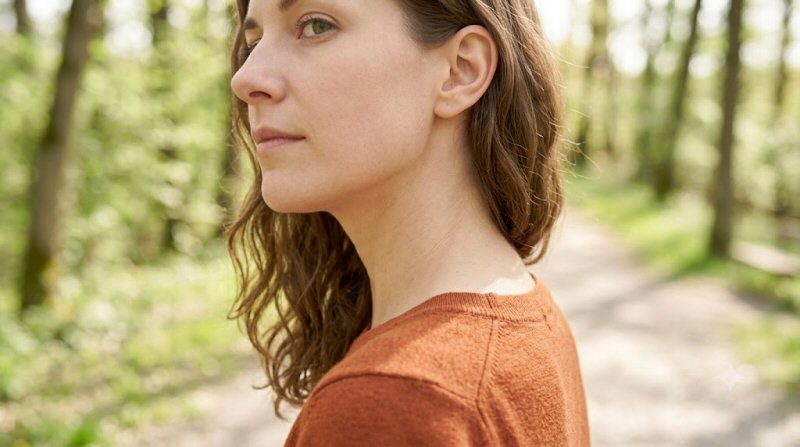
The catch shows up when you look back, not when you sit still. You check a blind spot, turn toward someone calling your name, or twist to see a shelf behind you, and a band along the side of the neck tightens up toward the bone behind the ear. It is often the splenius, a pair of strap muscles that still expect a brief glance behind while the rest of the body is moving. Most modern days never give them one. The head stays pitched toward a screen, the turn gets saved for the car, and the first real rotation of the afternoon feels like a strain.
What This Neck Catch Feels Like
People describe a dull pull from the base of the skull down toward the shoulder-blade corner, worse on one side, especially when they rotate toward that same side. Looking up and back can pinch. A long drive makes the next lane-change check feel rusty. Some notice a tender knot just under the hairline after a day of laptop work, or a headache that starts at the back of the skull and wraps toward the temple. Turning the other way may feel almost normal. The ache eases once you have walked and looked around for a few minutes, then returns after another hour of a fixed head.
A click without pain is common and usually a joint, not the muscle. Pain that shoots into the arm, true weakness, or a turn that is blocked after an accident is a different story.
What the Splenius Was Built to Do
Splenius capitis and splenius cervicis sit just under the trapezius, like bandages wrapped around the deeper neck muscles. Capitis runs from the lower neck and upper back spinous processes up to the mastoid process and the skull behind the ear. Cervicis runs a little lower and attaches to the transverse processes of the upper neck vertebrae. Nikolai Bogduk’s anatomical work on the cervical spine treats them as part of the superficial extensor sheet: together they tip the head back, and one side working alone turns and side-bends the head toward that same shoulder.
Electromyography lined up with that map. K. Takebe, M. Vitti, and John Basmajian recorded splenius capitis firing in extension and in rotation to the same side, not as a constant brace. Later magnetic-resonance work by Michael Conley and colleagues showed splenius capitis among the muscles that work hardest when the head extends against load. Anita Vasavada and colleagues measured moment arms and found these superficial muscles well placed to produce rotation and extension, while deeper muscles fine-tune the segments. The job is a glance, a scan, a turn while walking, not an all-day hold.
Augustus White and Manohar Panjabi mapped how much of head rotation actually lives at the top of the neck, especially between the atlas and axis. The splenius does not create that whole arc alone. It shares the turn with the sternocleidomastoid on the other side, the deeper obliques, and the joints. It still has to be willing to lengthen one way and shorten the other, many times a day, if the glance is going to stay cheap.
The Glance a Walking Day Used to Demand
A day on foot is full of small looks behind and to the side. You check a path, a child, a sound, a branch, the person you are walking with. The head rises toward the horizon, rotates through a useful arc, and comes back. Each glance is brief. The muscle shortens, lengthens, and rests. Load is shared with the rest of the gait, including the shoulder girdle and the eyes, which lead the turn.
That pattern is the one the splenius still expects. It is related to the larger habit described in why your neck still expects a horizon, but the specific missing input here is rotation, not only an upright gaze. A level monitor can still leave the splenius idle if the head never turns.
What a Still Head Does Instead
Desk and phone hours replace the glance with a long, small flexion. Grace Szeto and Leon Straker’s occupational studies of screen work found sustained neck flexion and low-variation postures in people who later reported neck discomfort. The head sits forward. Superficial extensors, including the splenius, often end up in a quiet isometric hold, fighting the weight of the skull rather than turning it. Gwendolen Jull and Deborah Falla showed a related pattern in neck pain: deep cervical flexors lag, and superficial muscles stay over-ready. The splenius is asked to be a guy-wire, not a rotator.
Then the car asks for the ancestral job all at once. A blind-spot check is a fast rotation after an hour of stillness, often with the shoulder belted and the eyes leading late. The same thing happens reaching into the back seat, painting a ceiling corner, or turning in bed after sleeping with the head wrenched to one side. Janet Travell mapped splenius trigger points that refer pain to the vertex and behind the eye, which is why a “sinus” ache sometimes tracks back to the side of the neck after a fixed day.
Neighbors get blamed too. The levator scapulae shares the angle between neck and shoulder, and the sternocleidomastoid is the opposite-side partner in rotation. A rusty glance often lights up more than one of them. The splenius is the one that protests when you turn toward the sore side and tip the chin slightly up.
Less Common but Serious Causes
Most glance-behind aches are muscle and joint stiffness from a still day. A few are not. Cervical disc irritation or a foraminal narrowing can make turning painful and send tingling into the arm. A vertebral artery problem is rare, but a turn that brings spinning, double vision, slurred speech, or a sudden severe headache is an emergency, not a tight muscle. After a fall or a car crash, restricted rotation can be a fracture or ligament injury even if you walked away. Fever, unexplained weight loss, or pain that is worse at night and unrelated to position needs a medical look. So does a turn that was free yesterday and is blocked today after trauma.
Hidden Triggers
Shoulder-belt driving with the head already rotated a few degrees toward the mirror. A monitor off to one side, so one splenius holds a small turn for hours. Stomach sleeping, or a stack of pillows that twists the neck. Cold air on the neck at the start of a walk, which makes the first glances feel sharper. Stress bracing, teeth lightly together, chin poked forward. A new sport that adds head turns, such as cycling with frequent shoulder checks, swimming breathing to one side only, or a weekend of ceiling work. Even a long phone call pinned between ear and shoulder loads the same corner without ever completing a real glance.
When to Worry
Get urgent care if a head turn brings fainting, new severe headache, weakness on one side of the face or body, trouble speaking, double vision, or loss of coordination. See a clinician promptly if arm pain, numbness, or grip weakness travels below the elbow, if you drop things, if walking feels unsteady, or if pain followed a crash or fall. A fever with neck stiffness, or pain that wakes you and is not eased by changing position, also deserves a visit. A sore glance that loosens as you move, stays above the shoulder, and matches a still day is the ordinary pattern.
Myths vs Facts
Myth: A side-of-neck ache when you look back means a disc is out.
Fact: Rotation pain after hours of a fixed head is usually splenius and joint stiffness. Disc pain more often travels into the arm and comes with nerve signs. Bogduk’s clinical writing separates local neck pain from radicular pain for this reason.
Myth: You should crank the neck until it pops.
Fact: Forcing end-range rotation on a cold muscle is how a glance becomes a strain. Range returns faster with small, frequent turns than with one aggressive stretch.
Myth: A perfect chair fixes it.
Fact: An upright seat helps the horizon, but the splenius still needs actual rotation. A still, well-aligned head is only half the input these muscles expect.
Myth: If it hurts to look over the shoulder, you should stop turning that way.
Fact: Avoiding the glance lets the range shrink. Gentle turns through a comfortable arc, repeated through the day, are the usual remedy. Sharp or electric pain is the signal to stop and get checked.
How to Give the Splenius Its Glance Back
Break the fixed head before it becomes a strain. Every half hour, look slowly over each shoulder as if someone called your name, eyes leading, shoulders quiet, five times each side. Add a small chin nod, not a hard tuck, so the deep flexors share the work Jull and Falla emphasized. Raise the screen so the horizon is available, then actually use the turn. On walks, scan the path, the trees, and the person beside you instead of locking the gaze on the pavement.
In the car, check mirrors with a slow turn before you need a fast one, and do not store the phone between ear and shoulder. At night, keep the nose roughly in line with the sternum. If one side is sore, a warm shower on the neck and easy rotations usually beat a deep stretch into the pain. Carry bags in the hand or on both shoulders so one side is not hiked all day. If cycling or swimming always turns you the same way, add glances the other way when you are off the bike or out of the pool.
Strength is optional and simple. Against a hand on the side of the head, gently try to rotate without letting the neck bend, a few seconds, both directions. The point is control through the arc, not a workout. Pain that sharpens, or tingling into the hand, is a stop sign.
When to See a Doctor
Book a routine visit if the glance stays sharp for more than a couple of weeks, if headaches from the back of the skull are new and frequent, or if you have had neck pain with arm symptoms before. A clinician can sort muscle pain from joint, disc, or nerve pain and, if needed, send you to physiotherapy that restores rotation without forcing it. Go sooner for the red flags above. Imaging is rarely the first step for a clear, movement-linked ache with no nerve signs.
FAQs
Why does looking over one shoulder hurt more?
The splenius on the side you turn toward shortens, and the one on the other side lengthens. A day with the monitor or the shoulder belt favoring one direction leaves that pair uneven, so the familiar turn feels fine and the other one catches.
Is this the same as a stiff trapezius?
They overlap. The trapezius is broader and shrugs the shoulder. Splenius pain sits deeper along the side of the neck, up toward the mastoid, and is provoked by turning the head more than by lifting the shoulder. Both can be tender after the same still day.
Can a pillow cause it?
Yes. A very high pillow or stomach sleeping holds rotation for hours. You wake already partway through the glance the muscle expected to do briefly, and the first look behind finishes the strain.
Should I stretch my neck every morning?
Gentle turns are useful. Long, forceful stretches into a sore end-range are not. A minute of easy rotation after you have walked around usually beats a hard pull while you are still cold.
Does this mean I need a standing desk?
Standing helps only if the head actually moves. A standing desk with the same fixed gaze still starves the splenius of rotation. The missing input is the glance, not the brand of desk.
When is a blind-spot ache an emergency?
If the turn brings spinning, a sudden severe headache, vision change, slurred speech, facial droop, or one-sided weakness, treat it as emergency care. Ordinary muscle ache stays local, eases as you move, and does not add those signs.
Conclusion
The splenius is a glance muscle. It still expects short turns toward sounds, paths, and people while the day is spent upright and looking around. Screens and belted seats replace that with a still, slightly flexed head, then ask for the whole rotation at once in the car or the back seat. Most side-of-neck catches after a fixed day are that mismatch, not a ruined disc. Give the muscle small looks behind through the day, keep the horizon available, and let a warm, easy turn replace the crank. A glance that brings nerve signs, trauma, or sudden neurologic symptoms is the one that should not wait.


