
Your skin is an ecosystem tuned for outdoor contact, sweat salts, and weather — not all-day indoor sterility. How the cutaneous microbiome still reads dirt, sebum, and climate, and what happens when soap, climate control, and fabric erase those cues.
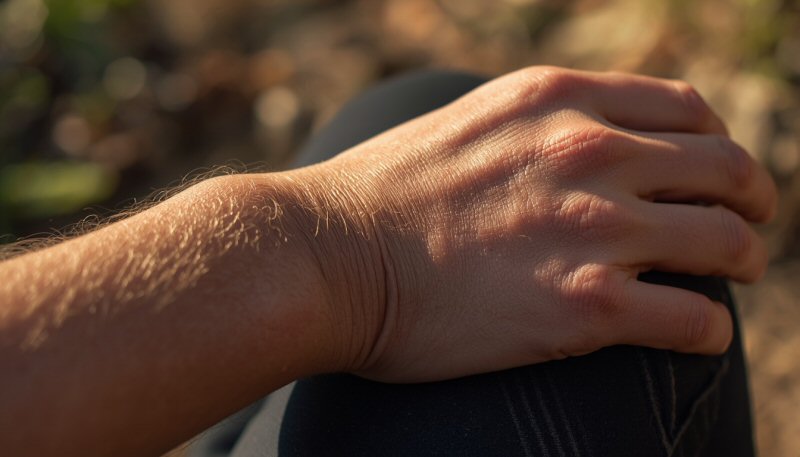
Your skin is not a sterile wrap. It is a living landscape of bacteria, fungi, viruses, and mites, mapped in detail by teams such as Julia Segre and Elizabeth Grice at the U.S. National Institutes of Health. Those residents live in oil, sweat, and the chemistry of the outer dead-cell layer. They were not designed for a life of indoor air, daily detergent, and unbroken fabric. They were designed for dirt on the hands, salt from a long walk, ultraviolet light, and the slow change of weather across a day.
When that briefing disappears, the skin does not become “cleaner” in any simple sense. It becomes quieter in some neighborhoods and noisier in others. Dry patches, flare-prone folds, and a barrier that stings after a shower are often the visible version of an ecosystem that still expects outdoor life.
What This System Was Built to Do
Human skin is an unusual habitat. It is dry compared with the mouth or gut, acidic because of sebum broken down into free fatty acids, and patched with very different climates on a single body. The forehead is oily. The forearm is relatively dry. The crease behind the knee is warm and damp. Segre, Grice, and Heidi Kong showed that those microclimates host distinct communities, as different from one another as soil from a tide pool.
Common residents include Cutibacterium (once called Propionibacterium) in oily sites, Staphylococcus species on drier surfaces, and Malassezia yeasts wherever sebum is plentiful. Richard Gallo’s group at the University of California San Diego showed that some of these neighbors are not passengers. Certain staphylococci make antimicrobial peptides that restrain more aggressive cousins. The skin’s own cells, nudged by the right microbes, make more of their own defenses.
That is a partnership, not a war. Graham Rook’s “old friends” framing, first built around gut and lung immunology, applies here too. Early and ongoing contact with a diverse environmental biota trains the immune cells that live in skin so they do not treat every protein as an invasion. Martin Blaser has argued that modern hygiene, antibiotics, and smaller households thinned that training set. The skin is one of the places you can still see the thinning.
The Cues Skin Still Expects
Outdoor life supplied three briefing systems the cutaneous microbiome still reads.
Dirt and living surfaces. Hands that touch soil, plants, animals, and untreated wood pick up transient environmental species. Most do not colonize. They still matter. They are a daily census the immune system uses to stay calibrated. Maria Gloria Dominguez-Bello’s work on early-life microbial inheritance, and Rob Knight’s mapping of household and outdoor microbial clouds, both point the same way: a life spent only on sealed indoor surfaces is a narrower classroom.
Sweat and salt. Eccrine sweat is mostly water and salt, with a little lactate and urea. It is not waste. It changes local pH, feeds some residents, and flushes others. A body that rarely sweats hard — climate-controlled rooms, short indoor walks, deodorant that blocks the signal rather than just the odor — leaves oily and dry sites in a flatter chemical state than a long warm day would have produced.
Weather. Temperature, humidity, wind, and ultraviolet light change how fast the outer skin sheds, how much sebum flows, and which species can hold a niche. The barrier itself still expects some of that weather, a theme explored in why your skin barrier still expects weather. Indoor air that stays near 22 °C and 30–40% relative humidity is a climate almost no ancestral skin lived in for sixteen waking hours.
Sunlight is part of that weather. Modest daytime ultraviolet exposure changes vitamin D status and local immune tone. The skin still expects some of that outdoor light, as laid out in why your skin still expects the sun. The point is not a burn. The point is that a year spent under LEDs is not a year spent under a sky.
What Changed
Several modern habits stack.
Daily hot showers with detergent surfactants lift lipids the barrier and many commensals need. That is useful after heavy soil or after a workout. It is a different act when it is performed every morning on skin that only sat at a desk. Harsh soaps raise pH; many residents prefer the slightly acidic mantle they help maintain.
Antibacterial washes and leave-on products can thin the very staphylococci that make useful peptides. Gallo’s laboratory has shown how some common ingredients and some pathogen-heavy states go together. Causation is not always one-way, but the pattern is not “more kill equals healthier skin.”
Indoor living cuts the environmental census. Sealed buildings, filtered air, and limited soil contact shrink the list of species a child’s or adult’s skin meets. Rook’s hypothesis and the hygiene-adjacent work that followed it do not say dirt is magic. They say a childhood and adulthood without microbial variety leave immune cells under-educated. Skin is one classroom. The same mismatch shows up in why your immune system is still fighting ghosts.
Clothes change the climate of whole regions of skin. Tight synthetic fabric against the groin, under the breasts, or in shoe boxes creates warm wet niches that favor different yeast and bacterial mixes than open air would have. Occlusion is not evil. All-day occlusion with no recovery window is a new habitat.
Antibiotics, even when needed, do not stay in the gut. They reach skin communities. Repeated courses, especially early in life, are one of the levers Blaser has warned about. The skin often recovers. It does not always recover the same roster.
What Disturbed Neighborhoods Feel Like
A thinned or skewed cutaneous microbiome is not a diagnosis you can see in the mirror with certainty. It is a background that makes several common complaints more likely.
The barrier loses water faster. Skin feels tight after washing, then itchy at night when cortisol is low and attention is high. Folds stay damp and overgrow yeast. Oily sites swing between congestion and irritation. After a course of antibiotics or a week of hotel soap, the face or hands feel unfamiliar for days.
Atopic dermatitis is the clearest clinical window. Lesional skin often carries more Staphylococcus aureus and fewer of the protective coagulase-negative staphylococci. That is not the whole disease — barrier genes, climate, and immune wiring all matter — but it is one reason flares cluster where the neighborhood has already thinned.
Acne is not simply “dirty skin.” Cutibacterium acnes is a normal oily-site resident. Strain-level shifts, excess sebum, and inflammation matter more than a failure to scrub. Over-washing can worsen the barrier around the follicle while the organism remains.
Myths vs Facts
Myth: Healthy skin is nearly sterile.
Fact: Healthy skin is densely occupied. Sterility is a wound-care goal, not a daily-life goal.
Myth: If it foams and kills 99.9% of germs, it is better for the body.
Fact: Those claims are about a laboratory film of microbes on a surface. They are not a map of a living ecosystem you need.
Myth: You should colonize your face with soil on purpose.
Fact: Outdoor time, ordinary contact, and less stripping are the usual briefing. Deliberate application of dirt or untested “probiotic” creams is not the same as living in weather.
Myth: Sweat is dirty and should be immediately erased.
Fact: Fresh sweat is a chemical cue. Odor after hours of bacterial metabolism on stale sweat is a different problem, solved by washing when needed, not by never sweating.
How to Brief the Ecosystem You Still Have
You do not need to recreate a Pleistocene campsite. You need to stop erasing every signal the skin still knows how to read.
Wash for soil and sweat, not for the calendar alone. After heavy dirt, after a hard workout, after a day in public transit crowdedness, soap earns its keep. On a quiet indoor day, lukewarm water and a bland cleanser on the oily and folded sites is often enough. The forearms and shins rarely need daily detergent.
Keep the mantle closer to acid. Most healthy skin sits below pH 6. Alkaline bars push it up. Syndet or mildly acidic cleansers are less disruptive for people whose barrier already stings.
Let weather in on purpose. Short outdoor time with uncovered forearms and face, in actual temperature swings rather than a sealed car-to-office hop, is a climate cue. So is a walk that produces a light sweat. You do not need a marathon. You need a body that sometimes changes state.
Give fabric a recovery window. Breathable cloth, time barefoot on safe indoor floors, and nights without tight waistbands let occluded sites dry and rebalance. Shoes that never dry are a microbial incubator you carry.
Be stingy with antibacterial products. Reserve them for wounds, high-risk care settings, or a clinician’s advice. Hands that just touched soil and then a sandwich still deserve ordinary soap. Hands that only typed do not need a second disinfectant film.
Protect early life without emptying it. Clean water, vaccines, and sewage are among the great health wins of the last century. They are not an argument for raising a child in a wipe-only habitat. Pets, outdoor play, and unpasteurized-looking gardens (the ordinary kind, not a medical prescription) are closer to the census Rook and Dominguez-Bello described.
Repair the barrier while the neighborhood recovers. After over-washing, eczema flares, or winter indoor heat, bland emollients reduce water loss so resident communities can restabilize. Moisturizer is not a microbe. It is housing stock.
When This Is Not Just a Mismatch
See a clinician promptly for spreading redness with fever, rapidly expanding warmth, honey-colored crust in a child that looks like impetigo, a new painful boil pattern, or a rash that blisters or peels. Those are infections and inflammatory diseases, not lifestyle footnotes.
Persistent facial burning after every product, sudden adult-onset severe acne, or eczema that breaks sleep deserve a proper exam. Some of those stories include contact allergy, rosacea, tinea, or immune conditions that will not wait for a walk in the park.
If you are immunocompromised, the calculus changes. Your clinician’s infection-prevention advice outranks any romantic sentence about dirt.
FAQs
Is it bad to shower every day?
Not inherently. Daily showers are a poor match when they are hot, long, and detergent-heavy on skin that was not dirty. Many people do well with a daily rinse of folds and a true wash after sweat or soil. The harm, when it exists, is barrier stripping, not water itself.
Do probiotic soaps or sprays fix a skin microbiome?
Most over-the-counter products have thin evidence. A few prescription and research strains are being studied for atopic skin. Until a specific product is shown to colonize and help in people like you, outdoor variety plus less stripping is the more reliable briefing.
Should I stop using deodorant?
Not automatically. Ordinary antiperspirants change the underarm community; that is measurable and usually local. If odor control matters for your life, use it. If you want less occlusion, you can experiment with milder options on days you will sweat less. Do not treat the underarm as a morality test.
Can I “seed” my skin by touching soil?
Ordinary gardening and outdoor play add transient species. That is different from rubbing compost into broken skin. Wash after heavy soil before you eat. Let contact be part of a day, not a protocol.
Why does my skin feel worse in winter offices?
Low indoor humidity raises water loss. Heating dries the outer layer. You wash the same way you did in humid summer air. The microbiome and the barrier both see a desert they were not briefed for. Humidify the bedroom, shorten hot showers, and moisturize after water.
Does this mean antibiotics damaged my skin forever?
Usually no. Communities often rebound over weeks. Repeated early-life courses and ongoing barrier disease change the odds. If a needed antibiotic is on the table, take it. Support the barrier while you recover.
Conclusion
Your skin still expects a world that leaves traces. Dirt on the hands, salt from effort, light and humidity that move across a day — those were the briefings a cutaneous ecosystem evolved to read. Indoor sterility, daily detergent, and climate control are remarkable comforts. They are also a quieter classroom. You do not have to live outdoors to restore the lesson. You have to stop washing away every signal, and you have to step, sometimes, into weather the skin already knows.