
Your semispinalis capitis is the main muscle that extends the head and holds it upright. Modern screen life rarely asks it for true looking-up work, so it can lose some of the readiness it evolved to keep.
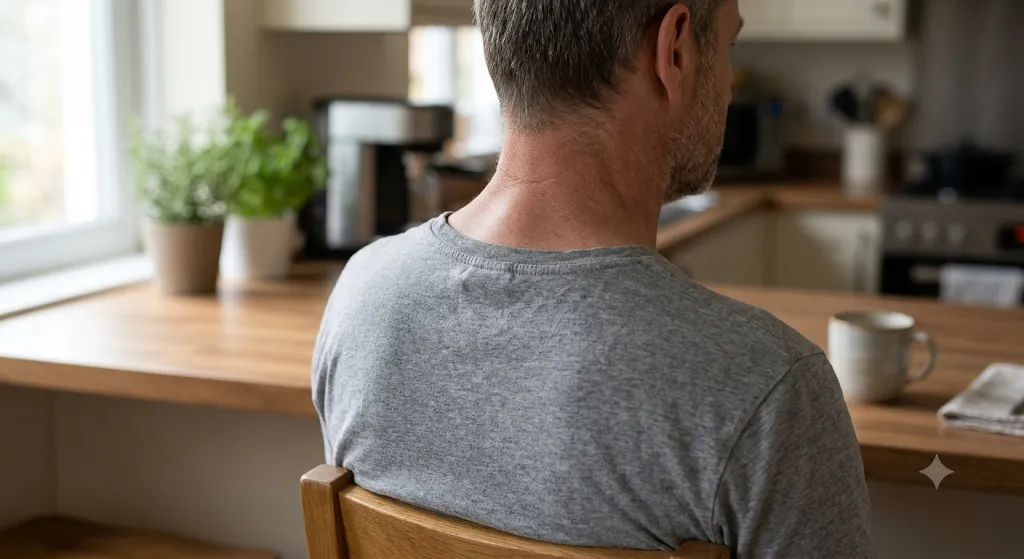
Most of the day the head stays roughly level or tipped slightly forward toward a screen. The thick muscle running up the back of the neck, the semispinalis capitis, still expects occasional moments of true extension—looking up at a shelf, scanning the sky, or simply holding the head fully upright without a forward drift. When those moments disappear, the muscle quietly loses some of the varied work it is built for.
What the Semispinalis Capitis Actually Does
The semispinalis capitis is the largest muscle in the posterior neck. It begins on the transverse processes of the upper thoracic vertebrae and the articular processes of the lower cervical vertebrae, then runs upward to attach between the superior and inferior nuchal lines on the occipital bone. Bilateral contraction extends the head and neck. Unilateral contraction helps with slight contralateral rotation and ipsilateral side-bending.
Electromyography work by Mayoux-Benhamou and colleagues in the late 1990s, using fine-wire electrodes, confirmed that the semispinalis capitis functions primarily as an extensor. It is recruited strongly when the head moves into extension and provides a steady low-level contribution when the head is simply held upright against gravity. The greater occipital nerve pierces the muscle, which is why tightness here can sometimes contribute to posterior head discomfort.
In everyday terms, this is the muscle that keeps the head from falling forward when you sit or stand tall, and the one that powers a genuine look upward. Your deep neck flexors balance it from the front; the semispinalis capitis supplies the counterweight from behind.
Why This Muscle Still Expects Occasional Looking Up
Human necks evolved for a world of varied visual demands. Scanning the horizon, checking overhead branches or rock faces, tracking movement above eye level, and simply holding the head fully upright while walking or standing were ordinary. The semispinalis capitis, working with the splenius and suboccipital muscles, handled both sustained upright support and intermittent full extension.
Modern life compresses those demands. Screens sit at or below eye level. Desks, phones, and steering wheels encourage a mild forward head posture for hours. The upper cervical segments often stay relatively extended while the lower cervical spine flexes, so the semispinalis capitis is asked to hold a lengthened or awkward position rather than move through a full, active range. Ultrasound studies, including work by Goodarzi and colleagues, have shown smaller thickness changes in the semispinalis capitis during maximal extension effort in people with forward head posture, suggesting the muscle is not recruiting as fully as it does in more neutral alignment.
The result is not dramatic weakness for most people. It is a loss of readiness. The muscle remains capable, but the occasional full-extension demand it still expects has become rare. That under-use can leave the posterior neck feeling stiff after long screen sessions or less prepared when you do need to look up.
How the Mismatch Shows Up
Common everyday signs include a sense of tightness or fatigue across the back of the neck after desk work, mild stiffness when you first try to look upward, or a feeling that the head wants to drift forward again as soon as you relax. Some people notice the area more when they stand after hours of sitting. These are usually the quiet effects of prolonged low-level holding rather than acute injury.
The muscle can also become overactive in a compensatory way. When the deep neck flexors are under-used, the posterior extensors sometimes work harder just to keep the eyes level. The combination of under-loaded full extension and over-worked postural holding is a classic modern mismatch. Related muscles such as the splenius capitis, which contributes more to rotation, face a similar shortage of varied head turns.
Less Common but Serious Signs
Most semispinalis-related stiffness is benign. Seek evaluation if you have progressive weakness when trying to extend the neck, pain that radiates into the arm or is accompanied by numbness or tingling, sudden severe headache with neck stiffness, or symptoms after trauma such as a fall or whiplash. Persistent one-sided pain that wakes you at night, or any neurological changes, also warrant a closer look. Everyday under-use does not produce these red flags.
Myths vs Facts
- Myth: A stiff back of the neck always means the muscle is tight and needs aggressive stretching.
Fact: The muscle is often under-recruited for full extension even while it holds a lengthened posture. Gentle active extension and varied movement usually help more than forceful stretching alone. - Myth: Looking up is bad for the neck.
Fact: Occasional, controlled looking up is exactly the demand the semispinalis capitis is built for. Prolonged static forward posture is the larger problem. - Myth: Only the upper trapezius matters for neck tension.
Fact: The deeper semispinalis capitis is a primary extensor and a frequent source of posterior neck fatigue, especially under forward-head conditions.
How to Give It the Work It Expects
You do not need long exercise sessions. Small, regular doses of true extension and upright holding restore the missing variety:
- Several times a day, gently look up toward the ceiling or a high shelf, hold for two or three seconds, then return to neutral. Keep the movement slow and pain-free.
- Practice sitting or standing tall for short periods with the chin slightly tucked and the crown of the head reaching upward. This loads the semispinalis capitis in a more balanced posture rather than a forward drift.
- When you stand up from a desk, take a moment to look around the room at different heights instead of immediately checking a phone.
- Light isometric extension—pressing the back of the head gently into your hands for a few seconds—can remind the muscle of its full role without heavy loading.
These small actions complement the work of the deep neck flexors and give the posterior extensors the intermittent full-range demand they still expect. Most people notice less end-of-day stiffness within a week or two of adding even brief looking-up moments.
When to See a Doctor
See a clinician if posterior neck discomfort lasts more than a week or two despite simple movement, if you have difficulty fully extending the neck, or if pain is accompanied by headache that is new or different, arm symptoms, or dizziness. Sudden onset after trauma, progressive weakness, or any neurological signs need prompt assessment. Ordinary postural under-use is common and manageable; structural or neurological issues benefit from early evaluation.
FAQs
Does the semispinalis capitis weaken just from looking down at screens?
It usually loses some readiness for full extension rather than dramatic strength. The muscle continues to work for postural support, but the varied recruitment pattern it expects becomes less frequent.
Is looking up safe if my neck already feels stiff?
Gentle, pain-free looking up is usually helpful. Start with small ranges and stop if sharpness appears. Persistent stiffness that does not ease with light movement should be checked.
Can tightness in this muscle cause headaches?
Yes, sometimes. Because the greater occipital nerve passes through or near the muscle, sustained tension can contribute to posterior head discomfort. Restoring occasional extension and balanced posture often reduces that contribution.
Will neck extension exercises help if I already have mild forward head posture?
Controlled active extension and upright holds are commonly used to retrain the muscle. They work best alongside habits that reduce prolonged forward drift. If you have significant neck pain, get guidance before adding new loading.
How is this different from the upper trapezius?
The upper trapezius helps with shoulder elevation and some head movement, but the semispinalis capitis is the deeper, more direct head and neck extensor. Both can feel tight, yet they respond to slightly different demands.
Conclusion
Your semispinalis capitis still expects the occasional full look upward and the steady upright hold that once filled ordinary days. Modern screens and forward postures quietly remove most of that variety. Small, regular moments of looking up and sitting tall give the muscle the work it is built for, usually easing the mild stiffness that builds across a screen-heavy day. The mismatch is common, reversible, and worth a few seconds of attention.


