
Your neck was built for frequent side-to-side tilts during walking, scanning, and carrying. Hours of fixed desk posture leave the lateral flexors underused and stiff.
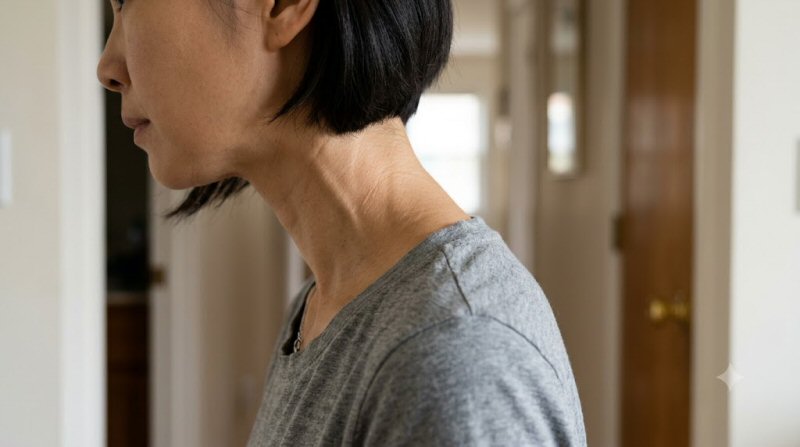
You finish a long stretch of focused work and turn your head to look over your shoulder. The motion feels slightly stiff, as if the side of your neck has been locked in place. A gentle tilt of the ear toward the shoulder brings a mild stretch you didn’t realize you needed. That small side bend used to happen dozens of times a day without thought. Your neck still expects it.
What This Feels Like
Most people notice it after hours at a desk, in a car, or on a phone. The sides of the neck feel tighter than the front or back. Turning your head fully to one side takes a little extra effort. A deliberate side bend—ear toward shoulder—feels both relieving and slightly restricted. The stiffness is usually bilateral but often stronger on the side you favor when you lean or hold a phone. It eases with a few slow movements and returns when you settle back into the same posture.
Why Your Neck Still Expects Occasional Side Bends
The cervical spine is the most mobile region of the vertebral column. It is designed for flexion, extension, rotation, and lateral flexion. Lateral flexion—side bending—lets you tilt your head to track movement, check the ground while walking, or balance a load on one shoulder. In ancestral environments, people walked long distances over uneven terrain, carried infants or tools on one side, scanned for food or threats, and frequently changed head position. Side bends were ordinary parts of those activities.
Modern work largely removes them. Desk screens, phones, and driving seats keep the head in a narrow range of forward or slightly rotated positions for hours. The muscles that produce and control side bending—primarily the scalenes, upper trapezius, levator scapulae, and the deeper intertransversarii—spend most of the day in a shortened or statically held state. Joints that are not regularly moved through their available range lose fluid exchange and become stiffer. The facet joints on the sides of the cervical vertebrae are particularly sensitive to this lack of variety.
Researchers studying cervical kinematics have long noted that sustained postures reduce the natural variability of neck motion. Nikolai Bogduk’s anatomical work on the cervical spine highlighted how the uncinate processes and facet orientation allow controlled lateral flexion while protecting the spinal cord and nerves. When that motion is rare, the surrounding soft tissues adapt by becoming less compliant. The result is the familiar end-of-day stiffness rather than an acute injury.
Common Everyday Triggers
- Long periods of screen work with the head held relatively still
- Driving with limited head turns and almost no side tilts
- Carrying a bag or backpack predominantly on one shoulder
- Phone use that keeps the head tilted slightly forward and to one side
- Sleeping with the neck in a fixed side-bent position
These habits do not damage the neck overnight. They simply remove the frequent, low-load side bends the tissues expect. Related patterns appear in neck stiffness after a long drive and in the broader motion the neck anticipates during ordinary walking.
Less Common but Serious Causes
True restricted side bending that is sudden, one-sided, or accompanied by arm pain, numbness, or dizziness needs medical attention. Cervical disc herniation, facet joint irritation, or, rarely, vascular issues can limit lateral flexion. Most everyday stiffness after desk work is not these conditions. If side bending becomes markedly painful or the range shrinks over weeks without an obvious postural cause, a clinician can check for more specific joint or nerve involvement.
When to Worry
- Side bending triggers sharp pain that radiates into the arm or hand
- You develop weakness, numbness, or tingling that persists
- The stiffness appears with headache, visual changes, or dizziness
- Range of motion keeps decreasing despite gentle movement
- Symptoms follow trauma or appear with fever or unexplained weight loss
For the common, activity-related version, the pattern is clear: better after movement, worse after stillness, no neurological signs.
Myths vs Facts
Myth: Neck stiffness means you need to “crack” it hard or force the range.
Fact: Gentle, repeated side bends restore motion more safely than aggressive manipulation. Forced cracking can irritate already sensitive joints.
Myth: Perfect posture eliminates the need for side bends.
Fact: Even ideal sitting posture becomes problematic when it is held without variation. The neck benefits from changing position more than from any single “correct” angle.
Myth: Side bending is only useful for athletes.
Fact: Everyday tasks—looking under a table, carrying a child on one hip, or scanning a street—use lateral flexion. Removing those movements is the mismatch, not the act of side bending itself.
How to Restore Occasional Side Bends
You do not need a long stretching routine. Small, frequent side bends throughout the day are closer to what the neck expects.
- Every 30–45 minutes, slowly tilt one ear toward the shoulder, hold for a few breaths, then switch sides. Keep the shoulders relaxed.
- While walking, occasionally glance sideways or tilt the head as you check your surroundings.
- Alternate the shoulder you use for a bag, and notice how the neck responds.
- Add a few controlled side bends after long drives or desk blocks, pairing them with gentle rotation.
- Sleep with a pillow that keeps the neck roughly neutral rather than sharply side-bent for hours.
These movements also complement the occasional extension the upper back benefits from, described in related work on thoracic spine extension.
When to See a Doctor
See a clinician if side-bending stiffness is accompanied by progressive neurological symptoms, follows an injury, or fails to improve with ordinary movement over several weeks. Most people simply need to reintroduce the side-to-side motion their neck still expects.
FAQs
Is mild stiffness when I tilt my head to the side normal after desk work?
Yes. Hours without lateral flexion commonly leave the sides of the neck less mobile. Gentle side bends usually restore comfort quickly.
Should side bends feel like a strong stretch?
A mild stretch is normal. Sharp or pinching pain is not. Stay within a comfortable range and move slowly.
Can carrying a bag on one shoulder make one side tighter?
Yes. The elevated shoulder and slight head tilt create an asymmetrical load. Switching sides and adding deliberate side bends on the tighter side helps.
Do I need to stretch my neck every day?
Frequent small movements matter more than a single long session. A few side bends scattered through the day match the original pattern better than one intense stretch.
Will side bends help if my neck also feels stiff when I turn it?
Often yes. Lateral flexion and rotation share some muscles and joint motion. Restoring one usually improves the other.
Is it better to do side bends seated or standing?
Either works. Standing or walking versions add a bit of whole-body context the neck recognizes from earlier patterns of movement.
Conclusion
Your neck still expects the occasional side bend that once came with walking, carrying, and looking around. Fixed modern postures remove those small tilts and leave the sides of the neck stiffer than necessary. Reintroducing a few slow, relaxed side bends during the day restores the motion the cervical joints and muscles were built to use. The change is small, the relief is usually prompt, and the neck treats it as a return to normal rather than a special exercise.


