
Long drives flatten the lumbar curve and keep discs under steady compression. Your spine still expects the short standing breaks that once interrupted every stretch of travel.
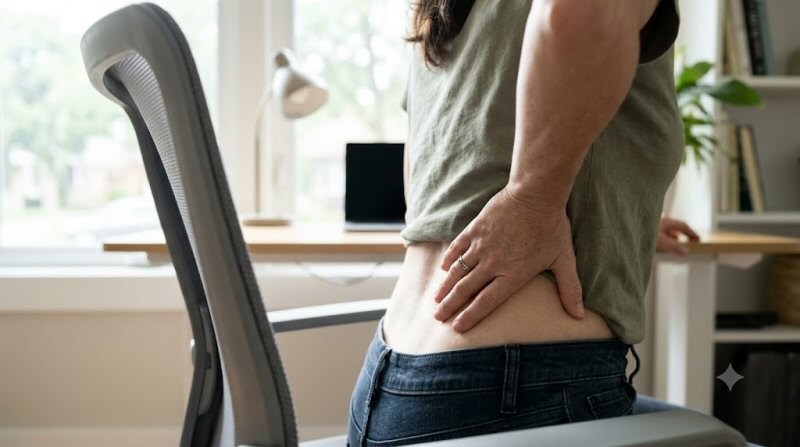
You finish a long drive and the first thing you notice is the dull ache across the small of your back. Standing up feels stiff. The seat that felt fine at the start of the trip now seems to have molded your spine into a shape it does not want to keep. Most people chalk this up to “just sitting too long.” That is true, but the deeper reason is older than car seats.
Your lumbar spine still expects the pattern of movement that shaped it: short periods of sitting or squatting interrupted by standing and walking. Continuous hours in a fixed seat were not part of that pattern. The ache after a long drive is one of the most common everyday signals that the modern version of travel has outrun the tissues that have to absorb it.
What This Ache Actually Feels Like
The typical post-drive lower-back ache is a deep, dull pressure or tightness centered just above the belt line. It may feel worse when you first stand, or when you twist to reach into the back seat. Some people notice it more on one side, or feel a mild pull into the upper glute. The discomfort usually eases once you walk around for a few minutes, though it can linger into the evening if the drive was especially long or the seat offered little support.
It is rarely sharp or electric. True nerve-related pain that shoots down the leg, causes numbness, or makes the foot weak is a different signal and deserves attention. The ordinary version is mechanical: compressed tissues, flattened curves, and muscles that have been held quiet for too long.
Why Sitting in a Car Loads the Lumbar Spine
Classic measurements by Alf Nachemson showed that unsupported sitting raises intradiscal pressure in the lumbar discs compared with standing. Later work by Wilke and colleagues refined the numbers and found that relaxed sitting can sometimes be closer to standing, yet the overall picture remains consistent: prolonged sitting flattens the natural inward curve of the lower back (the lumbar lordosis). Once that curve is lost, the discs and facet joints share load differently. The discs stay under steady compression, which slows the small exchanges of fluid that help nourish them. The facet joints at the back of the spine take more of the load and can become irritated.
A car seat adds its own details. Most seats are shaped like shallow buckets. The pelvis tips backward, the lower back rounds against the seat, and the hip flexors stay shortened. Road vibration adds a low-level constant input that the small stabilizing muscles must manage without rest. Over one or two hours the postural muscles fatigue; over three or four hours the cumulative compression and stillness become noticeable.
Your lower back still expects the interruptions that once came with ordinary travel on foot: brief standing, a few steps, a change in pelvic position. Those short breaks unload the discs, restore a little lordosis, and let the deep stabilizers reset. Without them, the tissues simply accumulate the load.
Common Triggers on Modern Roads
- A seat without usable lumbar support, or one whose support is set too low or too high.
- Sitting nearly upright (close to 90 degrees) instead of reclining the seatback slightly (around 100–110 degrees).
- Reaching for the pedals with the seat set too far back, which pulls the pelvis flatter.
- Hours without a full stop that lets you stand and walk.
- Already tight hip flexors or a habit of sitting in a rounded posture at a desk, so the drive starts from a shortened baseline.
- Carrying a wallet in a back pocket, which adds a small tilt on one side.
These are ordinary conditions, not signs of damage. They simply remove the movement variety the lumbar spine still expects. Related patterns appear in articles on why your lower back still expects a natural curve and why your discs still expect walking and a night unload.
Hidden Factors That Make It Worse
Road vibration is easy to overlook. It is not dramatic, yet it keeps the spinal muscles in a low-level state of readiness. When those muscles fatigue, the passive structures (discs, ligaments, joints) take more of the work. Tight hip flexors from hours of sitting also pull the pelvis forward when you finally stand, which can make the lower back feel as if it is working harder just to stay upright. Dehydration and a full bladder can add their own mild discomfort that gets interpreted as “back pain” until you stop.
People who already have mild disc changes or facet sensitivity notice the effect sooner. The same drive that leaves one person only slightly stiff can leave another feeling quite sore. That difference is usually a matter of baseline tissue tolerance, not a sudden injury.
When to Worry
Most post-drive aches settle with walking and a night’s rest. Seek care if you notice:
- Pain that radiates clearly below the knee, especially with numbness or tingling.
- New weakness in the foot or ankle, or difficulty controlling the bladder or bowel.
- Pain that wakes you at night or is clearly worse when you lie down.
- A history of cancer, unexplained weight loss, or fever alongside the back pain.
- Pain that does not improve after several days of ordinary movement and rest.
These signs are uncommon after a routine drive. They are worth checking because they point to possibilities other than simple mechanical load.
Myths vs Facts
Myth: If the seat feels soft, your back is protected.
Fact: Softness without support often lets the lumbar curve flatten. A firmer contact that preserves the inward curve usually feels better after a few hours.
Myth: Sitting is always worse for discs than standing.
Fact: Nachemson’s early data showed higher pressure in unsupported sitting. Later measurements by Wilke found more nuance, especially with relaxed postures. Continuous sitting without breaks is still the larger problem because it removes movement.
Myth: You should force a perfectly upright 90-degree posture.
Fact: A slight recline (roughly 100–110 degrees) with lumbar support usually reduces peak disc load compared with a rigid upright sit.
Practical Ways to Give the Spine What It Still Expects
Adjust the seat before the drive starts. Recline the back slightly, bring the seat close enough that your knees stay softly bent, and use the built-in lumbar support or a simple rolled towel in the small of the back. The goal is to keep a gentle inward curve rather than letting the lower back round against the seat.
Plan short standing breaks. Every 60–90 minutes, stop long enough to walk for a few minutes. Even five minutes of standing and slow walking unloads the discs and resets the hip flexors. On shorter trips, a brief stop at a rest area or gas station is enough.
Before you leave and when you arrive, spend 30–60 seconds on a simple hip-flexor stretch (kneeling or standing) and a few gentle backward bends or pelvic tilts. These restore the motion the drive removed. If you already sit a lot at a desk, the same habits that help there help in the car: frequent small position changes rather than one perfect posture held for hours.
For the longer picture of how walking and hinge patterns still matter, see why your lower back still expects you to hinge and walk.
When to See a Doctor
See a clinician if the ache keeps returning after ordinary drives, spreads into the leg, or interferes with sleep or daily walking. A physical therapist or physician can check seat setup, hip mobility, and whether any underlying disc or joint sensitivity needs specific guidance. Most people improve with the simple adjustments above; persistent or progressive symptoms deserve a closer look.
FAQs
Is it normal for my lower back to ache after a three-hour drive?
Yes, for many people. Sustained sitting flattens the lumbar curve and keeps the discs under steady compression. The ache usually eases once you stand and walk.
Does a lumbar support cushion actually help?
It helps when it fills the gap and preserves the natural inward curve. A rolled towel works as well as a commercial cushion if it is placed at the right height.
Why does my back feel worse when I first stand up after driving?
Standing reloads the joints and lets compressed tissues move again. That transition can briefly feel more uncomfortable before the stiffness settles.
How often should I stop on a long drive?
Every 60–90 minutes is a practical interval. A few minutes of walking is more useful than simply shifting in the seat.
Can car vibration make back pain worse?
Yes. Low-level vibration keeps stabilizing muscles working without rest. When they fatigue, the discs and joints take more of the load.
Should I see someone if this happens every time I drive?
If it is mild and settles quickly, the seat and break adjustments are usually enough. If it is worsening, spreading, or lasting more than a few days, a professional assessment is reasonable.
Conclusion
Your lower back still expects the short standing and walking breaks that once interrupted every longer stretch of travel. Car seats and continuous driving remove those breaks and flatten the curve the lumbar discs and joints prefer. A slightly reclined seat, simple lumbar support, and planned five-minute walks turn a long drive from a steady compression load into something closer to the varied pattern the spine was built for. The ache after the trip is usually just the tissues reporting that the pattern was missing, not a sign that something is broken.


