
Your iliocostalis muscles evolved for sideways reaches and uneven terrain. Modern sitting leaves them underused—here’s why that shows up as stiffness and what helps.
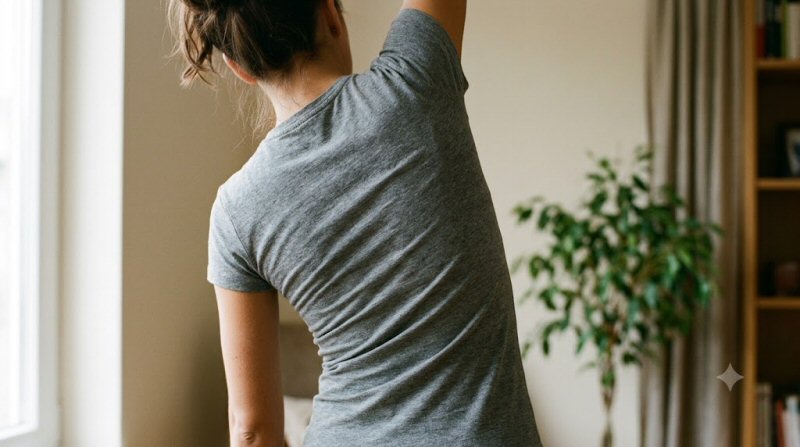
You stand up from your desk, twist to grab a water bottle, and feel a tight band along the side of your lower ribs. Or you reach sideways to pick up a bag and notice the stretch is shorter than it used to be. That band is largely the iliocostalis—the outermost column of the erector spinae—and it was built for frequent side bends, one-sided carries, and the small lateral adjustments that come with walking on uneven ground. Most modern days give it almost none of that.
What the Iliocostalis Actually Does
The iliocostalis is the most lateral of the three erector spinae columns (alongside longissimus and spinalis). It runs from the iliac crest and sacrum up the back, attaching to the angles of the ribs and, higher up, to the transverse processes of the lower cervical vertebrae. It has three overlapping parts: lumborum, thoracis, and cervicis.
When both sides contract together, it helps extend the spine and keeps you upright. When one side contracts, it produces ipsilateral lateral flexion—bending your trunk toward that same side. It also works eccentrically to control the speed of forward and side bends, and it contributes to the fine postural adjustments that keep your center of mass over your base of support. Spinal biomechanics work, including detailed dissections and modeling by researchers such as Nikolai Bogduk, has shown how these lateral fibers give the trunk leverage for side-to-side control that the more medial columns cannot match as effectively.
In short, the muscle is both a powerful side-bender and a quiet stabilizer that expects variety.
Why Ancestral Life Used It Constantly
Human ancestors spent most of their waking hours on their feet, moving across varied terrain. Carrying a child on one hip, lifting a load with one arm, stepping sideways over roots, or simply turning to track something in the periphery all loaded the iliocostalis unilaterally. Even ordinary walking involves small, rhythmic lateral shifts of the trunk; the outer erectors help damp those shifts and return the spine toward midline.
The muscle’s long, branching fiber arrangement (from the ilium out to the ribs) is well suited to this work. It can generate force over a useful range while protecting itself from shear. Occasional deeper side bends—reaching low to one side, hanging from a branch, or bracing against a slope—kept the tissue pliable and the motor patterns practiced. There was almost never a full day spent with the trunk locked in a single sagittal plane.
That pattern is still what the muscle’s architecture and neural control appear calibrated for. Related articles on the site explore similar ideas for the broader erector group and the deeper multifidus: why your erectors still expect an upright day and why your multifidus still expects a walking day.
What Modern Days Do Instead
Most desk, driving, and screen days keep the trunk relatively still and facing forward. The iliocostalis is asked mainly for low-level bilateral postural hold while the lumbar spine sits in a flattened or mildly flexed position. Side-to-side loading becomes rare. When a side reach finally happens—reaching for the seatbelt, twisting to look over the shoulder, or picking something off the floor—the muscle is often stiff, weak in its end range, or both.
One-sided habits amplify the mismatch. Hours spent with a mouse on the right, a bag always on the same shoulder, or a phone held in one hand create chronic low-level asymmetry. The underused side loses easy length; the overused side becomes fatigued or guarded. The result is often a vague tightness along the outer lower ribs or mid-back that people describe as “I just can’t bend that way anymore,” or a sharp catch when they finally do.
The neighboring quadratus lumborum is sometimes blamed for the same region; it also contributes to side bending and is covered in why your quadratus lumborum still expects a side load. The two muscles work together, but the iliocostalis’s longer reach onto the ribs gives it a distinct role in controlling the thoracic cage during lateral motion.
Common Ways This Shows Up
- Stiffness or a tight band along the side of the lower ribs after a long sit.
- Reduced ease when reaching sideways or when twisting to look behind you in the car.
- A catch or ache on one side of the mid- or lower back when you first stand up or when you bend laterally.
- Fatigue in the outer back after carrying something on one side for a while.
- A sense that the trunk feels “locked” in the forward plane and needs a deliberate side stretch to feel free again.
These sensations are usually mechanical and reversible. They are not, by themselves, signs of disc injury or serious structural damage.
Hidden Triggers That Make It Worse
Several everyday factors compound the under-use:
- Prolonged sitting with little variation. Even a good chair still removes the small lateral shifts that walking provides.
- One-sided load carrying. Bags, children, and briefcases repeatedly load one iliocostalis while the other rests.
- Screen and phone posture. Forward head and rounded shoulders alter the resting length of the upper fibers (iliocostalis cervicis and thoracis).
- Sudden unaccustomed side loading. Helping someone move furniture or playing a sport that involves cutting or reaching after weeks of stillness can irritate the muscle.
- Cool muscles and low hydration. Like other postural muscles, the iliocostalis is more prone to stiffness when cold or when overall fluid balance is low.
When to Pay Closer Attention
Most side-band tightness is benign. Seek a clinician if you notice any of the following:
- Pain that radiates down the leg, especially with numbness, tingling, or weakness.
- Pain that is severe, constant, or wakes you at night.
- Loss of bowel or bladder control, or saddle numbness.
- Pain that follows a significant trauma or is accompanied by fever, unexplained weight loss, or a history of cancer.
- Progressive weakness or a clear deformity.
In the absence of those red flags, the pattern is far more often a movement-variety problem than a disease process.
Myths vs Facts
Myth: Side tightness means you need to stretch the iliocostalis aggressively every day.
Fact: Gentle, frequent movement and light loading usually restore ease better than prolonged static stretches. The muscle responds well to being asked to work through its range, not just to be pulled on.
Myth: If it hurts when you side-bend, you should avoid side bending completely.
Fact: Complete avoidance usually increases stiffness. Gradual, pain-free side reaches and controlled lateral tilts help the tissue relearn its job.
Myth: Only the deep multifidus matters for spinal stability; the outer erectors are just movers.
Fact: Both matter. The multifidus provides segmental control; the iliocostalis provides longer-lever lateral stability and extension force. Under-using either shows up in daily movement.
How to Give It What It Still Expects
You do not need a gym program. Small, regular inputs work well:
- Occasional standing side reaches. Every hour or so, stand and reach one arm overhead while gently leaning the opposite way. Switch sides. Five slow repetitions each way is enough.
- Walking with natural arm swing. Arm swing produces mild trunk rotation and lateral shift that loads the outer erectors. Prefer outdoor or hallway walks over treadmill when possible.
- One-sided carries done deliberately. Carry a light bag or grocery on one side for a short distance, then switch. This gives the muscle a clear job and then a rest.
- Seated or standing lateral tilts. While sitting tall, place one hand on the opposite knee or desk and gently tilt the trunk sideways, then return. Keep the movement small and controlled.
- Brief loaded side bends if you already exercise. A light dumbbell side bend or a suitcase carry during a workout restores the pattern the muscle expects. Start light.
The goal is frequency and variety, not intensity. A few seconds of side-bending several times a day usually outperforms one long stretch session at the end of the week.
Frequently Asked Questions
Is it normal for the side of my back to feel tight after a full day at a desk?
Yes. Prolonged stillness removes the small lateral shifts and occasional side reaches the iliocostalis is built for. The tightness is usually reversible with brief movement breaks.
Does side-bending help or hurt if I already have lower-back discomfort?
Gentle, pain-free side reaches often help restore comfort. Sharp or radiating pain with side-bending should be checked by a clinician before you add more of that motion.
Can the iliocostalis cause rib-area pain?
Yes. Because it attaches to the angles of the ribs, irritation or stiffness in the muscle can feel like a band along the lower ribcage, especially on one side. It is distinct from true rib joint problems or intercostal strain, which usually have a clearer traumatic or respiratory trigger.
How is this different from quadratus lumborum tightness?
The quadratus lumborum sits deeper and more anteriorly in the flank and is a strong pure side-bender of the lumbar spine. The iliocostalis is more posterior and spans farther onto the ribs, so it influences both lumbar and thoracic motion. Both can feel tight in the same general region; addressing both with varied movement usually helps.
Will strengthening my core fix this?
General core work helps overall stability, but the specific missing input is lateral and varied loading. Adding occasional side reaches, one-sided carries, and walking usually addresses the iliocostalis more directly than planks alone.
How long does it take for the stiffness to ease?
Many people notice easier side movement within a few days of adding short, frequent side reaches and more walking. Longer-standing stiffness may take two to three weeks of consistent variety.
Conclusion
The iliocostalis is not a muscle that thrives on stillness. Its architecture and control systems still expect the occasional side bend, one-sided load, and small lateral adjustments that came with upright life on varied ground. Modern days of seated work and forward-facing screens quietly remove those inputs, and the muscle answers with stiffness along the outer back and ribs.
The remedy is simple and low-effort: stand and reach sideways a few times an hour, walk with natural arm swing, and deliberately load one side then the other when you carry something. Those small restorations of the pattern the muscle still expects are usually enough to keep the side of your back feeling free and capable.


