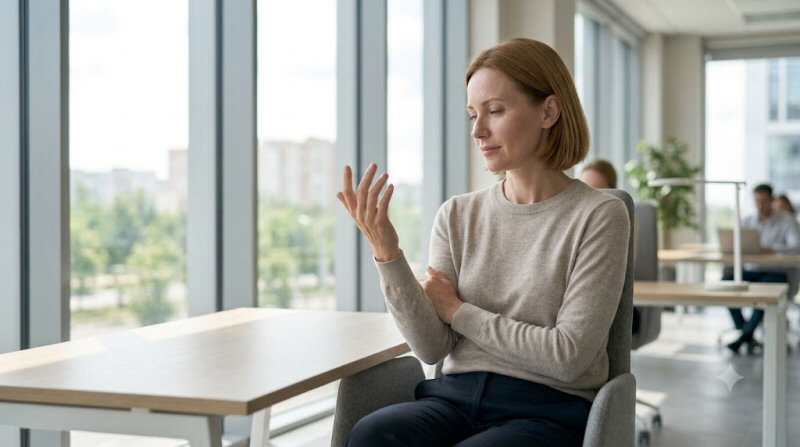
Your deep finger flexors evolved for firm grips on tools, branches, and irregular objects. Keyboard taps and phone swipes leave them underused—here’s what that means and how to give them the occasional load they still expect.
You finish a long stretch of typing or scrolling and notice your fingertips feel a little soft or your grip on a coffee mug feels weaker than it used to. Or you try to open a stubborn jar and the tips of your fingers refuse to curl as firmly as you remember. That quiet change is often the flexor digitorum profundus—the deep muscle that bends the very tips of your fingers—spending most of its day underloaded. It still expects the occasional strong, irregular grip that shaped human hands for tool use and climbing.
What This Muscle Actually Does
The flexor digitorum profundus (FDP) is the only muscle that can flex the distal interphalangeal joints—the last knuckles at the tips of your index, middle, ring, and little fingers. It originates along the ulna and interosseous membrane in the forearm, runs through the carpal tunnel, and inserts on the bases of the distal phalanges. When it contracts, it pulls those fingertip bones toward the palm, producing a deep curl.
Electromyography work by researchers such as John Basmajian showed that the profundus is especially active during power grips and when the fingers must conform to uneven surfaces. It works with the more superficial flexor digitorum superficialis, the lumbricals, and the thumb flexors, but only the profundus can finish the curl at the fingertips. Dual innervation (median nerve for the radial side, ulnar nerve for the ulnar side) lets it fine-tune individual fingers while still generating force across the hand.
Why Modern Life Leaves It Quiet
Keyboards, touchscreens, and light mouse use ask for rapid, low-force taps and swipes. The fingertips rarely wrap fully around a thick, textured object or resist a strong pull. Prolonged sitting with hands resting on a desk further reduces the chance of spontaneous deep curls. Over months and years the muscle and its long tendons receive less of the intermittent loading they were built for. The result can be subtle: a softer pinch, slower recovery after a firm grip, or a sense that the fingers “don’t quite close” the way they once did.
This is not dramatic atrophy. It is the ordinary underuse that appears whenever a capacity is no longer regularly called upon. Related patterns show up in other hand and forearm muscles that also expect occasional heavy or varied loading; see how hands still expect occasional movement to stay warm and how static grips can leave the fingers stiff after long drives.
The Evolutionary Expectation
Human hands retain a combination of forearm and hand muscles found across primates, yet the particular arrangement supports powerful and precise grips. Comparative work by researchers including Rui Diogo and Brian Richmond highlights that the flexor digitorum profundus and its tendons are part of the shared toolkit that later became specialized for tool manufacture and use. Ancestral daily life involved hanging, climbing, carrying irregular loads, shaping stone, and gripping branches or food items that required the fingertips to dig in and hold. Those actions repeatedly loaded the profundus through its full range.
Indoor, screen-based days supply almost none of that stimulus. The muscle does not disappear, but its capacity for strong distal flexion and the glide of its long tendons gradually drift toward the low end of what the body still maintains. Giving it occasional deliberate deep curls is a small way to keep the system within the range it still expects.
Common Everyday Signs
- Fingertips feel soft or less able to “hook” when you try to carry a heavy bag or open a jar.
- A firm grip on a thick object (water bottle, tool handle, railing) feels less automatic after a long desk day.
- Mild stiffness or a sense of reduced range at the last finger joints after hours of light finger work.
- The hand recovers more slowly from a single strong grip than it used to.
These are usually benign adaptations to low demand. They become more noticeable when you suddenly need the old capacity—lifting a suitcase, gardening, or playing with a child.
Less Common but Worth Checking
True weakness that appears suddenly, is limited to one finger or one side of the hand, or comes with numbness, tingling that persists, or visible atrophy is different from ordinary underuse. Anterior interosseous nerve issues can affect the profundus to the index and middle fingers and the flexor pollicis longus, producing a weak “OK” pinch. Jersey-finger injuries (avulsion of the profundus tendon) cause inability to flex the tip of one finger after a sudden pull. Persistent pain, swelling, or loss of motion that does not ease with rest and gentle movement deserves a clinical look.
Myths vs Facts
Myth: Keyboard work is “bad for the hands” in a general sense.
Fact: Light, repetitive finger motion is fine for many muscles; the specific gap is the absence of occasional higher-force, full-range distal flexion.
Myth: You need heavy weights or gym equipment to keep the profundus working.
Fact: Simple, body-weight or everyday-object grips performed a few times a week supply useful loading.
Myth: If the fingertips feel weaker, the problem must be the joints or the nerves.
Fact: In the absence of pain, numbness, or sudden change, simple underuse of the deep flexors is the more common explanation.
How to Give It What It Still Expects
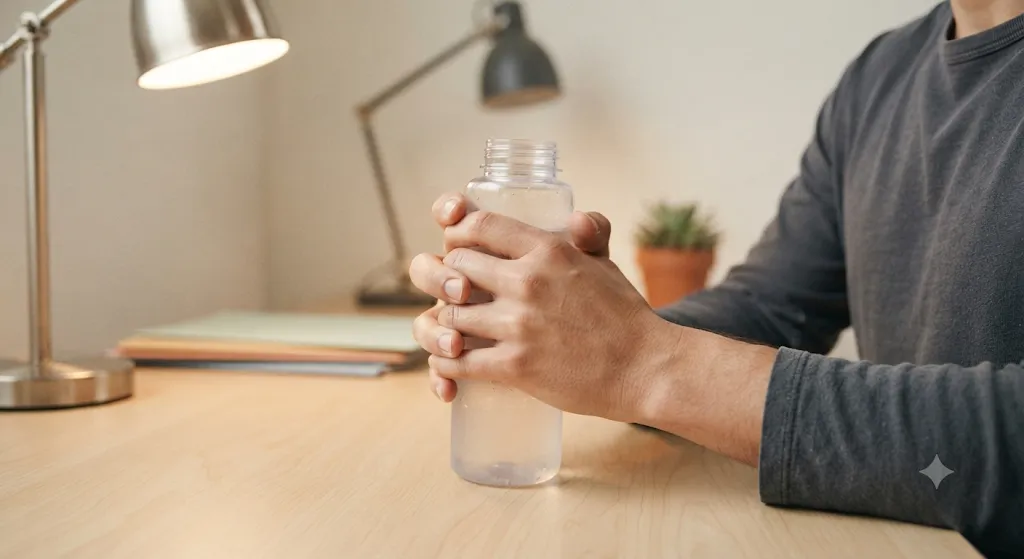
A few deliberate deep finger curls most days is enough. Sit or stand with the wrist in a neutral or slightly extended position. Curl the fingertips firmly into the palm or around a soft ball, thick towel, or water bottle, hold for 5–10 seconds, then slowly open. Repeat 8–12 times. Vary the object: a tennis ball one day, a rolled towel the next, a sturdy mug handle another. The irregular surface and the need to conform the tips are closer to ancestral grips than flat keyboard keys.
You can also hang lightly from a sturdy bar or door frame for a few seconds if it feels comfortable, or simply carry a moderately heavy bag with a full wrap of the fingers rather than a light hook. Keep the volume low—quality of the curl matters more than quantity. If the tendons feel irritable, reduce the hold time and avoid forcing the range.
These small additions sit comfortably alongside other habits that restore variety to the hand, such as occasional side-to-side wrist motion or periods away from continuous light tapping.
When to See a Doctor
Seek assessment if you notice sudden inability to flex one fingertip, progressive weakness that affects daily tasks, persistent numbness or tingling, visible muscle wasting in the forearm or hand, or pain and swelling that does not settle within a few days of rest and gentle movement. Most people with ordinary desk-related underuse improve with the simple loading described above and never need medical care.
FAQs
Is it normal for my fingertips to feel weaker after years of computer work?
Yes. The deep flexors receive far less high-force loading than they did in daily life that involved carrying, climbing, and tool use. The change is usually gradual and reversible with occasional deliberate grips.
Do I need special equipment?
No. A water bottle, rolled towel, soft ball, or even a thick book works. The key is a firm curl that bends the last finger joints and holds for several seconds.
Will this help with carpal tunnel symptoms?
Gentle, non-irritating loading can keep tendons gliding, but it is not a treatment for nerve compression. If you have ongoing numbness or night pain, get that evaluated separately.
How often should I do the curls?
A short set most days is sufficient. Consistency with modest load beats occasional intense sessions.
Can children or older adults do this?
Yes, scaled to comfort. Children usually get plenty of varied grip through play; older adults often benefit from the same simple reminder that the fingertips still expect occasional work.
What if one finger feels different from the others?
The profundus has some independent control, especially for the index finger. Persistent single-finger weakness or inability to curl the tip should be checked.
Conclusion
Your flexor digitorum profundus still carries the expectation of occasional deep, firm finger curls—the kind once required for hanging, carrying, and shaping tools. Modern light finger work does not erase that capacity; it simply stops calling on it. A few seconds of deliberate curling around an ordinary object most days is enough to keep the muscle and its tendons within the range they were built to maintain. The hand does not need a dramatic overhaul. It needs the occasional reminder that the fingertips are still meant to close with force.