
Your fingers naturally rest in a gentle curl because flexor tendons pull harder than extensors. Modern flat keyboards and phones force them straight, creating a small but constant mismatch.
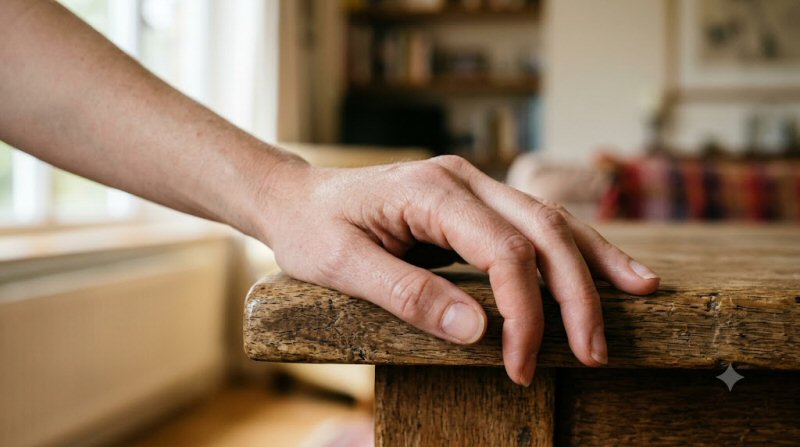
If you let your arm hang completely relaxed at your side, your fingers do not stay perfectly straight. They settle into a soft, gentle curl—almost as if they are resting around an invisible ball. The same thing happens when you sleep or when you stop thinking about your hands entirely. That slight curl is not a sign of tension or poor posture. It is the hand’s true resting position, shaped by the relative strength of the muscles and tendons that move your fingers.
Modern life repeatedly asks those same fingers to do something else. Keyboards, mice, phones, and flat surfaces keep the fingers more extended or flattened for hours at a time. The difference is small, but it is constant, and over a full day it can leave the small muscles on the back of the hand and forearm feeling tired or stiff.
What This Resting Curl Feels Like
When the hand is truly relaxed, the metacarpophalangeal joints (the knuckles) and the proximal interphalangeal joints (the middle joints) sit in mild flexion. The fingertips hover a little closer to the palm than they would if the fingers were fully straight. The thumb also rests with a slight bend rather than fully extended. Most people notice the curl most clearly when they shake out their hands or when they wake up and see their fingers loosely closed.
The amount of curl changes with wrist position. When the palm faces upward and the wrist is flexed, the fingers curl more. When the hand hangs at the side, the curl is milder. Ergonomic researchers who measured resting finger angles, including Kyung-Sun Lee and Myung-Chul Jung, found that the proximal interphalangeal joints often rest around 20–40 degrees of flexion depending on forearm rotation and shoulder position. The wrist itself tends to sit in slight extension—about 10–20 degrees—in the same relaxed state.
Why the Fingers Prefer a Slight Curl
The flexor muscles that bend the fingers (flexor digitorum superficialis and profundus in the forearm) are larger and stronger than the extensor muscles that straighten them. Even when both sets of muscles are quiet, the flexor tendons retain a small amount of passive elastic tension. That tension pulls the fingers toward the palm. The extensors, being weaker and having longer tendons on the back of the hand, do not counterbalance the pull completely. The result is a stable, low-energy resting posture.
This arrangement makes functional sense. A hand that already sits in mild flexion is one step closer to a power grip or a precision pinch. The energy cost of fully straightening the fingers and holding them there is higher than the cost of letting them rest slightly bent. Infants show the same pattern; the grasp reflex and the natural resting posture both favor flexion. Over evolutionary time, hands that could quickly secure a branch, a tool, or a piece of food had an advantage. The slight curl is one of the remaining traces of that history.
The same principle appears in related hand structures. The lumbricals still expect a curled grip because they work most efficiently when the fingers are flexed at the knuckles and extended at the tips. The thumbs still expect to pinch and hang for the same reason: the resting posture sets up the most common ancestral grips rather than a fully open, flat hand.
How Modern Surfaces Change the Resting Position
A standard keyboard or laptop trackpad keeps the fingers relatively straight and the wrists often in slight flexion or neutral. Holding a phone for texting or scrolling frequently extends the fingers or holds them in a static partial extension. Even resting the hand flat on a desk or table takes the fingers out of their preferred mild flexion. These positions are not harmful in short bursts, but they reverse the natural passive tension balance for many hours a day.
The extensor muscles and tendons on the back of the hand and forearm must work a little harder to maintain the straighter posture. Over time this can contribute to a sense of fatigue across the back of the hand, tightness in the finger extensors, or a vague ache that eases when the hand is allowed to curl again. People who already spend long periods writing or typing sometimes notice the same pattern; the cramp that appears during writing is often a sign that the small muscles are being asked to hold an extended position longer than they prefer.
Sleeping with the hands under the pillow or with the fingers tightly closed can exaggerate the natural curl and leave the extensors feeling stiff in the morning. Conversely, sleeping with the hands open and flat can leave the flexors feeling shortened. Neither extreme matches the mild resting curl the hand settles into when left alone.
When the Curl Becomes a Problem
A mild resting curl is normal and does not need correction. What is less normal is pain, progressive stiffness, or a loss of the ability to fully straighten or fully curl the fingers. Persistent morning stiffness that lasts more than 30–60 minutes, locking or catching of a finger, visible swelling at the joints, or weakness that makes it hard to open a jar or button a shirt should be evaluated. These signs can point toward tendon sheath inflammation, early arthritis, or, less often, a neurological issue affecting the median or ulnar nerve.
Numbness or tingling that travels into specific fingers, especially if it wakes you at night, is also worth checking. The resting curl itself does not cause nerve compression, but prolonged positions that combine wrist flexion with finger extension can increase pressure inside the carpal tunnel.
Myths vs Facts
Myth: Straight fingers are the anatomically neutral position.
Fact: Mild flexion is the low-energy resting posture. Fully straight fingers require active extensor work.
Myth: You should force your fingers straight to “stretch” them all day.
Fact: Occasional full extension is fine, but holding the fingers straight for hours increases load on the extensors without giving the flexors their preferred passive rest.
Myth: A resting curl means you are tense or gripping unconsciously.
Fact: The curl appears most clearly when the muscles are relaxed. True tension usually produces a tighter fist or a rigid extension.
How to Give the Fingers Their Preferred Rest
Small changes reduce the mismatch without requiring a full equipment overhaul.
- Let the hands hang or rest in the lap with the fingers naturally curled for a minute or two every hour.
- When typing, keep the wrists in slight extension and allow the fingers to stay lightly curved rather than pressing them flat against the keys. A low-profile or split keyboard often makes this easier.
- Alternate between a mouse and a trackpad, or use a vertical mouse that keeps the forearm in a more neutral rotation.
- For phone use, switch hands and take the device off the fingers periodically so they can curl again.
- A soft stress ball or a gentle fist-and-release sequence (close the hand softly, then open it fully, 10–15 times) restores the full range without forcing either extreme.
- At night, avoid pinning the hands under the head or under a pillow in extreme flexion or extension. A loose, neutral wrist position usually feels best.
These adjustments do not eliminate the modern demand for extended finger positions, but they give the passive flexor tension regular opportunities to reassert itself.
When to See a Doctor
See a clinician if finger stiffness lasts more than an hour each morning, if a finger locks or catches, if you develop progressive weakness or visible joint changes, or if numbness and tingling become constant. Most resting-curl discomfort improves with position changes and breaks. Persistent or worsening symptoms deserve a proper examination so that tendon, joint, or nerve problems can be addressed early.
FAQs
Is it bad that my fingers curl when I sleep?
No. The curl is the expected resting posture once muscle activity drops. Extreme tightness or pain on waking is more likely related to position or underlying joint issues than to the curl itself.
Should I try to keep my fingers straight while typing?
A light natural curve is usually more comfortable than forcing the fingers perfectly straight. The goal is to avoid both a rigid flat hand and a tight fist.
Why do my fingers feel stiffer in the morning?
Overnight stillness plus the natural flexor pull can leave the joints and tendons temporarily less mobile. Gentle movement usually restores the range within minutes. Prolonged stiffness needs evaluation.
Can phone use permanently change finger posture?
Long hours of static extension can increase extensor fatigue and contribute to tightness, but the underlying passive tendon balance remains. Regular breaks and varied grips prevent most cumulative strain.
Does the resting curl differ between people?
Yes. Wrist position, forearm rotation, hand size, and even the relative length of the flexor tendons produce small individual differences. The general pattern of mild flexion is consistent across healthy hands.
Will stretching the fingers straight every day help?
Occasional full extension maintains range of motion and is useful. Holding the stretch for long periods or forcing the fingers straight while working is less helpful than allowing the natural curl to return regularly.
The slight curl your fingers prefer is not a flaw to be corrected. It is the low-energy position the hand returns to when it is allowed to rest. Modern tools ask for more extension than ancestral life required, but the underlying anatomy has not changed. Giving the fingers brief, regular opportunities to settle back into that gentle curve reduces the small daily mismatch and keeps the hand more comfortable for the work it still has to do.


