Your eyes evolved for mostly distant outdoor vision with only brief near tasks. Prolonged screen focus strains the focusing muscles and contributes to modern visual fatigue.
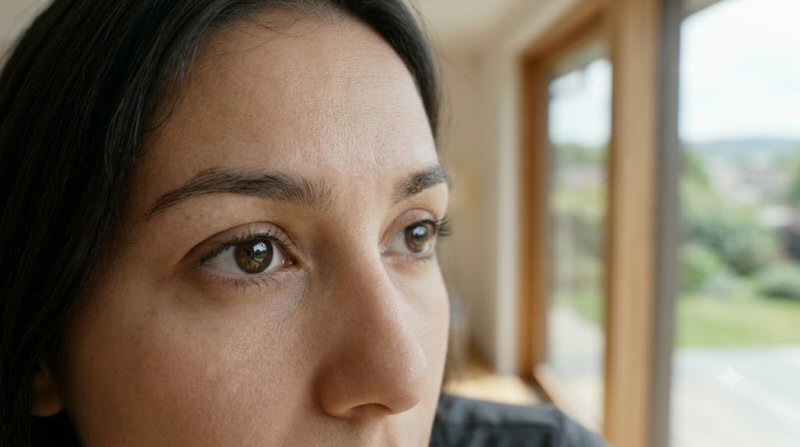
After a few hours of reading or scrolling, many people notice their eyes feel heavy, the words blur slightly, or they need to look out a window just to feel relief. This is not a design flaw. Human eyes spent most of their evolutionary history focused on distant scenes—horizon, sky, moving animals, and open landscapes—with only short bursts of close work for tasks like inspecting food or tools. Modern life reverses that pattern, keeping the focusing system locked on near targets for hours at a time.
What Distant Focus Feels Like in Practice
When you look far away, the ciliary muscle inside the eye relaxes. The crystalline lens flattens, and light focuses cleanly on the retina with little effort. Near work does the opposite: the muscle contracts, the lens thickens, and the system stays under continuous load. After prolonged near focus, people commonly describe a mild ache behind the eyes, temporary blur when glancing up, or a sense that the eyes simply want to rest. These sensations usually ease within minutes of looking into the distance.
Why the Visual System Expects Distance
For most of human history, daily life happened outdoors. Hunting, gathering, walking, and scanning the environment required sharp distance vision far more often than fine near work. The focusing apparatus (accommodation) developed to handle frequent shifts between far and near, but with far as the resting state. Studies of traditional societies with low rates of myopia show that children spend many hours outdoors looking at distant objects, and their eyes remain more stable in shape. Researchers such as Ian Morgan and others have documented how reduced outdoor time and increased near work correlate with rising myopia rates in modern populations.
The ciliary muscle was not built for sustained contraction. Like any muscle held in one position too long, it fatigues. When you finally look up from a screen, the muscle may take a moment to release fully, producing that brief blurry transition. This is a normal short-term response, not a sign of damage.
Common Triggers in Modern Life
Screens, books, phones, and detailed craft work all keep the eyes in near focus. Poor lighting forces the system to work harder. Small text or low contrast increases demand. Holding devices close—especially phones—amplifies the effort because the required focusing power rises as the object moves nearer. Many people also blink less while concentrating, which dries the tear film and adds surface irritation on top of focusing strain. Related patterns appear in dry eyes after screen time and in how the tear film still expects a full blink.
Less Common but Worth Noticing
Persistent blur that does not clear after looking far away, double vision, or pain that radiates into the head can point to uncorrected refractive error, convergence issues, or other eye conditions. Sudden changes in vision always deserve prompt evaluation. For most healthy adults, however, the heavy, tired feeling after desk work is simply the focusing muscle asking for its evolutionary rest state.
Hidden Contributors
Air conditioning and heating reduce humidity, so the tear film evaporates faster during long near tasks. Stress tightens muscles around the eyes and brow, adding tension. Late-night screen use combines focusing demand with circadian disruption. Even the posture of leaning forward shortens the viewing distance and increases the load. The meibomian glands that coat the tear film also function best with complete blinks, which become rarer during concentrated near work.
When to Worry
See an eye care professional if blur lasts more than a few minutes after looking away, if you develop frequent headaches tied only to near work, if one eye feels markedly different, or if vision changes suddenly. Children who hold books very close or squint at distant objects may be developing myopia and benefit from earlier assessment. Ordinary end-of-day eye fatigue that resolves with distance viewing is common and usually benign.
Myths vs Facts
Myth: Looking at screens permanently damages the focusing muscle.
Fact: The muscle recovers with rest and distance viewing; the larger concern with excessive near work is progressive myopia in younger eyes, not permanent ciliary damage in adults.
Myth: Blue light is the main reason eyes feel tired.
Fact: Focusing effort, reduced blink rate, and dry air explain most of the sensation. Blue light can affect sleep timing, but it is not the primary driver of daytime eye strain.
Myth: You should never look at screens.
Fact: Brief, well-lit near tasks are fine. The mismatch is continuous hours without distance breaks.
How to Give Your Eyes the Distance They Expect
Follow the 20-20-20 guideline: every 20 minutes, look at something at least 20 feet away for 20 seconds. This lets the ciliary muscle relax fully. Position screens at arm’s length rather than close to the face. Increase ambient lighting so the eyes do not strain to resolve detail. Take short outdoor walks; even a few minutes of horizon viewing resets the system more effectively than indoor rest. Consciously blink fully a few times during breaks to refresh the tear film.
If you wear glasses, an accurate prescription reduces unnecessary effort. Some people find that computer-specific lenses or slight plus-power readers ease prolonged near work, but only after an eye exam confirms the need.
When to See a Doctor
Schedule an eye exam if symptoms persist despite regular distance breaks, if you notice progressive blur at distance, or if headaches and eye strain interfere with daily tasks. Early myopia management in children and accurate correction in adults both reduce long-term strain.
FAQs
Why do my eyes blur for a few seconds when I look up from my phone?
The ciliary muscle has been contracted for near focus and needs a moment to relax so the lens can flatten for distance. The blur is usually brief and clears on its own.
Does looking far away actually prevent myopia?
Outdoor time and distance viewing are associated with slower myopia progression in children, according to large population studies. They do not reverse existing myopia in adults but can reduce daily strain.
Is eye strain from screens the same as dry eye?
They often occur together. Focusing fatigue is muscular; dryness comes from reduced blinking and evaporative tear loss. Addressing both—distance breaks plus conscious blinking—helps most people.
Can I train my eyes to handle more near work?
The focusing system can adapt somewhat, but prolonged continuous contraction still produces fatigue. Regular distance viewing remains the most effective relief.
Should children avoid screens completely?
Balanced use with plenty of outdoor time appears more protective than total avoidance. The key factors linked to myopia are total near work duration and limited time spent looking far outdoors.
Conclusion
Your eyes still expect the visual world they were shaped for: mostly distant scenes with only occasional close inspection. Giving them regular opportunities to rest at the horizon is a simple way to match that expectation and reduce everyday strain. Most of the heaviness people feel after screen time is the focusing system asking for the distance it was built to prefer.