
Your elbows evolved for hanging, full extension, and carrying loads, not constant bent desk postures. Learn the mismatch and simple ways to restore what they expect.
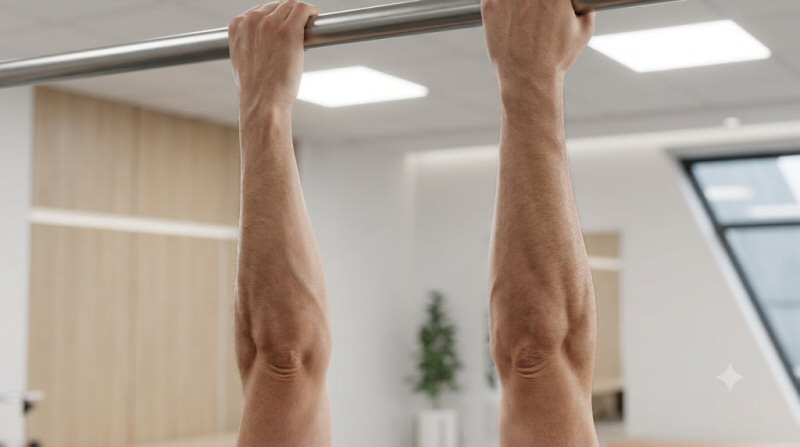
Your elbows spend most of the day bent at roughly 90 degrees while you type, drive, or scroll. They rarely reach full straightening under load, and they almost never hang from anything. That quiet under-use is not what the joint was shaped for. The elbow is a remarkably capable hinge that once regularly managed full extension while supporting body weight or carrying objects at your side. When modern life removes those demands, the tendons, ligaments, and stabilizing muscles lose the varied loading they still expect.
What This Expectation Looks Like in Daily Life
You notice it as a vague stiffness when you finally straighten your arms fully, a mild ache on the outer elbow after a long desk day, or a sense that your arms feel “heavy” when you try to hang from a bar or carry a heavy bag for more than a few minutes. Some people feel a click or slight catch near full extension. Others simply find that their elbows prefer to stay slightly bent and protest when asked to lock out under even modest load. These are common signals that the joint has adapted to a narrow range of bent, unloaded postures.
Why Evolution Shaped the Elbow for Hanging and Full Extension
Work by anthropologist Nathaniel Dominy and colleagues at Dartmouth has shown that the flexible shoulders and elbows of apes (and later humans) likely evolved in large part to help heavier primates climb down trees safely. Coming down is mechanically harder than climbing up; you must decelerate while gravity pulls. Apes extend their arms farther and use greater elbow angles during descent so their feet can act as brakes. That same capacity for full extension and load-bearing later helped early humans gather food, carry tools, and hang while moving through varied terrain.
Classic electromyography studies by John Basmajian mapped the muscles that make this possible. The brachialis acts as the reliable workhorse of elbow flexion under almost all conditions, while the biceps and brachioradialis join when load or speed increases. Near full extension the joint relies more on bony congruence and the capsule for stability, as detailed in biomechanical work by Bernard Morrey and others. The elbow therefore expects occasional moments of full or near-full extension under compression or tension—exactly the loads created by hanging, carrying a weight at your side, or pushing off the ground. Constant mid-range flexion without those end-range loads leaves the stabilizing structures under-stimulated.
Common Modern Mismatches
Most people now keep their elbows flexed for hours at keyboards, phones, and steering wheels. The forearm rests on a desk or armrest, so the joint rarely experiences the compressive load of hanging or the tensile load of carrying. When extension does happen, it is usually unloaded and brief. Related structures feel the same mismatch: the biceps still expect occasional hanging, the brachioradialis still expects a carry, and the scapulae still expect you to hang. The whole upper-limb chain is under-loaded at the positions it was built to manage.
Tennis elbow and similar overuse problems can still appear, but they often start from repetitive loaded flexion or gripping rather than from pure under-use. The deeper issue for many people is simply that the elbow’s full mechanical repertoire—full extension under load, hanging, and varied carrying angles—has largely disappeared from daily life.
When the Elbow Starts to Complain
Mild stiffness after long sitting, a dull ache on the outer or inner elbow that settles with movement, or a sense of weakness when you try to hang or carry are usually the joint asking for the loads it expects. These tend to improve with gradual reintroduction of full-range work. More concerning signs include sharp pain with specific movements, swelling, locking that does not release, numbness or tingling that travels down the forearm, or pain that wakes you at night and does not ease with position change. Those warrant professional assessment rather than simple loading experiments.
How to Give Your Elbows What They Still Expect
You do not need hours of hanging. A few short, deliberate exposures each day restore the missing stimulus:
- Hang lightly from a sturdy bar, door frame, or low branch for 10–20 seconds several times. Keep the shoulders relaxed and let the elbows approach full extension. Start with feet still touching the ground if needed.
- Carry a moderately heavy bag or backpack for a few minutes with the arm straight at your side rather than bent. Alternate sides.
- Include full elbow extension in warm-ups—straighten the arms overhead or out to the sides while holding a light object, or push lightly off a wall or the floor.
- Avoid locking the elbows hard under heavy load if you have any history of instability; the goal is controlled end-range contact, not aggressive hyperextension.
Pair these with the varied forearm rotation and grip your elbows also expect. Consistency matters more than intensity. Most people notice less stiffness within one to two weeks of daily short exposures.
Myths vs Facts
Myth: Elbows should never fully straighten because it is “bad for the joint.”
Fact: Full extension is a normal part of the elbow’s range and is important for bony stability and load sharing. Gentle, controlled full extension under modest load is what the joint expects.
Myth: Any elbow ache means you need rest and stretching only.
Fact: Many mild aches improve when the missing compressive and tensile loads of hanging and carrying are restored, provided there is no acute injury.
Myth: Only climbers or gymnasts need strong, fully extendable elbows.
Fact: Everyday carrying, pushing off the floor, and occasional hanging are ancestral norms for everyone. Desk life simply removed them.
When to See a Doctor or Therapist
Seek evaluation if pain is sharp or progressive, if the elbow locks or gives way, if swelling or redness appears, if you have a history of dislocation or fracture, or if symptoms include progressive weakness or sensory changes in the hand. A physical therapist can help distinguish simple under-loading from tendon irritation or instability and can guide safe progression of hanging and carrying loads.
FAQs
Is it normal for elbows to feel stiff if I never fully straighten them?
Yes. Joints that stay in a narrow mid-range lose some of the fluid exchange and tissue loading that full motion provides. Brief daily full extensions usually restore comfort.
Can hanging help elbow pain?
For many people with mild stiffness from under-use, short hangs reduce discomfort. If the pain is sharp or from a known tendon problem, start with feet on the ground and progress slowly, or check with a clinician first.
How often should I hang or carry with straight arms?
A few short sessions totaling one to two minutes of hanging, plus ordinary carrying of bags with the arm relaxed and straight, is enough for most people. More is fine if it feels good.
Why do my elbows click when I straighten them fully?
A painless click near end range is often gas release or a tendon snapping over a bony prominence and is usually harmless. Painful clicking or locking needs assessment.
Does desk work permanently change the elbow?
It adapts to the loads you give it. The structures remain capable of full extension and load-bearing; they simply need the occasional stimulus to stay comfortable and strong in those positions.
Are there differences between men and women?
Women typically have a slightly larger carrying angle (the natural outward tilt of the forearm when the elbow is extended). The underlying need for occasional full-extension loading and hanging is the same.
Conclusion
Your elbows still expect the occasional full straightening under load that hanging and carrying once provided every day. Modern bent postures removed that demand, so stiffness and mild aches are common. Short, deliberate hangs, straight-arm carries, and full-extension pushes restore the stimulus without requiring a lifestyle overhaul. Give the joint a few moments each day of what it was built for, and the quiet complaints usually fade.


