
The small anconeus muscle at the back of your elbow evolved to stabilize extension and protect the joint capsule under load. Desk-bound and flexed-arm modern life leaves it under-recruited until it stiffens or complains.
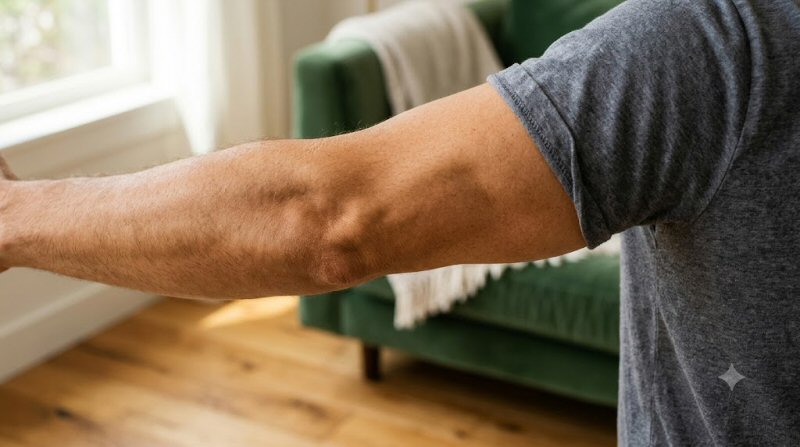
You straighten your arm after a long session of typing or scrolling and notice a tight, almost gritty feeling right at the back of the elbow, just above the pointy bone. It is not a sharp pain, more like the joint has forgotten how to finish the motion cleanly. That small triangular muscle sitting there—the anconeus—has spent most of the day in a half-flexed position and is reminding you it still expects the occasional full, loaded extension it was built for.
What the Anconeus Actually Does
The anconeus is a modest muscle on the posterior elbow. It originates on the lateral epicondyle of the humerus and inserts on the lateral surface of the olecranon and the upper shaft of the ulna. Anatomically it looks like a continuation of the lateral part of the triceps, and functionally it behaves as a weak but specialized assistant to elbow extension.
Early electromyography work by Basmajian and Griffin in 1972 showed clear activity during extension, greater than during flexion. Later studies have refined the picture: different regions of the muscle appear to have slightly different jobs. Longitudinal fibers assist extension and joint compression, while more transverse fibers help control the ulna during forearm rotation. Importantly, the muscle also tenses the posterior joint capsule so it is not pinched inside the olecranon fossa when the arm straightens fully. In short, it is less about generating big power and more about finishing and stabilizing the last part of extension under load.
When you push yourself up from a low chair, throw a ball, climb, or carry something with a straight arm, the anconeus is recruited alongside the triceps. It keeps the joint centered and protects the soft tissues at the end range. That is the pattern it still expects.
Why Modern Life Leaves It Quiet
Most contemporary postures keep the elbow bent. Desk work, phone use, driving, and even many gym exercises place the arm in mid-flexion for hours. Full extension under load—pushing a heavy door, rising from the floor, hanging briefly, or carrying a load with a straight arm—has become occasional rather than routine. The muscle receives less of the end-range, stabilizing work it was designed for.
Over time the posterior tissues can feel stiff, the joint may click or feel incomplete on straightening, and the small muscle itself can become sensitive when you finally ask it to work. This is not usually injury; it is under-recruitment followed by a sudden demand. Related articles on the larger extensors and flexors illustrate the same pattern: the triceps still expect a push off the ground, and the brachialis still expects a loaded bend. The anconeus sits in the middle of that continuum.
When the Quiet Muscle Starts to Complain
The most common everyday signals are a sense of tightness or mild ache at the back of the elbow after long periods of flexion, a momentary catch when you fully straighten the arm, or fatigue in the outer elbow region during push-up variations or overhead carries. These usually settle with movement and do not limit daily function.
Less common but worth attention are persistent pain that worsens with extension against resistance, swelling, true weakness, or symptoms that radiate down the forearm. Lateral epicondylalgia (tennis elbow) can sometimes involve nearby tissues, and true joint instability or nerve irritation (radial tunnel) is rarer still. If pain is sharp, progressive, or accompanied by numbness, loss of strength, or night pain that wakes you, it is time to have it checked rather than assume it is only a mismatch.
How to Give It the Occasional Loaded Extension It Expects
The goal is not heavy training but regular, gentle full extensions under modest load so the muscle and capsule stay mobile and coordinated.
- Wall or counter push-offs: Stand facing a wall or sturdy counter, hands at shoulder height, and slowly lower and push back to full arm extension. Keep the motion controlled so the elbow finishes straight without snapping.
- Light dumbbell or band extensions: Seated or standing, hold a light weight and fully straighten the elbow against gravity, pausing briefly at the end range. A few sets of 8–12 slow reps are enough.
- Floor or knee push-up variations: Even partial push-ups that finish with straight arms recruit the anconeus for stabilization.
- Everyday carrying and reaching: Occasionally carry a grocery bag or backpack with a straight arm, or reach to place something on a high shelf with a deliberate full extension.
A few minutes a couple of times a day is usually sufficient. Pair it with the forearm rotation work described in pieces on the forearms that still expect twist and grip, because the anconeus also assists during pronation and supination.
Myths vs Facts
Myth: The anconeus is too small to matter.
Fact: Its contribution to torque is modest, but its role in joint centering and capsule protection is real and measurable on EMG.
Myth: Elbow stiffness after desk work is always inflammation or arthritis.
Fact: In many people it is simply the cumulative effect of prolonged flexion and reduced end-range loading.
Myth: You need heavy weights to “wake it up.”
Fact: Controlled bodyweight or light resistance through full extension is enough to restore the pattern the muscle expects.
Frequently Asked Questions
Is it normal for the back of my elbow to feel tight after a long day at the computer?
Yes. Hours of mid-flexion reduce the stabilizing extensions the anconeus is built for. Gentle full extensions usually ease it.
Does the anconeus get stronger with regular push-ups?
It becomes better coordinated and more tolerant of end-range load. Strength gains are secondary to the larger triceps, but the small muscle still benefits from the recruitment.
Can ignoring this lead to tennis elbow?
Not directly in most cases. Tennis elbow involves the wrist extensors more than the anconeus, but prolonged poor elbow positions can contribute to overall lateral elbow irritation.
Should I stretch the anconeus?
Gentle extension under light load is more useful than aggressive stretching. The muscle responds better to controlled active work than to passive pulls.
When should I see a clinician?
If the ache becomes sharp, limits lifting or straightening, or is accompanied by swelling, true weakness, or radiating numbness, have it evaluated rather than self-managing indefinitely.
Conclusion
Your anconeus is a quiet specialist. It does not demand constant attention, but it still expects the occasional full, loaded extension that finishes the motion and keeps the joint capsule clear. Modern flexed-arm living quietly removes that stimulus. A few deliberate straight-arm pushes or carries each day restore the pattern without drama, and the tight, unfinished feeling at the back of the elbow usually softens in response. The muscle has not forgotten what it was built for; it is simply waiting for the motion it still expects.


