
Your adductor hallucis keeps the big toe aligned and the forefoot stable during push-off, yet narrow shoes and hard floors leave it under-stimulated.
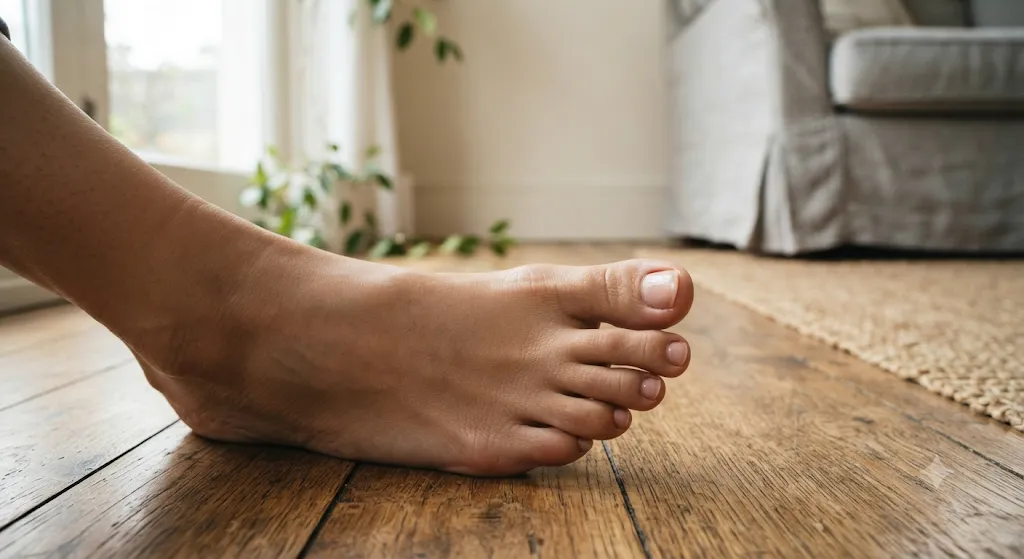
Your big toe has a small but important muscle on the underside of your foot that pulls it slightly toward the second toe and helps stiffen the front of your foot when you walk. That muscle is the adductor hallucis. On hard, flat surfaces and inside shoes that squeeze the toes together, it rarely gets the varied work it was built for. The result can be a quieter forefoot, less efficient push-off, and a greater chance that the big toe drifts outward over time.
What This Muscle Actually Does
The adductor hallucis sits deep in the sole of the foot and has two heads: a larger oblique head that comes from the middle metatarsal bases, and a thinner transverse head that spans across the forefoot. Both insert on the outer side of the base of the big toe’s proximal phalanx. Its main job is adduction—bringing the big toe toward the midline of the foot—and it also assists with flexion and helps support the transverse arch.
Fine-wire electromyography studies show the muscle is active during the later stages of stance, especially around toe-off, when the foot needs to stay stable as body weight shifts forward. In short, it helps turn the forefoot into a firm platform so the big toe can contribute to propulsion. Without that contribution, more load can fall on the other toes or the midfoot.
Why Modern Life Leaves It Underused
Ancestral walking happened on uneven ground, often barefoot or in soft footwear that allowed the toes to spread and grip. The adductor hallucis and its partner, the abductor hallucis, had to work together to keep the big toe properly aligned while the foot adapted to rocks, slopes, and soft soil. Today, most people spend hours in shoes with tapered toe boxes that hold the big toe in a passively adducted position. The muscle is no longer required to actively position the toe; the shoe does the job for it.
Hard indoor floors and paved paths further reduce the need for fine forefoot adjustments. Over years, the intrinsic foot muscles as a group can lose size and responsiveness. Research on minimalist footwear has shown that simply giving the foot more room and less cushioning can increase the thickness of some intrinsic muscles, suggesting that everyday constraint is part of the problem. The adductor hallucis, in particular, loses the daily practice of stabilizing the big toe under real load.
Common Everyday Effects
People often notice the downstream effects more than the muscle itself. The big toe may gradually angle outward (hallux valgus), the ball of the foot can feel sore after long walks, or the arch may feel less springy by the end of the day. Some notice that their big toe no longer plants firmly during a step and that they roll more toward the outside of the foot. These changes are usually gradual and related to years of limited toe mobility rather than a sudden injury.
Because the adductor and abductor hallucis work as a pair, an imbalance can appear when the abductor is chronically stretched by narrow shoes while the adductor remains relatively quiet. Related muscles that also contribute to toe control are covered in articles such as why your abductor hallucis still expects occasional barefoot balance and why your big toe still expects a push-off.
When the Feeling Becomes a Signal
Mild end-of-day foot fatigue or a sense that the forefoot is less responsive is common and usually improves with simple changes. More persistent symptoms deserve attention: progressive drifting of the big toe, a bunion that grows or becomes painful, numbness or burning under the ball of the foot, or pain that limits walking. Sudden swelling, redness, or inability to bear weight should be checked promptly. These red flags are uncommon for simple underuse but can point to other issues that need evaluation.
Practical Ways to Give the Muscle What It Expects
The goal is not aggressive strengthening but occasional active use in a position where the toes can move freely. A few minutes of barefoot time on a safe indoor surface or short grass lets the intrinsic muscles respond to small shifts in weight. Gentle toe-spreading drills—actively trying to fan the toes apart and then gently pressing the big toe down without curling—recruit both the adductor and its antagonist. Short-foot exercises, in which you gently draw the ball of the foot toward the heel without gripping the toes, also engage the deeper stabilizers.
Choosing shoes with a wider toe box for at least part of the day reduces the passive adduction and gives the muscle a chance to work. Transitioning to any less-supportive footwear should be gradual to avoid overload. On days when you sit a lot, standing barefoot and shifting weight slowly from side to side or doing a few controlled heel raises can reintroduce the load the forefoot expects. Consistency matters more than intensity; a few minutes most days is enough to keep the system responsive.
Myths Versus Facts
Myth: Narrow shoes “support” the big toe. Fact: They mainly hold it in a fixed position, reducing the need for the muscles that normally control it. Myth: Foot muscles cannot be trained after adulthood. Fact: Studies of people switching to wider or minimalist shoes show measurable increases in intrinsic muscle size within months. Myth: Only the abductor hallucis matters for bunions. Fact: Both the adductor and abductor contribute to alignment; balance between them is what the foot evolved to maintain.
Frequently Asked Questions
Can I feel the adductor hallucis working?
It is deep, so direct palpation is difficult. You may sense better forefoot stability or a firmer big-toe plant after a few weeks of barefoot time and toe exercises rather than an obvious contraction.
Does toe spreading strengthen the adductor hallucis?
Active spreading mainly works the abductor, but the controlled return toward the other toes and the stabilization during weight-bearing recruit the adductor. Both directions are useful.
How long before I notice a difference?
Many people feel more “awake” feet within two to four weeks of daily short barefoot sessions and wider shoes. Visible changes in muscle size take longer and are best measured by clinicians.
Is this related to plantar fasciitis?
Weak or underused intrinsic muscles can increase load on the plantar fascia. Improving toe control and arch stiffness sometimes reduces that load, but plantar fasciitis has multiple causes and may need specific treatment.
Should I do these exercises if I already have a bunion?
Gentle mobility and strengthening are often recommended as part of conservative care, but aggressive stretching of a painful joint can irritate it. A clinician can show you safe versions if the joint is already deformed or inflamed.
Conclusion
The adductor hallucis is a small muscle with a clear job: help keep the big toe aligned and the forefoot stable when you push off. Modern shoes and flat surfaces take that job away for most of the day. Giving the toes occasional room to move and the foot a few minutes of active, varied use restores some of the daily stimulus the muscle still expects. The change is modest and practical, yet it matches the way human feet evolved to work.


