A loud echo of your own voice or breath in one ear is often a briefly open Eustachian tube, not hearing loss. It usually eases when you lie down.
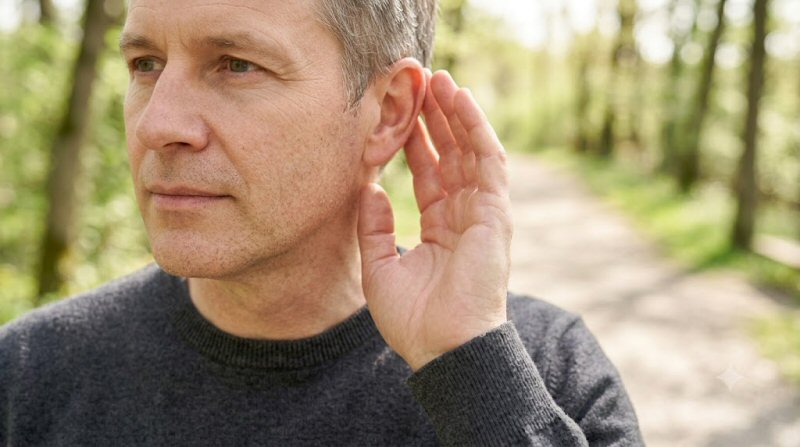
You start a sentence and your own voice booms back in one ear, hollow and too close. Breathing sounds like wind in a shell. Chewing is suddenly loud. Then you lie down and the echo fades. That pattern is common, and it is usually the ear tube staying open for a few minutes, not a failing eardrum. The tube was built to open briefly for a swallow, then seal. Dry air, a recent cold, or a lighter week of meals can leave it stuck open long enough for your own sound to take a shortcut.
What This Echo Feels Like
People describe autophony: the voice, breath, or chewing heard abnormally loud in the affected ear. It is often one-sided. The voice can sound as if you are talking into a barrel. Your breath may whoosh with each inhale. Footsteps or your own heartbeat are usually not the main sound. If the pulse is the loud part, that is a different complaint, covered in hearing your heartbeat in your ear.
A useful clue is posture. The echo is often worse upright, after a walk, or in a dry heated room, and better lying flat or bending the head down. A hard sniff can shut it for a second, which is why some people sniff all afternoon without meaning to. Fullness after a flight is the opposite problem: a tube that will not open. That feeling is described in ears that feel full after a flight.
Common Causes
- A patulous Eustachian tube, which stays open instead of closing between swallows.
- A cold or allergy week, when the lining is uneven and the tube flaps between stuck-shut and stuck-open.
- Dehydration, a long day in dry indoor air, or caffeine that leaves the lining less padded.
- Recent weight loss, which thins the fat pad around the tube opening.
- Pregnancy or hormonal shifts that change tissue around the tube.
- Overuse of nasal decongestant sprays, which shrink lining the tube needs in order to seal.
- A normal bone-conducted voice that simply feels louder when the room is quiet. A recording always sounds different from the voice in your head. That everyday mismatch is not autophony.
Why This Happens
The Eustachian tube runs from the middle ear to the back of the nose. It is meant to open for a fraction of a second when you swallow or yawn, equalize pressure, then close so sound from the throat does not pour into the ear. Charles Bluestone spent decades mapping that valve-like job. When the tube seals, your voice reaches you mostly through bone. Georg von Békésy and later Juergen Tonndorf showed why that bone path makes your voice sound deeper to you than to anyone else.
If the tube stays open, air and sound from the nasopharynx take a direct route to the eardrum. Your breath and voice arrive louder than the room. Joseph Toynbee described the tube’s link to swallowing in the nineteenth century. The open-tube form, patulous Eustachian tube, was clarified later by clinicians including Henry Pulec and, in modern endoscopic work, Dennis Poe. Poe’s group showed that the problem is often a floppy valve near the nasopharyngeal end, not a hole in the eardrum.
Lying down helps because blood and tissue fluid collect around the opening and nudge it shut. Standing, exercise, and a dry day do the reverse. That is why a bout on a walk can vanish on the sofa.
Less Common but Serious Causes
Superior canal dehiscence, described by Lloyd Minor in 1998, can also make your voice or eye movements feel loud inside the head. The clue is extra symptoms: dizziness triggered by sound, a strange sense that your eyes jump when you hear a loud noise, or better hearing of your own footsteps through bone. That needs an ear exam, not a humidity fix.
A perforated eardrum, middle-ear fluid, or a sudden one-sided hearing drop can distort your voice too, but they usually add muffled hearing, drainage, pain, or spinning. A whoosh locked to the pulse is pulsatile tinnitus, not a simple open tube. None of these is the typical upright-only echo that clears when you recline.
Hidden Triggers
- A week of nasal spray “so you can breathe,” which keeps the lining too thin to seal.
- Habitual hard sniffing. It closes the tube for a moment, then trains a cycle that Poe and others have linked with worse patulous symptoms.
- Very low fluid intake, a long flight, or a heated office with almost no humidity.
- A calorie deficit or illness that dropped weight quickly.
- Talking all day on calls, so you notice the echo the moment the room goes quiet.
- Anxiety about the sound, which makes every breath a test. The tube is still the hardware. Worry just turns the volume knob of attention up.
When to Worry
- The echo comes with spinning, sound-triggered dizziness, or a feeling that your eyes bounce.
- Hearing drops in that ear, or the voice is muffled rather than too loud.
- You hear a pulse whoosh, especially a new one on one side.
- There is drainage, fever, severe pain, or blood.
- Symptoms follow a head injury.
- The echo lasts most of the day for more than a few weeks, or sniffing has become constant.
Myths vs Facts
- Myth: If you hear yourself, the eardrum has a hole.
Fact: A brief open tube is far more common. A hole usually adds pain, drainage, or a clear hearing change. - Myth: Sniffing hard is the cure.
Fact: A sniff can close the tube for seconds. Repeating it all day can keep the valve from learning to seal. - Myth: It means you are losing hearing.
Fact: Patulous autophony is a conduction shortcut. Hearing is often normal. A true drop is a reason to get checked, not the usual story. - Myth: Decongestant spray will shut the echo.
Fact: Sprays that shrink tissue often make an open tube worse. They help a blocked tube, which is the other failure mode, the one behind a pop when you swallow. That sealed-tube job is covered in ears that pop when you swallow.
How to Manage It
- Drink enough water that urine is pale, especially on heated or travel days. A dry lining seals poorly.
- If a bout hits while you are upright, sit or lie down for a few minutes. Many echoes fade as soon as the head is level.
- Skip topical decongestant sprays unless a clinician asked for a short course. Saline mist is the gentler nose option.
- Notice the sniff. If you are sniffing to turn the echo off, pause and try a slow nasal exhale instead.
- Humidify a very dry room, and give calls a short break if your voice is the trigger you cannot stop monitoring.
- After illness or weight loss, expect a few weeks of easier symptoms as tissue around the tube recovers. Rapid further dieting tends to prolong it.
When to See a Doctor
See a clinician if the echo is constant, one ear feels deaf, there is drainage or spinning, or sound makes you dizzy. An ear, nose, and throat exam can watch the eardrum move with your breath, which is the classic patulous sign Pulec and later Poe described. Mention recent weight change, pregnancy, and any nasal sprays. Treatment for a stubborn open tube exists, from nasal strategies to procedures in selected cases. Brief upright echoes that clear when you lie down rarely need any of that.
FAQs
Why is it worse when I stand and better when I lie down?
Upright posture and exercise pull tissue fluid away from the tube opening, so a floppy valve stays open. Lying flat brings fluid back and often seals it. That posture switch is a hallmark of a patulous tube.
Can a cold cause this?
Yes. After congestion, the lining can be uneven. Some people get a blocked ear first, then a few days of hearing their own breath as the tube overshoots and stays open. It usually settles as the lining recovers.
Is the echo dangerous?
By itself, a reversible voice echo is uncomfortable, not an emergency. Danger signs are a new hearing loss, pulsatile whoosh, drainage, or dizziness set off by sound. Those need an exam.
Why does my recorded voice sound different if this is normal?
You always hear yourself partly through bone, which boosts low tones. A recording is air conduction only. That everyday surprise is not the same as a one-sided barrel echo of your breath.
Will chewing gum help?
Swallowing and yawning open a tube that is stuck shut. If the tube is already stuck open, gum can make the echo more obvious. Use it for pressure after a flight, not for a voice that is already too loud.
Can anxiety invent the sound?
Attention can amplify a real breath sound, especially in a quiet room. It does not invent the posture pattern. If the echo vanishes lying down and returns on a walk, the tube is doing something physical.
Conclusion
Hearing your own voice or breath too loudly in one ear is often a tube that forgot to close, not a damaged drum. Dry air, a cold, sprays, and a lighter body weight are the usual reasons. Lie down, hydrate, and stop the sniff-and-spray loop. Get checked if hearing drops, the pulse joins in, or sound makes the world tilt. Most of these echoes are a valve between breaths, and they seal again once the lining has something to seal with.