
Shoulder ache after carrying a bag is usually from sustained load on the trapezius and asymmetric posture, not a serious injury. Learn why it happens and when to worry.
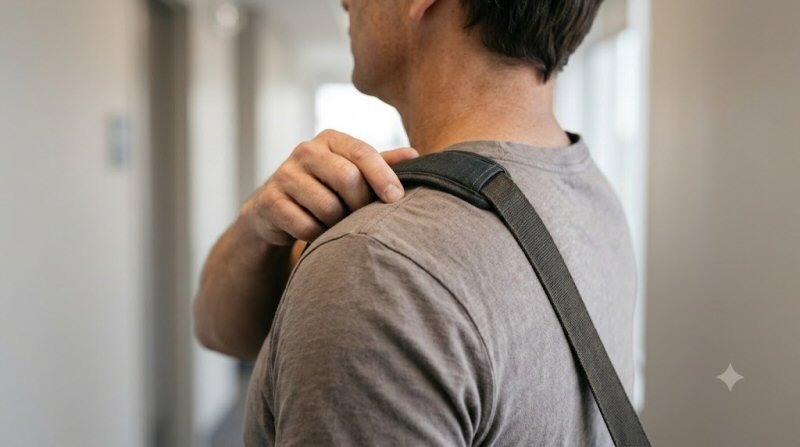
You finish a walk home with a laptop bag or backpack on one shoulder and notice a dull, heavy ache spreading across the top of that shoulder and into the base of your neck. The other side feels fine. By evening the tightness has settled in, and rolling the shoulder only brings temporary relief. It is a common everyday complaint, especially with modern bags that are heavier than the light loads our shoulders evolved to carry for short periods.
What This Symptom Feels Like
The ache is usually a deep, dull pressure rather than a sharp pain. It sits along the upper trapezius—the thick muscle that runs from the base of the skull out to the shoulder tip—or along the top of the shoulder blade. Some people feel it radiate a little toward the side of the neck or the upper arm. It often starts during the carry and lingers for hours afterward. Raising the arm overhead or reaching behind can feel mildly restricted until the muscle softens. The sensation is rarely accompanied by numbness or weakness unless a nerve is also irritated.
Common Causes
The most frequent cause is simply sustained load on one side. A single-strap bag or a backpack worn loosely on one shoulder keeps the trapezius and levator scapulae under continuous tension. Those muscles are built for brief, varied work—hanging, climbing, or shifting a load from one side to the other—not for hours of static holding. When the bag is heavy or the strap is narrow, the pressure concentrates on a small area of muscle and the underlying fascia. Asymmetric posture compounds the problem: the loaded shoulder rises slightly, the head drifts toward the opposite side, and the upper back rounds a little. Desk workers who already carry tension from screen posture notice the ache sooner.
Secondary factors include a weak or underused opposite side, previous minor strains that have not fully settled, and simply walking less than usual so the calf and core pumps that normally help circulation are quiet. Cold weather can make the same load feel heavier because muscle tissue stiffens and blood flow to the skin and surface muscles drops.
Why This Happens
The upper trapezius and its neighboring muscles evolved to stabilize the shoulder girdle while the arms reached, pulled, and carried varied loads for limited stretches of time. Human ancestors moved loads by hand, on the head, or in balanced bilateral fashion; continuous one-sided hanging from a narrow strap is a recent habit. When the muscle stays contracted without the usual cycles of relaxation and repositioning, local blood flow decreases, metabolic by-products accumulate, and the muscle spindle and fascia report a dull ache. The nervous system interprets the prolonged isometric work as a signal that the load is too constant, not that the muscle is damaged. Research on postural muscles by investigators such as Janet Travell and later work on scapular kinematics by Paula Ludewig and others has shown how small shifts in shoulder position quickly change the resting tension in the upper trapezius. A bag that pulls the shoulder down and forward simply exaggerates a pattern many people already hold at a desk.
For a deeper look at why the upper trapezius still expects a pack-style load rather than a single thin strap, see Why Your Trapezius Still Expects a Pack on Your Back. Related desk patterns appear in Is It Normal for Your Shoulders to Ache After a Desk Day?.
Less Common but Serious Causes
True nerve compression (such as a cervical radiculopathy) can produce shoulder ache that travels down the arm with tingling or weakness; that pattern is less common after simple bag carrying and usually has other triggers. A rotator-cuff irritation or acromioclavicular joint problem can flare with load, but the pain is typically sharper with specific arm movements rather than a broad dull ache after carrying. Systemic issues such as inflammatory arthritis are rare causes of isolated one-sided shoulder ache that appears only after bag use. In the great majority of cases the symptom remains mechanical and self-limited.
Hidden Triggers
- Carrying the same strap on the same shoulder day after day
- A bag that is heavier than necessary (laptop plus extras)
- Narrow or poorly padded straps that dig in
- Walking with the head tilted toward the phone while the bag is on
- Prior desk days that have already raised baseline trapezius tension
- Dehydration or low magnesium that makes muscle recovery slower
When to Worry
Seek medical advice if the ache is accompanied by true arm weakness, persistent numbness or tingling that does not settle when you put the bag down, night pain that wakes you, or pain that spreads into the chest or down the arm with shortness of breath. Sudden severe pain after a fall or direct blow, visible swelling, or a shoulder that looks or feels unstable also warrants prompt evaluation. Otherwise, an ache that eases within a day or two of lighter loads is almost always benign.
Myths vs Facts
Myth: Shoulder ache after a bag means you have a torn muscle or need imaging right away.
Fact: The great majority of cases are reversible overload of postural muscles; imaging is rarely helpful unless red-flag symptoms are present.
Myth: You should never carry a bag on one shoulder.
Fact: Brief, varied one-sided carries are fine; the problem is hours of the same static load without relief.
Myth: Stretching alone will fix it permanently.
Fact: Stretching helps the immediate tightness, but changing how and how long you carry the load is what prevents recurrence.
How to Manage It
Switch the bag to the other shoulder every 10–15 minutes, or better, use both straps of a backpack and keep the load close to the body. Lighten the bag by removing non-essentials. After you arrive, gently roll the shoulders backward and downward, then perform a few slow neck side-bends and shoulder-blade squeezes to restore normal position. A brief walk without the bag, or simply standing and letting the arms hang, often clears the ache faster than prolonged sitting. Heat or a warm shower can relax the surface muscle; ice is useful only if the area feels inflamed after a particularly heavy day. Over-the-counter anti-inflammatories are optional and short-term; most people do well with load management alone.
Strengthening the mid-back and lower trapezius with simple rows or face-pull motions (once the acute ache has settled) gives the shoulder girdle better endurance for the loads modern life still asks it to handle. For related ideas on upper-back loading, see Why Your Upper Back Still Expects Reaching and Pulling.
When to See a Doctor
Make an appointment if the ache lasts more than a week despite lighter loads and simple movement, if it begins to limit daily arm use, or if any of the red-flag symptoms listed earlier appear. A clinician can check for referred pain from the neck, assess scapular control, and rule out less common joint or nerve issues. Most people never need that step.
FAQs
Is it better to use a backpack than a single-strap bag?
Yes, for longer carries. A properly fitted backpack distributes the load across both shoulders and the hips, reducing the continuous one-sided demand on the upper trapezius.
Why does only one shoulder hurt even if I switch sides sometimes?
Habit, slight strength or mobility differences between sides, and the fact that one side often starts with higher baseline tension from desk posture all contribute. The side you use most still accumulates more total load.
Can this ache turn into a frozen shoulder?
Unlikely from bag carrying alone. Frozen shoulder (adhesive capsulitis) has a different pattern of progressive stiffness and is not typically triggered by ordinary load.
Does the type of strap padding matter?
Yes. Wider, padded straps spread pressure over a larger area of muscle and reduce the focal compression that makes the ache appear sooner.
Should I stop carrying bags entirely?
No. Varied, moderate carrying is useful loading for the shoulder girdle. The goal is to avoid prolonged static one-sided tension, not to eliminate all carrying.
Conclusion
Shoulder ache after carrying a bag is a normal response of postural muscles to a sustained, often asymmetric load they were not designed to hold for hours. Lightening the bag, switching sides or using both straps, and restoring normal shoulder position afterward usually resolve the symptom quickly. Persistent or neurologically accompanied pain deserves a closer look, but for most people the fix is simply a more varied way of carrying the everyday loads modern life still asks the shoulders to manage.


