
A watery nose on a run is usually exercise-induced rhinitis — more airflow, cooler drier mucosa, and a parasympathetic drip — not automatically a cold or pollen allergy. Why the nose leaks when you work hard, who notices it more, and when runner’s nose needs a look.
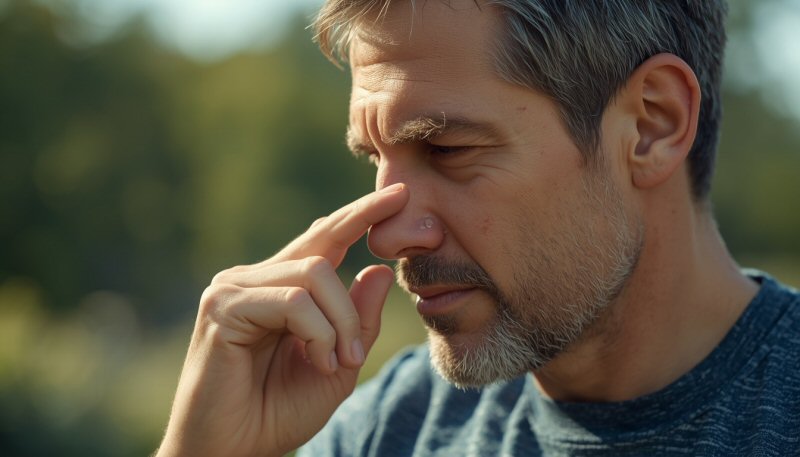
Five minutes into a run the air feels clean, your legs have found a rhythm, and then a thin stream of clear fluid starts down one nostril. You sniff. You wipe. A minute later it is back. There is no fever, no sore throat, and often no sneeze. It happens on the treadmill too. It happens more in cold air. It happens to people who swear they do not have allergies.
This is a real, named pattern: exercise-induced rhinitis, sometimes called runner’s nose. It is not a virus that only appears when you lace up. It is not proof that you “caught something at the gym.” It is the nasal lining doing three jobs at once — warming air, humidifying air, and defending the lower airway — under a sudden increase in flow that the resting nose never sees.
What This Symptom Feels Like
People who have it recognize a tight sequence:
- Clear, watery drip that starts after a few minutes of steady effort, not at the first step.
- Often one-sided at first, then both, matching whichever side of the nose is more open that hour.
- A sense of cool air high in the bridge of the nose, sometimes with a tickle but not always a sneeze.
- Worse outdoors in cold or dry weather, in chlorinated pools, and on high-pollen days if you already have allergic rhinitis.
- Better within minutes to an hour after you stop, unless the mucosa was already inflamed.
Some people get congestion instead of drip. Some get both: first a run, then a stuffy rebound when they cool down. That mix is still the same organ, not two separate diseases.
What the Nose Is Trying to Do While You Run
At rest you move roughly five to eight liters of air a minute through the nose. At a hard run that number can climb toward 50 to 100 liters a minute, and much of it eventually spills into the mouth. Before it does, the nasal vault still tries to condition what it can.
The lining is a heat-and-moisture exchanger. Turbinate tissue is a vascular radiator. Glands under parasympathetic control add water and mucus. Cilia sweep the film backward. During dynamic exercise, sympathetic tone usually constricts the turbinate vessels. Classic work summarized in ARIA documents by Sergio Bonini, Jean Bousquet and colleagues showed that dynamic effort can drop nasal resistance by as much as half in healthy noses — the airway opens so more air can pass. That is useful for oxygen. It is also a larger blast of unwarmed, unhumidified air across a thinner film.
Two things then happen in parallel. First, evaporation cools and slightly concentrates the surface liquid, the same osmotic logic that helps explain exercise-induced bronchoconstriction farther down the airway. Second, cold and dry receptors — including TRPM8-family sensors that also drive winter rhinorrhea — fire a parasympathetic reflex that tells the glands to pour. The result looks like a leak. It is closer to an over-correction: the mucosa is trying to replace water as fast as the airstream steals it.
Why Researchers Treat This as More Than “Just Cold Air”
William S. Silvers and colleagues described exercise-induced rhinitis as a distinct, activity-triggered cluster — rhinorrhea, congestion, itch, sneeze — that can appear in people with and without atopy. In later clinic work with J. A. Poole, indoor exercise still provoked symptoms in a large fraction of volunteers, which means temperature alone is not the whole story. Increased inspiratory flow, wall shear, and mucosal cooling can irritate the lining even in a climate-controlled room.
Pavol Surda’s group, reviewing rhinitis across sports, found published prevalence ranging from about 27 to 74 percent depending on the cohort and the definition. Swimmers and cold-air athletes sit at the high end. Chloramines in indoor pools and sub-freezing outdoor air are frank chemical and thermal insults. Track athletes sit closer to background rates unless pollen or pollution is high. B. Steelant, Valerie Hox and colleagues have shown that athletic noses can accumulate neutrophils and show slower mucociliary transport after long efforts — a picture of irritation more than classic allergic eosinophilia.
L. B. Schwartz and the PRACTALL sports-allergy consensus placed exercise-induced rhinitis next to exercise-induced bronchoconstriction: shared evaporative stress, shared autonomic swings, shared environmental amplifiers. That does not mean every runny nose on a jog is “hidden asthma.” It means the upper and lower airways are one continuous surface facing the same air.
Common Causes and Hidden Triggers
The usual drivers stack rather than compete:
- Flow and evaporation. Harder breathing means more water lost from the film and more cooling of the mucosa.
- Cold or dry air. The same reflex that produces skier’s nose on a chairlift works on a winter run. If cold air already makes your nose drip at rest, exercise multiplies the volume.
- Allergen load. A run multiplies minute ventilation. Someone mildly allergic to grass inhales far more pollen in thirty outdoor minutes than they would walking to the car.
- Pool chemistry. Swimmers meet trichloramine and related gases at the water line. The nose is the first wet surface those gases hit.
- Baseline rhinitis. A nose that is already swollen from perennial allergy or nonallergic rhinitis has less reserve. Isometric work can even raise nasal resistance in those noses, the opposite of the healthy dynamic-exercise response.
- The nasal cycle. One side is usually more open. The open side takes more flow and often drips first — the same laterality people notice when one nostril feels more blocked at rest.
Indoor gyms are not automatically safe. Dry HVAC air, fragrance, chalk dust, and shared mats add irritant load even when pollen counts are zero.
Less Common but Serious
Clear drip after exercise is almost never cerebrospinal fluid. CSF leak is typically a watery, salty, one-sided leak that worsens on bending or straining and follows head trauma or sinus surgery. It does not clock in with your warm-up and clock out with your cooldown.
Bloody discharge after a hard outdoor session in dry air is usually crusted mucosa cracking, not a tumor. Recurrent thick green discharge, facial pain, fever, or smell loss that lasts days after the workout is sinusitis or a separate infection, not runner’s nose.
Wheeze, chest tightness, or a cough that starts during or right after exercise belongs in the exercise-induced bronchoconstriction conversation. The nose and the bronchi can complain together. They should not be collapsed into one shrug.
When to Worry
Get a proper look if any of these are true:
- The drip is only one side, persists at rest, and tastes salty, especially after a head injury.
- You have fever, facial swelling, or colored mucus that outlasts the workout by days.
- Exercise brings wheeze, chest tightness, or a cough that limits training.
- Smell is suddenly gone and stays gone.
- Over-the-counter decongestant sprays have become a daily habit. Rebound congestion (rhinitis medicamentosa) will make every run worse.
Myths vs Facts
Myth: A runny nose during exercise means you are getting sick and should stay home.
Fact: Viral colds produce thicker mucus, sore throat, and a time course of days. Exercise-induced drip is watery and effort-locked.
Myth: Only people with allergies get this.
Fact: Atopy raises the odds, but Silvers, Surda and others documented symptoms in nonallergic athletes, especially in cold air and chlorine.
Myth: You should always breathe only through your nose when you run.
Fact: At higher intensities the mouth must share the load. Forcing exclusive nasal breathing when flow demand is high just increases shear on an already busy mucosa. Easy runs can stay nasal. Hard intervals usually cannot.
Myth: If antihistamines do nothing, the drip is imaginary.
Fact: Nonallergic and cold-air rhinorrhea are driven more by nerves and glands than by histamine. An antihistamine that helps spring pollen may do little on a January tempo run.
How to Manage It
You do not need to quit the sport. You need to reduce the evaporative and irritant load, and treat any baseline rhinitis so the mucosa has reserve.
- Warm the first air. A light buff or mask on cold mornings is not vanity. It recycles a little heat and moisture into the next breath, the same principle that calms cold-induced rhinorrhea at rest.
- Saline before and after. An isotonic rinse or spray before an outdoor session washes allergens and leaves a thicker starting film. A rinse after chlorine or pollen unloads what stuck.
- Treat the baseline. If you already have allergic rhinitis, a daily intranasal corticosteroid — the standard first-line anti-inflammatory for the lining — often shrinks exercise flares more than a last-minute pill. Ipratropium nasal spray, an anticholinergic, is specifically useful when watery drip is the main complaint, because it blocks the glandular reflex rather than histamine.
- Watch the environment. Shift high-pollen workouts indoors or to early morning. Give indoor pools decent ventilation and a post-swim rinse. Do not make phenylephrine or oxymetazoline a training partner.
- Hydrate like it matters. Systemic dehydration does not create rhinitis by itself, but a dry mouth and a dry nose travel together in winter training.
The spicy-food reflex that makes some noses run at dinner is a cousin, not a clone: another parasympathetic glandular burst, this time from oral capsaicin rather than airway cooling. People who drip from chili often drip from cold air too. The shared theme is a twitchy trigeminal–parasympathetic loop, described in a different setting in our piece on gustatory rhinitis.
When to See a Doctor
See a clinician if the drip is new and one-sided at rest, if smell is lost, if you need a daily decongestant spray to train, or if chest symptoms join the nasal ones. An allergist or ENT can sort allergic from nonallergic rhinitis, look for a structural bottleneck, and choose an anticholinergic or steroid that actually matches the mechanism. Most recreational runners never need that step. They need a warmer first breath and a less angry lining.
FAQs
Is a runny nose during exercise a sign I should stop working out?
Not by itself. Watery, effort-locked drip without fever or chest tightness is a mucosal reflex, not an infection warning. Stop or slow down if you add wheeze, chest pain, faintness, or thick colored mucus with fever.
Why is it worse in winter than in summer?
Cold air holds less water. Each liter you inhale steals more moisture from the lining and cools receptors that drive a parasympathetic drip. Summer pollen can still provoke the allergic version; winter favors the irritant version.
Can I prevent it with an antihistamine before I run?
If pollen is the amplifier, a scheduled antihistamine or, better, a daily nasal steroid can help. If the trigger is cold dry air or chlorine, an antihistamine often disappoints. Ipratropium spray targets the watery reflex more directly.
Why does only one side run?
The nasal cycle leaves one passage more open. That side takes more flow, loses more water, and drips first. Laterality that appears only during exercise and swaps days is usually this cycle, not a one-sided disease.
Do elite athletes get this more than weekend runners?
Published rates are highest in swimmers and winter-sport athletes, where chemical and thermal exposure is chronic. Recreational runners still get classic runner’s nose; they simply meet less chlorine and fewer sub-zero hours.
Is this the same as a sinus infection?
No. Sinusitis lingers, thickens, and usually hurts. Exercise-induced rhinitis starts with effort and fades when the air demand falls.
Conclusion
Your nose did not evolve for 10-K pace in January air or for an hour over a chlorinated lane. It evolved to condition a modest stream of outdoor air and to keep the lungs from meeting raw cold and grit. When minute ventilation jumps, the same lining that usually succeeds at that job can leak, swell, or both. That leak is usually physiology under load — flow, evaporation, autonomic drip — not a character flaw and not a cold you caught from the person on the next treadmill. Warm the first air, rinse the film, treat any baseline rhinitis, and save the urgent appointment for the rare drip that does not follow the workout.