
A painless click or pop in the jaw when you yawn is common and usually harmless. It often reflects a small disc shift that snaps back into place on wide opening.
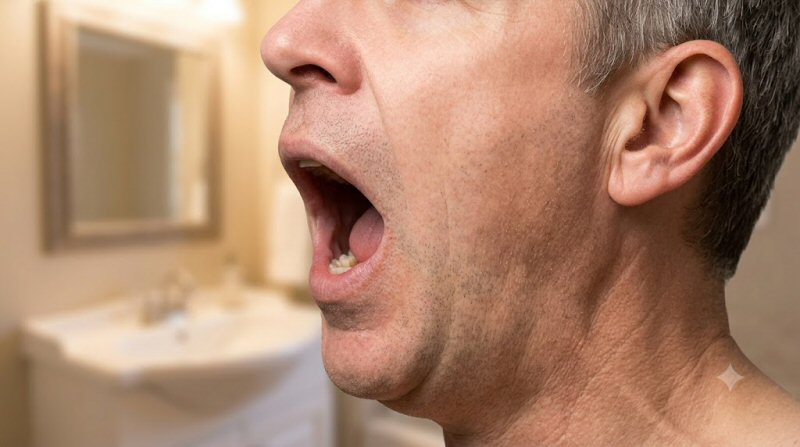
You stretch your arms, take a big breath, and open wide for a satisfying yawn—only to hear a distinct click or pop right by your ear. It can feel startling the first few times, especially if it happens on one side or seems louder in a quiet room. For most people this is simply the sound of the jaw joint doing a slightly imperfect version of its normal job.
What This Click Feels Like
The sensation is usually a single sharp click or softer pop felt just in front of the ear as the mouth reaches near full opening. Some people also notice a reciprocal (closing) click when the jaw comes back together. It may be louder to you than to anyone nearby because sound conducts through bone. Importantly, the jaw continues to open fully and closes without catching. There is no pain, no lasting shift in how the teeth meet, and no sense that the joint is stuck.
Common Reasons the Jaw Clicks on a Yawn
The temporomandibular joint (TMJ) is a sliding hinge. Between the ball-shaped condyle of the lower jaw and the socket of the skull sits a small fibrocartilage disc that normally moves with the condyle. When the disc sits a little farther forward than ideal while the mouth is closed, the condyle must climb over its thickened rear edge during opening. That sudden realignment produces the click—known as disc displacement with reduction.
A second, equally common mechanism occurs simply at the end of normal range. On a wide yawn the condyle translates fully onto the articular eminence. The brief mechanical “bump” as it rides over that bony contour can create a pop without any disc problem at all. Both patterns are frequently painless and stable for years.
Researchers including Jeffrey Okeson have long noted that joint sounds alone are extremely common in the general population. Large reviews estimate that disc displacement with reduction is present in roughly 18–35 % of adults, and imaging studies have found anterior disc displacement even in a substantial fraction of people who have never had symptoms.
Why Wide Opening Makes It Noticeable
Ordinary chewing rarely demands the full translation that a yawn does. The condyle travels farther forward, increasing the chance that a mildly displaced disc will be recaptured or that the joint will reach its natural end-range contour. Fatigue, mild muscle tension from daytime clenching, or simply the relaxed posture of a long yawn can make the click more consistent on one side for a while. None of these changes necessarily mean the joint is deteriorating.
Related reading on everyday jaw loading appears in articles about jaw clicking while chewing and why the masseter still expects tougher food.
When the Click Deserves Attention
Most painless clicking never progresses. Watch for changes that suggest the disc is no longer reducing reliably or that other structures are irritated:
- Pain that appears with the click or lingers afterward
- Catching or momentary locking that requires a maneuver to open fully
- Progressive limitation of opening (difficulty fitting two or three fingers between the teeth)
- A sudden change in how the teeth meet, or new deviation of the jaw to one side on opening
- Clicking that is accompanied by ear fullness, facial pain, or headaches that were not present before
These patterns warrant an evaluation by a dentist familiar with temporomandibular disorders. Imaging is rarely needed for straightforward painless clicking, but it becomes useful when locking or significant pain develops.
Myths Versus Facts
Myth: A clicking jaw will inevitably get worse and lock.
Fact: Longitudinal studies of disc displacement with reduction show that the majority of cases remain stable and painless for years; adaptation is the rule rather than progression.
Myth: You should force the jaw past the click to “pop it back in.”
Fact: Repeated extreme forcing can irritate the joint capsule and ligaments. Gentle, pain-free movement is preferable.
Myth: Only people who grind their teeth get jaw clicks.
Fact: While clenching and grinding can increase joint load, many people with clicks have no history of bruxism. The disc position can shift for mechanical or developmental reasons alone.
Practical Ways to Keep the Joint Comfortable
If the click is painless, no specific treatment is required. A few simple habits still protect the joint over the long term:
- Avoid deliberately forcing a yawn to its absolute maximum if the click feels sharp or is followed by tenderness.
- Notice daytime clenching (common during focused screen work or driving) and let the teeth rest slightly apart with the lips closed.
- Choose softer foods for a few days if the joint feels temporarily irritated after an especially wide yawn or after dental work.
- Support the jaw with a warm compress for 10–15 minutes if mild muscle fatigue appears.
- If you clench at night, a dentist can discuss a simple night guard; this is not necessary for isolated painless clicking.
For more on resting jaw posture, see the piece on why the jaw still expects a small resting gap.
When to See a Dentist or Physician
Schedule a visit if pain develops, if opening becomes limited, if the jaw locks open or closed, or if the bite suddenly feels different. Early conservative care—habit modification, short-term soft diet, and, when indicated, a stabilizing appliance—resolves or stabilizes the large majority of symptomatic cases. Surgery is reserved for the uncommon situations in which locking persists despite non-surgical measures.
Frequently Asked Questions
Is a single click on one side during a yawn normal?
Yes. Unilateral painless clicks are extremely common and do not indicate that one joint is “worse” than the other.
Should I stop yawning if it clicks?
No. Natural yawning is harmless. Only avoid forcing the jaw past a point that produces pain or a catching sensation.
Can the click disappear on its own?
Sometimes the disc position adapts and the noise fades. Even when it remains, most people simply stop noticing it.
Does clicking mean I have arthritis in the jaw?
Not by itself. Arthritis typically produces crepitus (a grinding or sandy sound) rather than a clean click, and is usually accompanied by other symptoms.
Will chewing gum make it worse?
Excessive gum chewing increases joint load and can make an existing click more noticeable or add muscle fatigue. Occasional gum is fine for most people.
Conclusion
A click or pop when you yawn is, for the large majority of people, a normal mechanical event inside a well-adapted joint. The sound reflects either a disc that briefly shifts and snaps back or the condyle reaching the end of its natural range. As long as the jaw opens and closes freely and without pain, the click can be treated as a harmless quirk rather than a warning sign. Attention is warranted only if pain, locking, or a change in bite appears—patterns that remain uncommon and are usually manageable with straightforward care.


