
Tingling fingers on a bike ride are often handlebar pressure on the ulnar nerve at the wrist, not a circulation failure. Position, grip, and fit usually settle it.
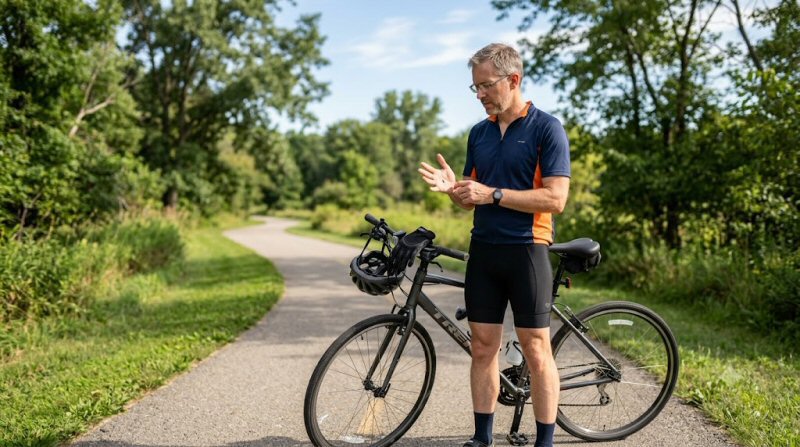
Twenty minutes into the ride the ring finger and pinky go fuzzy. You shake the hand, reset your grip, and the feeling comes back. By the time you coast into the driveway the palm feels thick, as if the skin were wrapped in cloth. It is easy to assume the hands have “lost circulation.” On a bicycle they usually have not. They have been leaning on a nerve.
The pattern has a name in sports medicine: cyclist’s palsy, sometimes called handlebar palsy. It is pressure on the ulnar nerve where it crosses the wrist, in a tight channel called Guyon’s canal, named for the nineteenth-century surgeon Jean Casimir Félix Guyon. The same ride can also irritate the median nerve if the wrist stays cocked back on a flat bar. Both versions are common enough that long recreational rides produce them in people who are otherwise healthy. They are a fit-and-posture problem first, and a nerve-injury problem only if the numbness outlasts the ride or the hand gets weak.
What This Tingling Feels Like
The everyday version is pins and needles, buzzing, or a dull numb patch that arrives after a stretch of steady riding and eases when you take weight off the bars. Ulnar compression favors the little finger and the half of the ring finger beside it, sometimes the outer edge of the palm. Median compression favors the thumb, index, and middle finger, the same territory people notice with desk-edge hand tingling. Both hands can be involved, or the hand that carries more weight if you sit slightly crooked on the saddle.
Weakness is the detail that changes the story. Spreading the fingers, pinching a key, or holding the brake lever can feel clumsy if the deep motor branch of the ulnar nerve has been pressed. That branch can be compressed even when the skin still feels almost normal, a point Domenico Capitani and Serafin Beer described in cyclists whose grip looked intact until the small hand muscles were tested. Most weekend riders never reach that stage. They get a reversible sensory buzz.
Pain is usually mild. A burning line along the outer hand, or an ache at the heel of the palm where it meets the bar, is typical. A sharp electric shock that shoots to the neck is not the usual handlebar story.
Why the Bars Do This
A bicycle asks the hands to be a third point of support. On a road bike a large share of upper-body weight rests on a narrow contact patch. Drop bars, aero extensions, and a long reach push that load forward. Flat bars on a city bike do it differently: the wrist extends, the heel of the hand presses the grip, and the ulnar nerve sits right under that pad of skin.
Nerve fibers do not like sustained pressure. Göran Lundborg’s work on nerve compression showed that modest external pressure slows blood flow inside the nerve before it physically crushes axons. Richard Gelberman’s carpal-tunnel pressure studies made the same point for the median nerve: ischemia comes first, structural injury later. On a bike the load is often in that first zone. Shake the hand, change the hood position, and the tingling fades because flow returns. Stay in one aero posture for an hour and the same nerve can stay irritable into the evening.
Patrick Patterson, Matthew Jaggars, and Martin Boyer followed long-distance cyclists and found both ulnar and median nerve palsy after extended rides, more often sensory than motor. Venu Akuthota and colleagues later measured nerve conduction in distance cyclists and again found ulnar and median changes related to time on the bike, not to a mysterious loss of blood to the whole hand. The fingers are pink. The pulse at the wrist is there. The complaint is focal.
Road buzz adds a second insult. High-frequency vibration from rough pavement travels up a rigid bar into the same contact point. Occupational researchers such as Michael Griffin and Massimo Bovenzi mapped hand-arm vibration in power-tool workers; a bicycle is a milder cousin, but a cheap bar tape and a death grip make the dose larger than it needs to be.
Common Setups That Bring It On
A first long ride of the season, when the hands have not practiced the posture. A new bike with a lower, longer reach. Locking the elbows so the skeleton, not the muscles, props the trunk. Squeezing the grips harder than the brakes require, especially on a descent. Worn tape, thin gloves, or no gloves on a narrow bar. Aero bars that park the ulnar side of the wrist on a hard pad for the whole tempo section. A saddle that is too nose-down, or too far back, so the rider slides forward onto the hands.
City riders meet a different version. Upright bars should spare the hands, and often do, until a backpack, a heavy basket, or a tense commute locks the wrists in extension. The same median-nerve posture shows up in people whose fingers go numb holding a phone: a bent, loaded wrist, held still.
Cold air makes the buzz easier to notice. Skin sensation dulls, grip tightens, and the nerve is already near its pressure threshold. Heat and sweating can do the opposite trick: gloves slip, the rider regrips harder, and the contact patch shrinks.
Less Common but Serious Causes
Handlebar palsy is the usual label, not the only one. A cervical disc or a tight thoracic outlet can send tingling into the hand that riding merely unmasks, especially if neck turning or overhead reach reproduces it. True carpal tunnel syndrome, the night-waking kind, can flare on the bike and also off it. Cubital tunnel at the elbow — the nerve people irritate when they lean on an elbow and the pinky tingles — can add a second ulnar site if the elbows stay sharply bent on the hoods.
Rarely, a wrist ganglion or an old fracture narrows Guyon’s canal so that ordinary bar pressure is enough to cause lasting weakness. Diabetes, thyroid disease, and vitamin B12 deficiency make nerves less tolerant of compression, so a ride that friends finish comfortably leaves one rider numb for days. Those are amplifiers, not proof that the bicycle is irrelevant.
Vascular causes are uncommon on an ordinary ride. A white, cold, painful hand with a missing pulse is a different event from pink fingers that buzz. Prolonged pressure can contribute to effort thrombosis or arterial injury in extreme endurance settings, but that is not the story of a numb pinky on a Saturday path.
Hidden Triggers People Miss
The contact point is often the last thing checked. Riders swap saddles and still plant the same outer palm on the same bare metal. Brake hoods rotated down force the wrist into extension. Gloves with a thick seam exactly over Guyon’s canal concentrate pressure instead of spreading it. A mirror, a phone mount, or aero pads that cannot be moved leave no second hand position.
Core fatigue matters more than people expect. When the trunk sags, the hands catch the weight the legs and saddle were sharing. A too-high gear that makes the rider stand and then collapse back onto the bars does the same. So does looking down at a bike computer for long stretches: the neck flexes, the shoulders roll in, and the heels of the hands take more load.
Previous elbow or wrist irritation lowers the threshold. A week of desk leaning, then a Sunday ride, stacks two compressions on one nerve.
When to Worry
Stop and get the hand checked if you cannot spread the fingers, if the hand claws, if you drop objects after the ride, or if weakness is still obvious the next day. Numbness that lasts more than a day or two, that wakes you at night when you are not riding, or that comes with neck pain, arm weakness, or a band of numbness up the forearm needs a clinician, not another pair of gloves.
Urgent care is for a hand that turns cold and white, a sudden severe headache, chest pain, trouble speaking, or tingling that arrives with leg weakness and imbalance. A single crash with wrist pain and new numbness should be examined for fracture as well as nerve bruise.
A buzz that starts mid-ride, stays in the outer fingers or the thumb side, and clears within minutes of standing up and shaking the hands is the ordinary pattern.
Myths vs Facts
Myth: Numb hands mean you are out of shape and should push through.
Fact: The signal is local pressure and reduced nerve blood flow. Riding longer in the same posture usually makes it worse, not fitter.
Myth: It is poor circulation, so a harder grip will pump blood back.
Fact: A harder grip raises pressure on Guyon’s canal and the carpal tunnel. Patterson, Akuthota, and the earlier report by Philip Eckman in bicycle riders all point to nerve compression, not a failed artery. The fingertip pulse is usually intact.
Myth: Only racers get this.
Fact: Any sustained lean on a narrow bar can do it. Touring riders, indoor-trainer sessions, and upright commuters all show up in clinic descriptions reviewed by Marc Silberman and other sports-medicine writers.
Myth: Tingling on the bike is always carpal tunnel.
Fact: Pinky and ring-finger symptoms are ulnar, at the wrist or less often the elbow. Thumb-side symptoms are the median pattern. The fix starts with where the bar meets the palm.
Myth: Padded gloves alone solve it.
Fact: Gloves help spread load. They do not fix a reach that is too long or a grip that never changes.
How to Manage It
Change hand position before the buzz starts. On drop bars, rotate among hoods, tops, and drops every few minutes. On flat bars, roll the wrist so the heel of the hand is not parked on the grip end. Sit up and coast with light hands for thirty seconds when the fingers fade.
Soften the contact. Fresh bar tape, a gel strip under the outer palm, and gloves without a seam on the ulnar border are the cheap changes. Keep a small bend in the elbows so the arms share load instead of locking. Lighten the grip to what the steering actually needs. Brake levers should sit where a straight wrist can reach them.
Check the fit if this happens on every ride. A shorter stem, a slightly higher bar, or hoods rotated so the wrist is nearer neutral often does more than any supplement. A saddle that supports you keeps weight off the hands. On a trainer, raise the front wheel or use a block so you are not sliding forward for an hour.
If the hand is already numb, end the hard effort, shake the arm, and avoid sleeping on that wrist. Most sensory symptoms settle over hours to a couple of days once the pressure stops. Do not “test” the nerve with another long ride the same day. Return with shorter outings and planned position changes.
A physiotherapist or bike fitter is reasonable if the pattern repeats. Nerve glides are optional and should be gentle. Forcing a numb wrist into extreme extension is not a treatment.
When to See a Doctor
See a clinician if weakness, clumsiness, or numbness persists beyond a few days, if symptoms are progressing, or if riding is only one of several triggers. A hand surgeon or neurologist may order nerve-conduction studies if motor loss is suspected. Capitani’s deep-branch cases are the reason not to ignore a hand that looks fine but cannot spread the fingers.
Mention night symptoms, neck pain, diabetes, thyroid disease, and any recent crash. Imaging is for trauma, a suspected mass in Guyon’s canal, or neurological red flags, not for a single ride that cleared by dinner.
FAQs
Is it normal for only the pinky and ring finger to tingle on a ride?
Yes. That is the classic ulnar distribution at Guyon’s canal. Thumb, index, and middle finger point more toward the median nerve at the carpal tunnel. Either can be pressure from the bar.
How long should the numbness last?
Many riders clear within minutes of changing position. Lingering buzz into the evening can still be ordinary after a long ride. Weakness or numbness that is still obvious after a day or two deserves a check.
Will gloves fix handlebar palsy?
They reduce peak pressure. They do not replace position changes, a lighter grip, or a bike fit that stops you leaning your whole trunk on the wrists.
Can an indoor trainer cause the same thing?
Yes. A fixed posture with no stops for traffic often means more uninterrupted pressure than an outdoor ride of the same length. Stand up, shake out, and vary the grip on a schedule.
Should I worry about a blood clot?
A pink hand with buzzing fingers is not the usual clot story. A cold, pale, painful hand, sudden swelling of the whole arm, chest pain, or breathlessness needs urgent care. Those are uncommon on a casual ride.
Does this mean I should stop cycling?
No. Most people return once the contact point and the reach are fixed. Stopping for a few days while a weak hand recovers is sensible. Abandoning the bike is rarely the treatment.
Conclusion
Tingling hands on a bike are a common answer to a simple mechanical question: how long can a nerve tolerate the weight of your trunk on a narrow bar? Guyon’s canal and the carpal tunnel sit exactly where that weight lands. The work of Eckman, Patterson, Boyer, Akuthota, and Capitani describes a compression palsy, not a heart or circulation emergency. Shift your hands, soften the bar, unlock your elbows, and let the saddle and the pedals carry their share. If the fingers stay weak or numb after the ride is over, that is the moment to stop experimenting and have the nerve examined.


