
Tight hamstrings after hours at a desk are extremely common. Learn why prolonged sitting shortens these muscles, how pelvic tilt plays a role, and simple ways to ease the feeling.
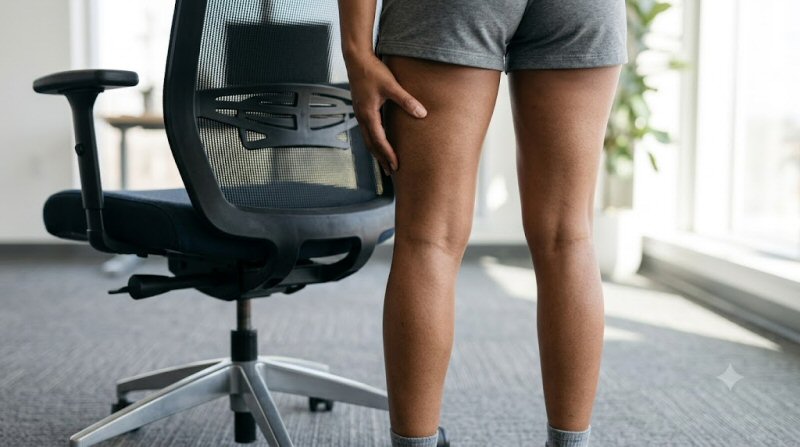
You stand up after a long stretch at the computer, take a few steps, and the backs of your thighs feel stiff and shortened. Reaching down to pick something up feels harder than it should, and a gentle stretch reveals a clear tug behind the knees. This “desk-day hamstring tightness” is one of the most ordinary side effects of modern sitting.
For most people it is a temporary adaptation, not a sign of injury. The hamstrings—semitendinosus, semimembranosus, and biceps femoris—spend hours in a shortened position when the knees are bent and the hips are flexed. Over days and weeks the muscle and its surrounding fascia simply adjust to that length. When you finally stand, they register the change as tightness.
What This Sensation Usually Feels Like
The typical pattern is a dull, band-like stiffness across the back of one or both thighs that appears after two or more hours of continuous sitting. It is most noticeable when you first stand, walk, or try to hinge forward at the hips. Many people describe it as a “pull” or “resistance” rather than sharp pain. The feeling often eases after a few minutes of walking or a simple stretch, then returns the next day if sitting resumes.
Unlike a sudden muscle strain, there is no bruising, swelling, or loss of strength. The tightness is bilateral more often than not, and it correlates with the length of the sitting bout rather than with any specific movement.
Common Everyday Causes
Prolonged sitting is the dominant trigger. Studies of office workers and students consistently show reduced hamstring flexibility (measured by straight-leg raise or active knee extension) after six to eight hours of chair time. When the knee stays bent, the hamstrings rest in a shortened state; the muscle spindles and connective tissue adapt, a process physiologists call adaptive shortening.
A second common factor is the accompanying pelvic position. Sitting tends to tilt the pelvis backward. The hamstrings, which attach to the ischial tuberosities, help maintain that tilt. Over time the combination of a shortened muscle and a habitually posterior pelvis makes the back of the thigh feel tight even when the muscle itself has not been injured.
Weak gluteal muscles often accompany the pattern. When the glutes are under-used, the hamstrings take on extra work stabilizing the pelvis, which can leave them feeling both tight and overworked. Physical therapist Matt Natanson and others have noted this “double duty” effect in people who sit most of the day.
Why the Hamstrings Respond This Way
Early observations by J. J. Keegan in the 1950s linked hamstring length directly to pelvic rotation and lumbar posture. Later work has confirmed the relationship: tighter hamstrings favor greater posterior pelvic tilt and a flatter lumbar curve while seated. Research groups examining desk workers (including studies by Fatima and colleagues and by Madhubabu Kothapalli) repeatedly find that longer daily sitting hours predict poorer hamstring flexibility scores.
The mechanism is straightforward. Muscle and fascia remodel to the positions they occupy most often. Six to eight hours of knee flexion is enough for measurable shortening. When you stand, the sudden demand for a longer resting length produces the familiar stiffness. Walking or light stretching restores temporary length; without regular interruption, the adaptation returns.
This is not the same as a true muscle strain or nerve irritation. It is a length-adaptation problem driven by modern sedentary hours—exactly the kind of everyday mismatch the body registers as tightness.
Less Common but More Serious Possibilities
True hamstring strains, sciatic nerve irritation, or referred pain from the lumbar spine can mimic simple tightness. A strain usually follows a sudden sprint, jump, or heavy lift and produces sharp pain, bruising, or difficulty walking. Sciatic symptoms often travel below the knee and may include tingling or numbness. Disc-related pain typically worsens with prolonged sitting or forward bending and may be accompanied by back pain.
If the “tightness” is one-sided, constant, or paired with neurological signs, it deserves a different explanation than ordinary desk adaptation.
Hidden Triggers That Amplify the Feeling
- Long uninterrupted sitting blocks (more than 60–90 minutes without standing).
- Low chair height that keeps the knees more flexed.
- Habitual posterior pelvic tilt or slouching.
- Weak glutes and hip flexor tightness that alter pelvic control.
- Recent increase in sitting hours (travel, deadlines, new desk job).
- Inadequate recovery after previous exercise that already loaded the hamstrings.
Even people who exercise can develop the pattern if the majority of their waking hours are still spent seated.
When the Tightness Is Worth Closer Attention
Seek evaluation if you notice:
- Sudden sharp pain during activity, followed by swelling or bruising.
- Weakness that makes it hard to walk or climb stairs.
- Numbness, tingling, or pain radiating past the knee.
- Tightness that does not ease with walking or gentle stretching and persists for days.
- Associated low-back pain that limits daily movement.
- Night pain or symptoms that wake you.
For the common post-desk stiffness that improves with movement, medical attention is rarely needed.
Myths vs Facts
Myth: Tight hamstrings always mean you need to stretch more.
Fact: Stretching helps, but the primary driver is hours spent in the shortened position. Breaking up sitting time often reduces the sensation more than stretching alone.
Myth: Only athletes get tight hamstrings.
Fact: Sedentary adults frequently show greater tightness than recreational athletes precisely because of prolonged knee flexion.
Myth: The feeling means the muscle is injured.
Fact: Adaptive shortening produces stiffness without tissue damage. Strength and function remain normal.
Practical Ways to Ease Desk-Day Hamstring Tightness
Simple, repeatable habits work best:
- Stand and walk for two to three minutes every 45–60 minutes. Even short interruptions reset muscle length.
- Perform a gentle standing hamstring stretch (heel on a low step or floor, slight knee bend, hinge from the hips) for 20–30 seconds per side once or twice a day.
- Strengthen the glutes with bridges or short walks so the hamstrings are not forced to stabilize the pelvis alone.
- Check chair height so the thighs are roughly parallel to the floor and the knees are not excessively flexed.
- Include occasional hip-hinge movements (light deadlift pattern or simply picking objects up from the floor with a flat back) to remind the hamstrings of their full length.
These steps align with the findings that periodic stretching and reduced continuous sitting improve lumbar posture and hamstring comfort. For related patterns, see how calves often feel tight after long sitting and why the lower back still expects its natural curve.
When to See a Doctor or Physical Therapist
Most desk-related tightness resolves with the habits above. Consult a clinician if the sensation is progressive, one-sided, or accompanied by neurological symptoms, significant weakness, or back pain that interferes with work or sleep. A physical therapist can distinguish adaptive shortening from true strain or nerve involvement and guide targeted loading.
Frequently Asked Questions
Is it normal for only one hamstring to feel tight after sitting?
Yes. Slight side-to-side differences in posture, chair position, or previous minor strains are common. If the difference is large or new, note whether it travels below the knee.
Will stretching every day permanently fix it?
Daily stretching improves comfort, but the tightness returns if sitting hours remain long and uninterrupted. Combining stretch with frequent standing breaks is more effective.
Can tight hamstrings cause low-back pain?
They can contribute. Posterior pelvic tilt linked to short hamstrings flattens the lumbar curve and increases passive tissue load. Addressing both the hamstrings and sitting habits often reduces the back discomfort.
How long does it take for the tightness to improve?
Many people notice less stiffness within a week of regular movement breaks and light stretching. Full restoration of flexibility may take several weeks of consistent change.
Should I avoid sitting altogether?
No. The goal is interruption, not elimination. Standing desks, walking meetings, and simple timers all help without requiring a complete lifestyle overhaul.
The Bottom Line
Feeling tight hamstrings after a desk day is a normal, reversible response to hours spent with the knees bent. The muscles and fascia adapt to the shortened position; standing simply reminds them of the length they once held more often. Frequent short walks, gentle stretches, and attention to pelvic position restore comfort for most people. If the sensation stays sharp, one-sided, or travels down the leg, a professional check is sensible—but for the ordinary post-sitting tug, movement is usually the most effective remedy.


