Eyes watering or even bubbling when you blow your nose is usually just pressure traveling the wrong way through the tear duct. Here’s why it happens and when it is worth checking.
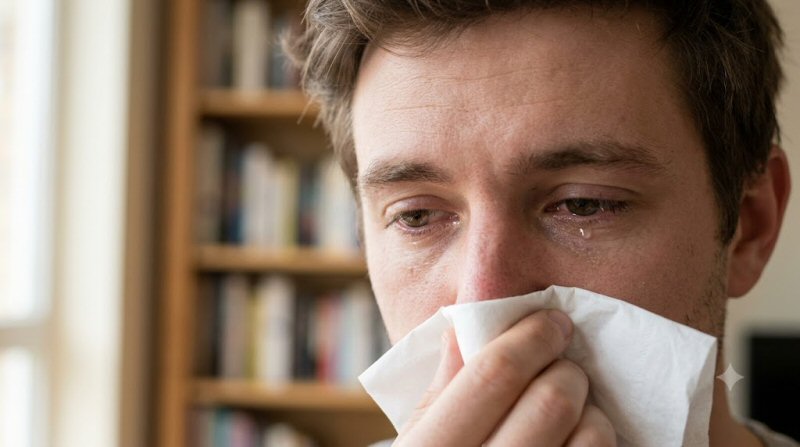
You lean over a tissue, blow your nose after a cold or allergies, and suddenly one eye waters—or you feel a tiny bubble of air escape near the inner corner. It can be surprising, even a little alarming the first time. For most people it is a normal, short-lived effect of the shared plumbing between your eyes and nose.
What This Symptom Feels Like
The watering is usually one-sided or stronger on the side you are blowing harder. You may notice a tear spilling onto your cheek, a wet sensation at the inner corner, or, in some people, a small puff of air or mucus that briefly exits near the punctum (the tiny opening on the eyelid). It stops almost as soon as the pressure drops. The eye itself does not feel injured, and vision stays clear.
This is different from the steady tearing that can happen with wind, cold air, or a blocked duct. Here the trigger is the act of blowing itself.
Why This Happens
Tears are produced by the lacrimal gland and spread across the eye with each blink. Excess fluid drains through two small openings called puncta—one on the upper lid and one on the lower—into tiny canals (canaliculi) that empty into the lacrimal sac. From there the nasolacrimal duct carries the fluid down into the lower part of the nose, just under the inferior turbinate. The same pathway is why your nose runs when you cry: the tears simply finish their journey into the nasal cavity. You can read more about that reverse direction in our article on why your nose runs when you cry.
At the bottom of the duct sits the valve of Hasner (named after the 19th-century anatomist Hans Hasner von Artha). Under ordinary conditions this one-way flap helps keep nasal air and mucus from flowing upward. When you blow your nose you create a brief spike of pressure inside the nasal cavity. If that pressure is high enough—or if the valve is a little lax—fluid or air can be pushed backward through the duct, up into the lacrimal sac, and out through the punctum. The result is watering, or occasionally visible air bubbles, at the inner corner of the eye.
The phenomenon is simply reverse flow through a connected system. It is more noticeable during a cold or allergy flare because the nasal lining is already swollen and the duct opening can be partly narrowed, so pressure builds more easily.
Common Causes
- Forceful nose blowing, especially with both nostrils pinched shut at once.
- Nasal congestion from a cold, sinus irritation, or allergies that reduces the space for air to escape downward.
- A naturally narrower or slightly incompetent valve of Hasner in some people.
- Recent upper-respiratory illness that leaves the ducts a little more permeable for a few days.
None of these require a structural problem. The connection between eye and nose is normal anatomy; the pressure simply travels the path of least resistance for a moment.
Less Common but Serious Considerations
True nasolacrimal duct obstruction (partial or complete) can cause persistent watering that is unrelated to blowing. In adults this may develop gradually from inflammation, prior surgery, or age-related narrowing. In those cases the eye waters in wind, cold air, or throughout the day, not only when the nose is blown. Infection of the lacrimal sac (dacryocystitis) produces swelling, redness, and tenderness at the inner corner plus discharge. Facial trauma or recent sinus surgery can also create abnormal pathways for air. These situations are uncommon relative to ordinary pressure reflux.
Hidden Triggers
Holding the nose tightly closed while blowing forces more pressure into the ducts. Using a tissue that blocks both nostrils at the same time has the same effect. Dry indoor air or continued congestion can make the lining more reactive, so even moderate blowing produces the sensation. People who frequently reverse the flow may also notice similar pressure effects with yawning or vigorous nose clearing, though those are milder.
When to Worry
Occasional watering or a single bubble of air that resolves immediately is not a cause for concern. Contact a clinician if you notice:
- Watering that continues for hours after the blow, or happens without any nose blowing.
- Yellow, green, or bloody discharge from the eye or the inner corner.
- Pain, swelling, or redness at the side of the nose near the eye.
- Changes in vision, double vision, or a feeling of something in the eye.
- Symptoms that began after facial injury or surgery.
These can point to obstruction, infection, or, rarely, a more significant connection between the nose and the orbit.
Myths vs Facts
Myth: Air or fluid coming out of the eye means the eyeball itself is leaking.
Fact: The fluid or air travels through the tear-drainage system, not through the globe of the eye.
Myth: This only happens if you have a blocked tear duct.
Fact: Most people who experience it have open ducts; the pressure simply overcomes the one-way valve temporarily.
Myth: Blowing your nose hard is harmless as long as nothing hurts.
Fact: Repeated high pressure can push mucus into the ducts and raise the chance of local irritation or infection. Gentle technique is better.
How to Manage It
Blow gently and one nostril at a time. Place a finger against the opposite nostril, keep the pressure moderate, and avoid pinching both sides shut. A saline rinse or steam can loosen mucus so less force is needed. If congestion is the main driver, treating the underlying cold or allergy usually reduces the episodes. Over-the-counter nasal saline sprays are generally safe and help keep the duct opening clearer.
If the watering becomes frequent or bothersome even with gentle technique, an eye-care professional can check whether the ducts are draining normally. Simple tests (such as dye disappearance or gentle irrigation) can confirm that the pathway is open.
Related everyday pressure effects appear in other places: the same kind of short pressure change can make your ears pop when you swallow, and outdoor air movement can increase ordinary tearing, which we cover in why eyes water in the wind.
When to See a Doctor
See a primary-care clinician or optometrist/ophthalmologist if the watering is persistent, one-sided and worsening, accompanied by discharge or swelling, or if you have had recent facial trauma. Most cases of simple pressure reflux need no treatment beyond gentler nose blowing. Persistent obstruction, when present, is usually managed with massage, drops, or, less often, a minor procedure to open the duct.
FAQs
Why does only one eye water?
You are usually generating more pressure on the side you are blowing harder, or that side’s valve is slightly more permissive. Both sides share the same anatomy.
Can this spread infection into the eye?
In theory, forceful reverse flow can carry nasal mucus upward. That is one reason clinicians recommend gentle, one-sided blowing. Occasional mild episodes rarely cause problems.
Is it the same as air coming out of the eye under water?
Yes. The same pathway allows air to travel upward when nasal or sinus pressure is high enough. Brief bubbles are usually harmless.
Does this mean I have a blocked tear duct?
Not necessarily. Blocked ducts cause ongoing tearing; pressure reflux causes brief tearing only while you blow. A clinician can distinguish the two if needed.
Will it stop once my cold is gone?
In most people, yes. Once swelling decreases and you return to gentle blowing, the episodes become rare or disappear.
Conclusion
Eyes that water—or briefly bubble—when you blow your nose are a straightforward consequence of the tear duct’s connection to the nasal cavity and the temporary pressure of a hard blow. The anatomy is normal; the direction of flow is simply reversed for a second. Gentle, one-nostril technique usually prevents it. Persistent watering, pain, or discharge are the signals that deserve a closer look, but for everyday colds and allergies the phenomenon is common, self-limited, and harmless.