
Stiff elbows after a long desk day are common. Learn why mouse use, static postures, and forearm loading cause it, plus practical ways to ease the stiffness.
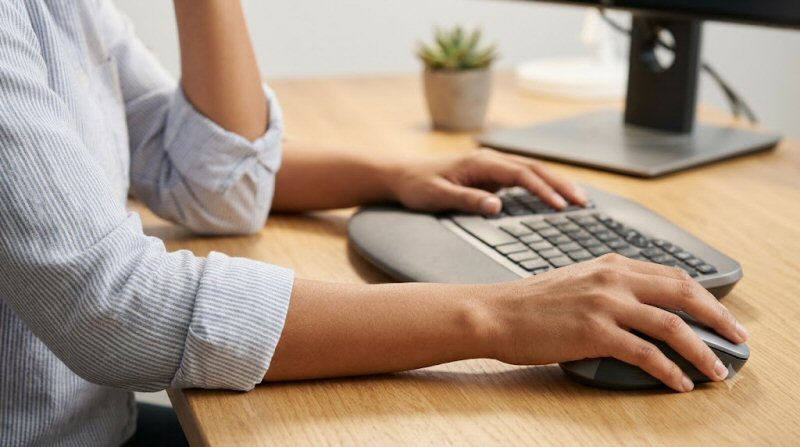
You stand up after hours at the computer and your elbows feel stiff. Straightening them fully takes a moment, and there is a dull tightness on the outside of one or both elbows that was not there this morning. Gripping a mug or turning a doorknob later feels slightly awkward. This is a familiar end-of-day sensation for many people who spend most of their time seated at a keyboard and mouse.
Yes, mild elbow stiffness after a full desk day is common and usually benign. It reflects how the joint and its surrounding tendons respond to prolonged static positions and thousands of small, repetitive loads rather than a sudden injury.
What This Symptom Feels Like
The stiffness is often most noticeable when you first change position—standing up, reaching for something, or fully straightening the arm. It may sit on the outer bony knob of the elbow (the lateral epicondyle) or feel more general around the joint. Some people describe a mild ache that appears only after gripping or lifting, while others notice the elbows simply feel “rusty” until they move them a few times. The sensation usually eases with gentle movement and is rarely sharp or accompanied by swelling at first.
Common Causes
Several everyday desk habits contribute:
- Hours spent with elbows bent near 90 degrees and forearms held in a relatively fixed position.
- Mouse use that keeps the wrist slightly extended while the hand grips or clicks repeatedly.
- Keyboard work that involves frequent small finger and wrist motions without full arm movement.
- Insufficient forearm support, so the muscles that cross the elbow stay lightly active all day.
- Leaning the elbows on a hard desk edge for long periods, which compresses soft tissue and nerves.
Occupational studies have linked longer mouse and keyboard time with higher rates of elbow symptoms. The NUDATA study of nearly 7,000 computer operators, led by Christina Funch Lassen and colleagues, found that mouse time predicted elbow pain even at relatively low weekly exposures, without a clear safe threshold.
Why This Happens
The elbow joint and the tendons that attach there are built for varied, intermittent loading—reaching, carrying, turning tools, climbing, and occasional pushing. In a typical desk day the joint stays flexed, the wrist extensors (especially the extensor carpi radialis brevis) experience continuous low-level tension from mouse gripping and clicking, and the arm rarely goes through its full range. Over many hours the tendons and joint capsule can feel temporarily less pliable, and the muscles that stabilize the elbow accumulate mild fatigue. This is not inflammation in the classic sense for most people; it is more often a load-and-recovery mismatch. When the same pattern continues for weeks, the outer elbow can develop the irritation commonly called “mouse elbow” or lateral epicondylalgia.
Workstation factors matter. Research examining office setups has shown that inadequate arm support, mouse position, and keyboard height are associated with higher rates of elbow and wrist symptoms. When the forearm is unsupported, the elbow joint and its tendons bear more of the arm’s weight for hours.
Less Common but Serious Possibilities
Most desk-related elbow stiffness is mechanical and resolves with changes in position and load. Less often, the same habits can contribute to cubital tunnel irritation (ulnar nerve compression at the elbow) if you lean heavily on the inner elbow, or to a developing tendinopathy that begins to hurt with everyday gripping. True joint arthritis of the elbow is less common than at the hip or knee and usually produces more persistent stiffness and pain with broader movement loss.
Hidden Triggers
- A mouse placed far to the side, forcing the shoulder and elbow into prolonged abduction.
- A keyboard or desk that is too high, keeping the wrists extended and the elbow loaded.
- Working in a cool room, which can make muscles and tendons feel stiffer.
- Sudden increases in mouse-intensive tasks (data entry, design, gaming) after a quieter period.
- Previous minor elbow strain that has not fully recovered before returning to long desk sessions.
When to Worry
Mild stiffness that eases within minutes of standing and moving is usually not a concern. Seek medical advice if you notice:
- Numbness or tingling that travels into the ring and little fingers (possible ulnar nerve involvement).
- Noticeable weakness when gripping, turning a key, or lifting light objects.
- Pain that wakes you at night or is present even at rest.
- Visible swelling, redness, or warmth around the elbow.
- Stiffness that steadily worsens over weeks despite simple adjustments.
Myths vs Facts
Myth: Elbow problems only happen to people who play tennis or golf.
Fact: Desk-based repetitive loading of the wrist extensors is a well-documented cause of outer-elbow symptoms, often called mouse elbow.
Myth: Complete rest is the best treatment.
Fact: Prolonged rest can leave tendons less tolerant of load. Gradual, controlled movement and progressive loading usually work better once acute irritation settles.
Myth: If the desk is at elbow height, the elbows cannot be the problem.
Fact: Height is only one factor. Mouse reach, wrist position, forearm support, and total hours of sustained use still influence tendon load.
How to Manage It
Small changes often reduce the stiffness within days:
- Keep elbows close to your sides and bent roughly 90 degrees, with forearms supported by the desk or armrests.
- Bring the mouse closer and try to keep the wrist neutral rather than cocked upward.
- Take short movement breaks every 30–45 minutes: straighten the elbows fully, gently turn the palms up and down, and shake the arms.
- Avoid resting the full weight of the elbow on a hard edge for long periods; use a soft pad if needed.
- Strengthen the forearm gradually with light wrist-extension exercises once the acute stiffness has eased—slow, controlled repetitions rather than aggressive stretching.
These adjustments also help related issues. People who notice fingers feeling stiff after typing all day often benefit from the same forearm and wrist positioning changes. The underlying load pattern is similar to the one described in discussions of why the wrist extensors still expect occasional loaded extension rather than hours of sustained low-level tension.
When to See a Doctor
Most desk-related elbow stiffness improves with ergonomic tweaks and regular movement. Contact a clinician if symptoms persist beyond two to three weeks, if you develop clear numbness or weakness, or if the elbow begins to hurt with ordinary daily tasks such as lifting a kettle or shaking hands. Early guidance can distinguish simple overload from developing tendinopathy or nerve irritation and prevent longer recovery times.
FAQs
Why does only my mouse-side elbow feel stiff?
The mouse hand usually works with a more sustained grip and slight wrist extension than the keyboard hand, so the outer elbow tendons on that side accumulate more load.
Will switching to a vertical mouse help?
Many people find a vertical or neutral-grip mouse reduces wrist extension and therefore outer-elbow load. It is worth trying, but forearm support and break habits still matter more than any single device.
Is this the same as tennis elbow?
Early stiffness can be the mild end of the same spectrum. Tennis elbow (lateral epicondylalgia) is the name used when the outer elbow tendons become more persistently irritable with gripping and wrist extension.
Should I wear a brace while I work?
A counterforce strap can temporarily reduce tendon strain for some people, but it does not fix the underlying posture or load pattern. Use it as a short-term aid while you adjust the workstation, not as a permanent solution.
How long does the stiffness usually last after I stand up?
For most people it eases within a few minutes of moving the arms through a fuller range. If it lingers for hours or is accompanied by pain with light gripping, the load has likely been higher than the tissues can recover from overnight.
Conclusion
Feeling your elbows stiffen after a long day at the desk is a common response to sustained flexed postures and repetitive low-level forearm loading. The joint and its tendons are simply not designed for eight hours of nearly static mouse and keyboard work. Simple changes—supporting the forearms, keeping the wrists closer to neutral, and inserting brief full-range movements—usually restore comfort quickly. Persistent stiffness, especially with numbness or weakness, deserves a closer look, but for most people the sensation is a manageable signal that the elbows need more variety than a modern desk day provides.


