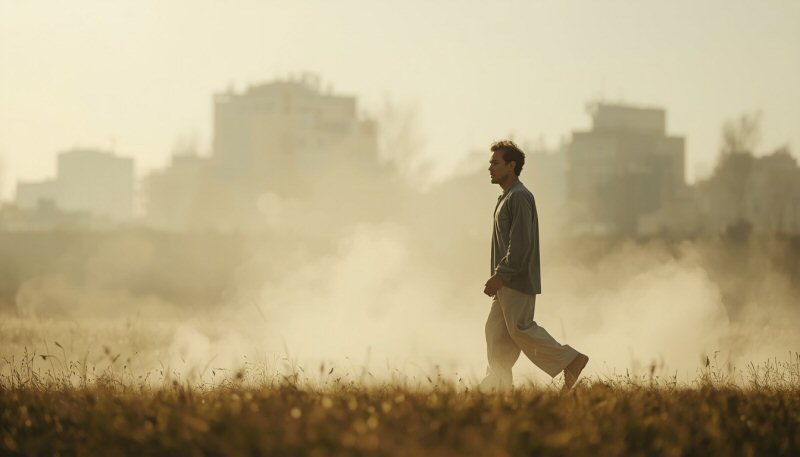
The prostate still expects upright walking, pelvic-floor loading and a dark night of lower androgen drive. McNeal, Huggins, Coffey and Isaacs mapped a gland modern sitting and light rarely rest.

The prostate is a walnut-sized gland that most men only notice when it starts to argue with a night of sleep. It sits under the bladder, wraps the first stretch of urethra, and spends decades making a thin, alkaline fluid meant to travel with sperm. It was not designed as a hobby organ. It was designed as a reproductive accessory that expected two old conditions: a body that walked, and a night that actually went dark.
Neither condition is guaranteed now.
John McNeal’s zonal anatomy still explains why the argument starts in one neighborhood of the gland and not another. Charles Huggins showed how tightly the tissue listens to androgen. Donald Coffey and John Isaacs mapped how that listening turns into growth when the cue never quite turns off. The mismatch is not that men still have a prostate. It is that the gland still expects a walking day and a quiet hormonal night, and modern sitting, obesity, and evening light keep briefing it as if both were optional.
What the gland actually is
The adult prostate is not a single blob. McNeal divided it into zones that behave like different organs sharing a postcode.
The peripheral zone is the bulk of the gland, the region most prone to cancer. The central zone sits around the ejaculatory ducts. The transition zone — a small sleeve around the urethra — is the region that enlarges in benign prostatic hyperplasia (BPH) and pinches the pipe you notice at 2 a.m. A fibromuscular stroma wraps the whole structure and answers to the same pelvic-floor pressure system described in why your pelvic floor still expects walking and a squat.
Fluid from the gland is rich in citrate, zinc, and prostate-specific antigen (PSA), a protease whose job in semen is to liquefy the clot so sperm can swim. High zinc and citrate are expensive. The epithelium spends metabolic effort keeping citrate from being burned in the Krebs cycle — a biochemical oddity that Gerald Costello and others later tied to zinc’s inhibition of m-aconitase. A working prostate is not idle tissue. It is a secretory factory that expects occasional emptying, not a decade of low-flow sitting.
Embryologically the gland buds from the urogenital sinus under androgen and stromal instruction. Gerald Cunha’s tissue-recombination work showed that mesenchyme tells epithelium what to become. That conversation never fully ends. In adult life the stroma still whispers growth factors — FGF, IGF, TGF-β — whenever androgen, insulin, and local inflammation stay high.
Huggins and the androgen brief
In the 1940s Charles Huggins demonstrated that prostate cancers often shrink when testicular androgen is removed or blocked. The observation won a Nobel Prize and created an entire field. It also revealed something quieter about the healthy gland: prostate epithelium is androgen-dependent tissue. It does not grow on a whim. It grows when dihydrotestosterone (DHT), made locally by 5α-reductase type 2, occupies androgen receptors and turns on a transcriptional program of survival and secretion.
That program evolved under a different calendar.
Ancestral adult men had androgen, but they also had nights of true darkness, days of locomotion, lower body fat, and far fewer years of uninterrupted caloric surplus. Testosterone itself has a circadian shape — higher in the morning, lower at night — that sleep and darkness help keep honest. Evening light, short sleep, and the pineal story in why your pineal gland still expects true darkness flatten that rhythm. The receptor in the prostate does not read “lifestyle.” It reads ligand.
Finasteride and dutasteride later proved the point from the other direction: block 5α-reductase, lower intra-prostatic DHT, and transition-zone volume often stops climbing. The drugs are not a philosophy. They are evidence that the gland is still listening to a steroid brief that modern life rarely turns down.
Walking was part of the plumbing
The prostate does not have a muscle pump of its own the way the calf does. It lives in a pressure neighborhood.
Each step loads the pelvic floor, changes venous drainage through the prostatic plexus, and briefly alters urethral and bladder-neck geometry. Long sitting does the opposite. Intra-abdominal pressure stays low-grade and constant. The plexus drains more slowly. The transition zone, already hugging the urethra, spends more of the day in a warm, still, slightly congested state.
Epidemiology is not destiny, but it is consistent enough to take seriously. Elizabeth Platz, Edward Giovannoni and colleagues have repeatedly found that higher physical activity — especially walking and vigorous movement across adulthood — tracks with lower risk of BPH symptoms and, in some cohorts, lower risk of advanced prostate cancer. Obesity and the metabolic syndrome track the other way. Insulin and IGF-1 are growth signals. Adipose aromatase and inflammatory cytokines are growth signals. A gland that expected scarce calories and a walking day now sits in a chair under a surplus.
This is the same family of mismatch as veins that still expect a calf pump and lymph that still expects you to walk. The prostate is smaller and more hormonal than a calf. It is not exempt from gravity or stillness.
Heat is a second quiet input. The testes hang outside the body because spermatogenesis needs a cooler niche — the story in why your testes still expect to hang cool. The prostate sits inside. It does not need scrotal cooling. It does, however, share a pelvis with organs that sit warmer during long chair time, laptop-on-lap hours, and tight clothing. No serious researcher claims that a laptop causes BPH by itself. A warm, still pelvis for ten thousand hours is still a different brief than a walking one.
Night, emptying, and the 2 a.m. argument
BPH symptoms are not only “a big gland.” They are a mismatch between gland, bladder, and night.
As the transition zone grows, the urethra narrows and the bladder works harder. Detrusor muscle thickens. Sensitivity rises. The first thing many men notice is not a weak stream at noon. It is waking to void, standing longer at the bowl, then lying down and needing to go again. Nocturia has many parents — late fluid, sleep apnea, poorly timed caffeine, a bladder that was trained for just-in-case trips. A growing transition zone is one of the common ones after midlife.
Sleep architecture makes the argument louder. Deep sleep and a proper overnight fast blunt some of the overnight urine production that light sleep and late eating encourage. Growth hormone and cortisol clocks still expect that night, as other articles on this site have mapped. When the night is short and bright, the bladder and the prostate share the same poorly timed briefing.
Ejaculation empties prostatic acini. It is not a medical treatment, and frequency advice should stay out of folklore. But a secretory gland that almost never empties is not in its ancestral use pattern either. The point is mechanical and biochemical, not moral.
Inflammation as a modern extra
Giovannoni’s work on prostate inflammation, and a long trail of histopathology after McNeal, shows that many aging prostates are not merely “hormonal.” They are quietly inflamed. Corpora amylacea, immune infiltrates, and cytokine chatter sit in the same zones that later scar and grow.
Possible drivers include reflux of urine into ducts, metabolic inflammation, sexually transmitted or urinary microbes in some men, and the general inflammatory tone of visceral fat. Ancestral life was not sterile. It was also not a fifty-year run of sitting, ultra-processed surplus, and untreated sleep apnea. Chronic low-grade inflammation is a growth factor the transition zone did not need more of.
Zinc loss from inflamed epithelium is one of the quieter biochemical insults. When zinc falls, citrate metabolism shifts and the gland’s differentiated secretory identity wobbles. That is not a supplement slogan. It is a reason “take zinc for prostate health” keeps returning in weaker form than the underlying cell biology deserves.
What is not an evolutionary story
Prostate cancer is not “BPH gone bad.” Different zones, different natural histories. A PSA rise, a nodule, blood in semen, bone pain, or unexplained weight loss is not a walking prescription. It is a reason to see a clinician who can separate hyperplasia from cancer and infection from both.
Acute bacterial prostatitis is a fever-and-pain emergency, not a mismatch essay. Chronic pelvic pain syndromes overlap the pelvic floor and the gland and need a different workup than “walk more.” Medications, alpha-blockers, 5α-reductase inhibitors, and surgery exist because anatomy sometimes wins. Evolutionary context explains the setup. It does not replace urology.
Age is real. Autopsy series since the mid-twentieth century have shown that histologic BPH and small prostate cancers become common with decades of androgen exposure. Hunter-gatherer men who reached those decades were fewer. Modern longevity unmasks a gland that was allowed to keep listening.
How to give the gland a more familiar day
You cannot put the transition zone back in 20,000 BCE. You can stop briefing it as if sitting and a lit night were the species-typical plan.
Walk on most days, including after meals. Pelvic venous drainage and insulin both improve with the same habit. The after-meal walk that steadies glucose is not a different organ’s story from this one.
Stand, squat, and change hip angle during the workday. The pelvic floor and the prostatic plexus notice stillness more than any single stretch video will admit.
Protect a dark night. Dim screens, finish the large drink earlier, and treat snoring as a bladder-and-prostate problem as well as a sleep problem. A man who wakes three times to void may have a gland, a bladder, an apnea, or all three.
Keep waist circumference honest. Visceral fat is an endocrine organ aimed at the same androgen and insulin receptors the prostate already has.
Do not chase unproven “prostate cleanse” products. The evidence that sits on real names — McNeal, Huggins, Coffey, Isaacs, Platz, Giovannoni — points to androgens, growth factors, inflammation, and mechanics, not a detox tea.
If the stream has changed, if night voiding is new, or if there is blood, fever, or bone pain, get examined. A walking gland is still allowed to need a doctor.
Myths vs facts
Myth: A large prostate always means cancer.
Fact: BPH lives mainly in the transition zone. Most cancers start in the peripheral zone. Size and malignancy are not the same measurement.
Myth: If you can still void, the gland is fine.
Fact: Compensation can hide obstruction for years while the bladder thickens and nights fragment.
Myth: Sitting has nothing to do with pelvic organs.
Fact: Venous drainage, pelvic-floor tone, and metabolic signals all change with hours of chair time. The prostate lives in that neighborhood.
Myth: Testosterone therapy automatically ruins the prostate.
Fact: The relationship is more careful than slogans. Untreated deficiency and reckless excess are both poor briefs; decisions belong with measured levels and a urologic plan.
Myth: Saw palmetto replaces evaluation.
Fact: Symptom teas do not map zones, exclude cancer, or treat retention.
When to see a doctor
Seek care promptly for inability to void, fever with pelvic or perineal pain, blood in urine or semen, unexplained bone pain, or a rapidly rising need to strain. See someone sooner rather than later for new nocturia, a stream that has thinned over months, or a first-degree relative with early prostate cancer. Age-based screening conversations are individual. They are not optional forever.
FAQs
Why do prostate problems show up at night first?
Lying down redistributes fluid, the bladder’s working reserve is smaller after a long day, and a narrowed urethra plus a thicker detrusor make the first stretch of sleep a poor time to store urine. Night is when the mismatch becomes audible.
Does cycling harm the prostate?
Prolonged pressure on the perineum can numb pudendal nerves and irritate the region. It is not a proven cause of BPH. Fit, saddle choice, and time off the seat matter more than folklore about “bike prostate.”
Can ejaculation frequency change prostate cancer risk?
Some cohort data, including work associated with Giovannoni’s group, have linked higher ejaculation frequency in adult life with lower reported prostate-cancer risk. The finding is epidemiologic, not a prescription dose. It does not replace screening.
Is PSA a cancer test?
PSA is a protein the gland makes for semen. Blood levels rise with cancer, hyperplasia, infection, and even recent ejaculation. It is a signal to interpret, not a diagnosis.
Do women have anything like this?
The female paraurethral (Skene) glands are homologous in a limited embryologic sense. They do not recreate BPH. The walking-and-night brief still applies to pelvic floor and bladder in every body.
Will walking shrink an already large prostate?
Walking is better at changing trajectory, insulin, and venous tone than at melting established transition-zone volume. Drugs and procedures exist for a reason. Movement is still one of the few briefs the gland recognizes from older life.
Conclusion
The prostate is a secretory sleeve around a tube, written in androgen and maintained in a walking pelvis. McNeal drew the zones. Huggins showed the steroid switch. Coffey and Isaacs described how growth keeps listening. Platz and Giovannoni tied the modern extras — stillness, fat, inflammation — to the symptoms men feel at night.
You do not owe the gland a mythic past. You can give it a day with steps in it and a night that is actually dark. That is a smaller request than the one the transition zone makes when it has been ignored for twenty years.