
The pronator teres still expects short, forceful forearm twists. Hours of palm-down typing leave it quiet, then a jar or screwdriver burns the inner elbow.
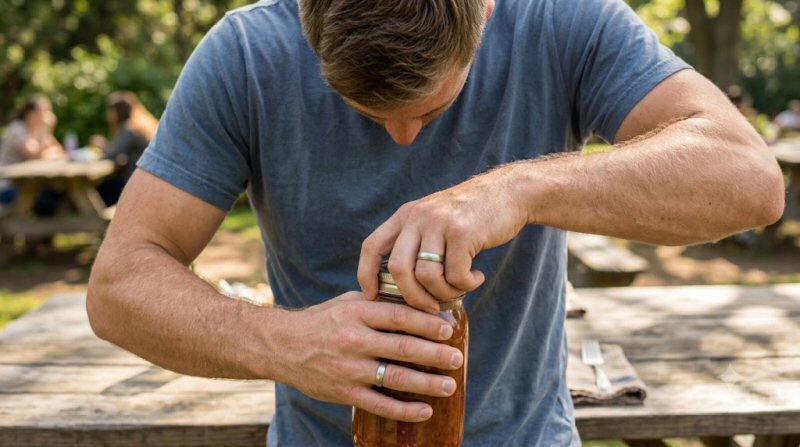
The lid should have given way on the second try. Instead the forearm locks, the inner elbow heats up, and the hand shakes before the seal breaks. The same thing happens with a stiff faucet, a long screwdriver job, or a towel wrung out after the first real workout in months. The keyboard never complained. The twist did.
That burn usually sits in the pronator teres, the power muscle that turns the palm down. It still expects short bursts of real rotation: tools, cords, hides, nuts, a grip that changes direction under load. A day of palm-down typing holds the forearm still in one position and never asks for torque. The muscle does not disappear. It just shows up late, and loud, the next time a jar will not move.
What This Ache Feels Like
The pronator teres runs from the inner elbow, just above the bony knob on the medial side, across the upper forearm to the middle of the radius. When it is unhappy, the ache is on the inner upper forearm, sometimes right at the common tendon where the wrist and finger flexors also begin, sometimes a few centimeters down toward the thumb side of the mid-forearm.
People notice it tightening a lid, driving a screw, turning a doorknob that sticks, using a manual can opener, or wringing a cloth. The keyboard and the phone feel fine. The protest starts when the hand leaves the desk and has to rotate against resistance. A next-day soreness after a move, a bike repair, or an afternoon of yard tools is common. So is a shaky, corded feeling if you try to keep turning after the muscle has already faded.
Pain that zings into the pinky after a knock on the inner elbow is the ulnar nerve in its groove, a different story from a tired pronator. Numbness in the thumb, index, and middle finger that wakes you at night is more often the median nerve at the wrist. A deep forearm ache that comes on with repeated twisting, with tingling in those same fingers while you are using the arm, can be the median nerve where it passes between the two heads of the pronator. Those patterns are covered below. A burn that tracks the twist and settles within a day or two is usually the muscle and its tendon, doing unpaid overtime.
What the Muscle Was Built to Do
Palm up and palm down are not small gestures. The radius rotates around a relatively still ulna. The axis runs from the radial head at the elbow to the ulnar head at the wrist. Healthy adults usually have something on the order of 70 to 90 degrees of pronation and a similar arc of supination, a range Bernard Morrey and colleagues mapped in elbow and forearm biomechanics work. You do not need the whole arc to type. You do need it, under load, to use the hand as a tool.
Two muscles pronate. Pronator quadratus sits deep at the far end of the forearm, close to the wrist. Electromyography from John Basmajian’s lab found it active in nearly every pronation, including slow unresisted turns. Pronator teres is the larger, more proximal muscle, with a humeral head from the medial epicondyle region and often an ulnar head from the coronoid. Basmajian’s recordings showed it recruited when pronation was fast or resisted, and it also assists elbow flexion. It is the muscle you feel when the lid fights back.
Supination, palm up, belongs mostly to the supinator when the elbow is straight and the load is light, and to the biceps when the elbow is bent and the load is heavy. A stuck jar rarely asks for one muscle. The forearm oscillates. The side that has not practiced forceful rotation is the side that burns.
Ancestral hands did this all day in short bouts: twisting fiber, turning a digging stick, hafting a tool, wringing a hide, cracking a nut between a rotating grip and a stone, climbing with the forearm rolling as the hand re-gripped. The loads were intermittent. The direction changed. The elbow was rarely pinned at a right angle for eight hours with the palm glued downward.
Why Desk Life Deletes the Twist
Modern forearm life is mostly a posture, not a task. A keyboard holds both forearms pronated. A mouse keeps the right one there. A phone cradled in one hand adds a small static bend. None of these ask the pronator teres for the brief high-torque contractions it was built to deliver. The muscle spends the day either quietly on, holding a position, or nearly off, while the wrist and finger flexors do the tiny keystrokes.
Then Saturday arrives with a jar, a screwdriver, or a faucet. The nervous system can still send the signal. The tendon and the muscle fibers have not seen that load in weeks. Force rises fast, the medial common tendon takes a share of it, and the inner elbow complains. The same pattern shows up in people who type all week and then do a single long session of manual work. It is not that the lid was uniquely evil. It is that the twist had no rehearsal.
There is a second mismatch inside the posture itself. Sustained pronation narrows the space where the median nerve passes between the pronator heads and under the lacertus fibrosus, the fibrous edge of the biceps tendon. Hours of that position do not equal a nerve injury. They do make a sudden, forceful pronation more likely to irritate both the muscle and, in a smaller group of people, the nerve running through it.
The forearm that still expects twist and grip is the wider version of this story. The pronator is the specific rotator inside it. The brachioradialis that still expects a carry lives on the other side of the same elbow and prefers a neutral, thumb-up hold. Desk life starves both, in different grips.
What the Recordings and the Tendon Studies Show
Basmajian and colleagues, using fine-wire EMG, separated the jobs. Pronator quadratus was the consistent pronator. Pronator teres joined for speed and resistance, and it contributed to elbow flexion. Supinator handled unresisted supination; biceps dominated resisted supination with the elbow flexed. The practical reading is simple: light daily turns keep the deep pronator honest, and occasional hard turns are what the pronator teres is for. A life with neither leaves a gap.
Kai-Nan An, Wendy Murray, and Morrey’s groups measured moment arms at the elbow and forearm. Pronator teres has a useful pronation moment and a smaller flexion moment. That is why a heavy twist with a bent elbow can ache both at the inner elbow and along the upper forearm. The muscle is doing two jobs at once.
On the tendon side, Robert Nirschl’s work on medial epicondylalgia, the pattern people call golfer’s elbow, found failed healing in the common flexor tendon rather than a hot inflammatory soup. Pronator teres and flexor carpi radialis are the usual neighbors in that tissue. The pain is load-related. It is not proof that the elbow is structurally ruined. It is proof that the tendon was asked for torque it had not been earning.
Henrik Seyffarth described pronator syndrome in 1951: median-nerve irritation at the forearm, distinct from compression at the wrist. Later surgical series, including work associated with Robert Spinner and colleagues, mapped the squeeze points: a ligament from an extra bony spur above the elbow, the lacertus, the pronator heads, and the arch of flexor digitorum superficialis. It is uncommon next to carpal tunnel. It is worth naming because the trigger is the same motion this article is about, and the nerve symptoms are the branch point between a tired muscle and a problem that needs a clinician.
Hidden Triggers
A few ordinary habits make the first hard twist louder.
The all-palm-down day. Keyboard, trackpad, and phone, with no mid-day turn of the forearm. The muscle is not weak in a dramatic sense. It is unpracticed at torque.
The cold start. Tools in a cold garage, a lid straight from the fridge, bare forearms in wind. Tendon and muscle tolerate load better once they are warm. The first rep takes the whole cost.
The shrugged shoulder and locked elbow. People attack a jar by hiking the shoulder and stiffening the wrist. The pronator then works as a posture muscle and a rotator. A slightly soft elbow and a closer grip share the job with the biceps and the shoulder.
One-sided life. The dominant hand opens every lid and drives every screw. The other pronator never sees the load, then complains the day you are forced to switch.
Grip size. A tiny lid or a thin screwdriver handle forces the finger flexors to clamp while the pronator twists. Wider handles, or a rubber jar opener that enlarges the lid, cut the squeeze so the rotator can do its own job.
A new sport on top of a desk week. Climbing, rowing, tennis serves, and manual labor all ask for forearm rotation. The elbow that still expects hanging and throwing is the same joint, loaded in a different direction. Adding both in one weekend is a classic way to meet your pronator suddenly.
When to Worry
Most twist-related inner forearm ache is mechanical and settles as the load becomes familiar. Some patterns are not a deconditioned pronator.
Numbness or tingling in the thumb, index, and middle finger that persists after you stop twisting, or that wakes you from sleep, needs a proper look. Night waking points more toward the wrist. Tingling that appears while you pronate against resistance, with aching in the upper forearm and a palm that feels dull over the thumb muscles, points more toward the pronator region. Weakness of pinch or of thumb abduction is not a normal training effect.
Pain after a fall, a pop at the elbow, visible swelling, or a forearm that will not rotate at all is urgent. So is inner elbow pain with chest pressure, breathlessness, or pain climbing into the jaw or left arm, which is a heart story until proven otherwise. Fever, redness, and a hot swollen joint are not a jar problem.
Neck pain with arm symptoms, symptoms in both arms, or clumsiness in the hands belongs with the cervical spine until someone competent says otherwise. A single sore twist does not.
Myths vs Facts
Myth: Inner elbow pain after a jar means you tore the muscle. Fact: A next-day ache after an unusual twist is usually tendon and muscle overload. A pop, bruising, and clear weakness are the tear pattern, and they are less common.
Myth: Palm-down typing trains the pronator. Fact: It holds a position. Basmajian’s split still applies. Position is not resisted rotation.
Myth: Golfer’s elbow only happens to golfers. Fact: Medial epicondylalgia is a load problem at the common flexor origin. Jars, tools, pull-ups, and carrying a heavy bag with a bent wrist are ordinary triggers. Golf is just the nickname.
Myth: You should stretch a burning pronator hard. Fact: Aggressive end-range stretches into a fresh tendon pain often irritate it. Gentle motion and smaller loads do more.
Myth: If the funny bone zings, the pronator is damaged. Fact: A brief shock into the pinky after a knock is the ulnar nerve in its groove. The pronator ache is a twist burn on the inner forearm, not a lightning zap.
How to Give the Twist Back
The aim is short, real rotation most days, not a heroic jar session on Sunday.
Turn something small on purpose. A towel wrung gently both ways, a screwdriver into a scrap board for a minute, a doorknob, the lid of an already-loose jar. Both directions. Both arms. Elbow soft, shoulder down, wrist not cocked hard. Twenty or thirty easy turns beats one stuck lid fought to the end.
Warm the forearm first if the task is heavy. A minute of easy open-and-close hand motion, or the first few turns done light, before you load the seal.
Change the tool before you blame the elbow. A rubber grip, a larger handle, or opening the jar with the hand turning palm-up against the thigh shares torque with the biceps and the shoulder. That is not cheating. It is how a fresh tendon survives contact with a modern lid.
Break the palm-down day. Once an hour, turn the forearms toward palm-up and palm-down a few times, unweighted, and let the arms hang. You are not building strength. You are reminding the rotation axis that it exists.
Progress the hard jobs. If a move or a repair day is coming, practice a few loaded turns earlier in the week. Tendon handles a familiar load better than a novel one, which is the practical lesson under Nirschl’s tendinosis description.
If the inner elbow is already sore, shrink the twist for several days. Keep easy motion. Avoid the one lid that reproduces a sharp pain. A slow return, with fewer hard repetitions, beats a week of total rest followed by the same jar.
When to See a Doctor
Get the arm examined if numbness lasts, if pinch is weak, if night pain in the hand keeps returning, if rotation is blocked, or if the ache is still limiting ordinary tasks after a couple of weeks of lighter load. Pronator-region nerve irritation and carpal tunnel are treated differently, and the split is a clinical one, not a guess from which jar you opened.
See someone sooner after trauma, swelling, or a pop. Seek urgent care for chest symptoms that ride along with arm pain, or for a hot, red joint. A first-week muscle burn after an unusual twist can wait out a quieter week. A changing nerve pattern should not.
FAQs
Why does only the inner elbow hurt when I open a jar?
Tightening a lid, and many screwdriver strokes, load pronation. Pronator teres pulls from the medial epicondyle region, so the inner elbow and upper forearm take the torque. Loosening often loads supination more. Either side can ache if that direction is unpracticed.
Is palm-down typing bad for the pronator?
The posture itself is ordinary. The problem is hours of it with almost no resisted twist. The muscle holds or idles, then meets a high load cold. Short unloaded turns through the day, and occasional real rotation, close the gap better than quitting the keyboard.
How is this different from the funny-bone shock?
A funny-bone zap is the ulnar nerve firing when you bump the groove on the inner elbow, and it runs toward the pinky. Pronator ache is a burn or fatigue during twisting, on the upper inner forearm. They can live in the same neighborhood and still be different tissues.
Can a tired pronator numb my fingers?
The muscle ache alone usually does not. The median nerve passes between the pronator heads, so repeated forceful pronation can irritate the nerve in a minority of people and tingle the thumb side of the hand. Night waking and thenar weakness need a clinician, because the wrist is the more common trap.
Should I wear a brace for this?
A strap sold for medial elbow pain sometimes lowers load on the common tendon during a flare. It does not replace gradual twisting. If a brace lets you keep attacking stuck lids, it is delaying the actual fix.
How long should a new twist ache last?
A mild burn that fades over a day or two after an unusual job is common. Pain that sharpens with every twist, numbness, or weakness that is still there next week is past the “unpracticed muscle” explanation.
Conclusion
The pronator teres is a torque muscle in a posture century. It still expects the short, forceful turn that came with tools, cords, and a grip that changed direction. Palm-down desks never hand it that job, so the first real lid feels like an injury. Most of the time it is an unpaid bill. Give the forearm small twists before the hard one, share the jar with a better grip, and let the inner elbow rehearse the rotation it was built to own.


