
Your small chest muscle that helps reach and stabilize the shoulder blade was built for varied arm motion, not hours of rounded desk posture. Here’s why it tightens and what helps.
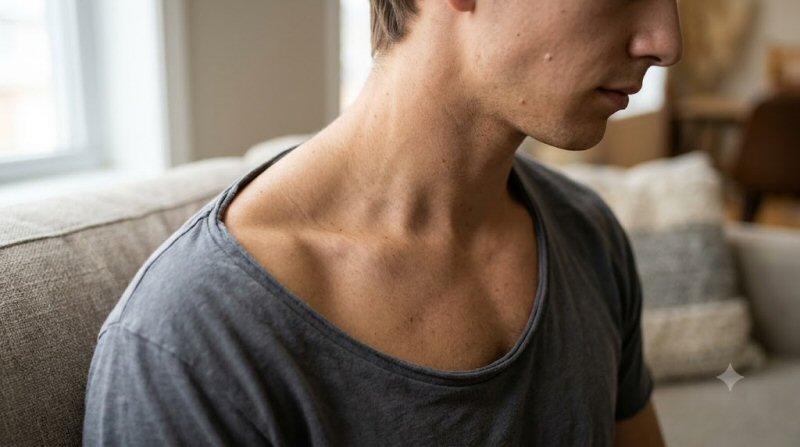
You finish a long afternoon at the desk, stand up, and notice your shoulders feel rounded and a little tight across the front of the chest. Raising your arms overhead takes more effort than it used to, and the area under your collarbone feels short. That small muscle—the pectoralis minor—is doing exactly what its anatomy prepared it for: pulling the shoulder blade forward and down when the arm reaches. The problem is that modern sitting keeps it in that shortened position for hours, with almost no counter-motion.
Unlike the larger pectoralis major that drives big pushing movements, the minor works more as a stabilizer and fine controller of the scapula. Researchers studying shoulder mechanics have shown how adaptive shortening of this muscle changes how the shoulder blade sits and moves. The result is a common, usually mild mismatch between what the muscle still expects and what a desk day actually provides.
What the Pectoralis Minor Actually Does
The pectoralis minor starts on the front of the third, fourth, and fifth ribs and runs upward and outward to attach to the coracoid process—the small bony hook on the front of the scapula. When the ribs are fixed, it draws the scapula forward (protraction), downward, and into a bit of anterior tilt. This helps stabilize the shoulder blade against the rib cage during forward reaching and assists in certain rotational movements of the scapula.
It also works with the serratus anterior during protraction and can act as an accessory breathing muscle when the scapula is fixed. In short, it is built for repeated, varied arm movements that keep the shoulder girdle mobile and the blade gliding smoothly. Anatomists and clinicians including Shirley Sahrmann and later researchers such as Paula Ludewig and John Borstad have described how chronic shortening of this muscle pulls the scapula into a more protracted and anteriorly tilted resting position.
Why It Still Expects Occasional Reach and Stabilization
For most of human history, arms were used for reaching, carrying, climbing, throwing, and bracing against resistance throughout the day. The pectoralis minor participated in those varied loads—shortening when the arm reached forward, lengthening when the arm came back or overhead, and sharing stabilizing work with the muscles on the back of the scapula. The motion was intermittent and multi-directional.
Desk work, driving, and phone use keep the arms forward and the shoulder blades protracted for long stretches. The muscle rests in a shortened range for hours. Over time it adapts by losing resting length—exactly the pattern observed in people who spend most of their day seated with rounded shoulders. Work by Borstad and Ludewig linked shorter pectoralis minor resting length with scapular kinematic changes similar to those seen in subacromial impingement. The muscle is still “expecting” the occasional full reach, the stretch that comes with arm elevation, and the balance of posterior stabilizers. When those inputs disappear, it simply stays short.
Related pieces on the site explore similar mismatches in neighboring muscles: why the larger pectoralis major still expects occasional horizontal pushing, and why the middle trapezius still expects occasional rowing and retraction.
Common Everyday Triggers
- Hours of computer work or typing with the shoulders rolled forward
- Driving with the arms held in front of the body
- Frequent phone or tablet use held low in the lap or against the chest
- Carrying a bag or backpack that encourages one-sided rounding
- Sleeping with the arm tucked tightly across the body
None of these are harmful in isolation. The issue is the cumulative time spent in the shortened position with little opposing motion.
Hidden Contributors
Weakness or poor endurance in the lower trapezius, serratus anterior, and rhomboids lets the scapula drift forward more easily, so the pectoralis minor never gets the stretch it would receive during proper upward rotation. Thoracic stiffness (a rounded upper back) reduces the space available for the scapula to tilt posteriorly. Stress-related shoulder hiking or breath-holding can keep the upper chest chronically elevated and tight. Even the simple habit of tucking the chin and rounding the shoulders while looking at a screen reinforces the pattern.
When the Tightness Is Usually Harmless
Mild tightness across the front of the chest, a slight forward shoulder posture, and a feeling that the arms don’t reach quite as far overhead as they once did are extremely common. Most people notice improvement with consistent movement breaks and simple stretches. The change is gradual and reversible for the majority of desk workers.
When to Pay Closer Attention
See a clinician if you have:
- Pain that radiates down the arm, especially with numbness or tingling
- Marked loss of arm elevation or strength that doesn’t improve with rest and gentle movement
- Pain at night that wakes you or is unrelated to position
- Sudden onset of shoulder weakness after an injury
- Symptoms that persist for weeks despite basic self-care
Rarely, a very tight pectoralis minor can contribute to compression of nerves or vessels under the coracoid (one form of thoracic outlet–type symptoms). This is uncommon and usually part of a broader picture rather than an isolated muscle issue.
Myths vs Facts
Myth: You must stretch the chest aggressively every day or the muscle will permanently shorten.
Fact: Consistent but gentle lengthening plus strengthening the opposing muscles is more effective than aggressive stretching alone. Over-stretching a chronically short muscle without addressing the surrounding pattern often leads to temporary relief only.
Myth: Rounded shoulders are purely a posture problem you can fix by “sitting up straight.”
Fact: Prolonged sitting changes muscle resting length. Simply cueing “shoulders back” without restoring length and endurance rarely lasts. The research on scapular dyskinesis emphasizes both mobility and motor control.
Myth: A tight pec minor means you need imaging or surgery.
Fact: In the absence of trauma or neurological signs, this is a soft-tissue adaptation. Most cases respond to conservative movement strategies.
Practical Ways to Give It What It Still Expects
You do not need a full gym session. Small, frequent inputs work better than rare intense ones.
- Every 30–45 minutes, stand and gently open the arms wide or place your hands on a doorframe and lean forward slightly for 20–30 seconds. Keep the stretch mild—you should feel a gentle opening, not a sharp pull.
- Practice a few slow arm elevations, focusing on letting the shoulder blades rotate upward rather than shrugging.
- Strengthen the opposing muscles with simple rows or “Y” raises (lying face-down or standing with light resistance) to restore balance. See the related article on middle trapezius for more detail.
- When driving or sitting, periodically roll the shoulders back and down and take a few deeper breaths that expand the lower ribs.
- If you use a phone a lot, hold it higher so the shoulders stay less protracted.
People who notice stiffness after long drives often benefit from the same brief resets: shoulder stiffness after driving is a related everyday pattern.
When to See a Doctor or Physical Therapist
If self-care for two to three weeks does not reduce the tightness or if you develop radiating pain, weakness, or true night pain, a musculoskeletal assessment is reasonable. A clinician can check scapular motion, measure resting length (often with the simple table-to-acromion distance), and rule out other causes. Most people improve with a short period of targeted mobility and strengthening rather than passive treatment alone.
FAQs
Is a tight pectoralis minor the same as a tight pec major?
No. The major is larger and more superficial; it powers pushing and horizontal adduction. The minor is deeper, attaches to the scapula, and mainly affects scapular position. Both can shorten with rounded posture, but they are assessed and stretched slightly differently.
Can this cause shoulder impingement?
It can contribute. A shortened pectoralis minor is associated with reduced upward rotation and posterior tilt of the scapula during arm elevation—motions that help clear the rotator cuff tendons. Addressing the length and the surrounding muscle balance often improves symptoms, though it is rarely the sole cause.
How long does it take to notice a difference?
Many people feel less tightness within a week of adding movement breaks and gentle stretches. Restoring resting length and scapular control usually takes several weeks of consistent practice.
Should I avoid all chest exercises?
No. Horizontal pushing is useful when done with good form and balanced with pulling movements. The issue is chronic resting in the shortened position, not the occasional loaded push.
Does sleeping position matter?
Yes, somewhat. Spending the night with the arm tightly crossed over the body keeps the muscle short. A slightly more open arm position or a supportive pillow arrangement can reduce morning tightness for some people.
Conclusion
Your pectoralis minor is a small but precise muscle that still expects occasional forward reach, stabilization, and the opposing length that comes from arm elevation and scapular retraction. Modern sitting removes most of those inputs and leaves it resting short. The resulting tightness and forward shoulder position are common, usually mild, and highly responsive to brief, regular movement that restores a bit of the variety the muscle was built for. A few doorframe stretches, upright arm raises, and opposing pulls throughout the day are often enough to keep the mismatch from becoming a daily complaint.


