
The slender palmaris longus muscle tenses the palm during firm grips. Modern keyboards and handles give it less varied work than ancestral tool use, so it can feel under-used or tight.
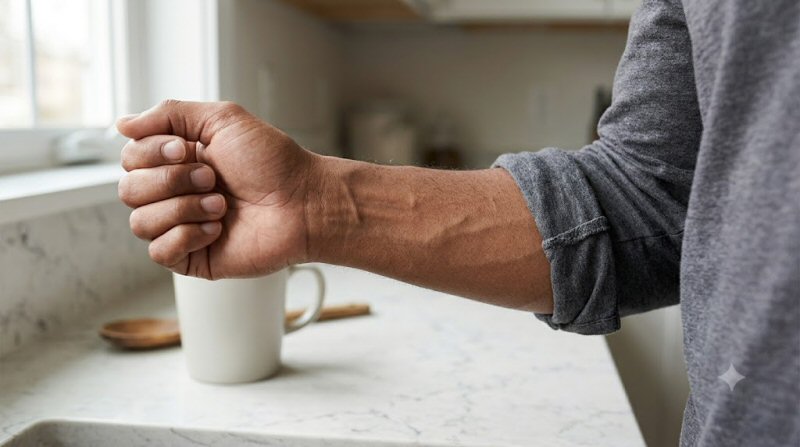
You press your thumb to your little finger and flex your wrist, and a slim tendon pops up in the middle of your wrist. That is the palmaris longus—if you have one. For most of human history this small muscle helped tense the skin and fascia of the palm while the hand locked onto tools, branches, or food. Today most of its work is limited to the same flat grips on phones, keyboards, and steering wheels. The muscle still expects occasional firm, varied tension across the palm, and when that demand disappears it can feel oddly tight, under-used, or simply invisible.
What This Muscle Actually Does
The palmaris longus is a slender, spindle-shaped muscle in the superficial flexor compartment of the forearm. It arises from the medial epicondyle via the common flexor tendon and inserts mainly into the palmar aponeurosis and flexor retinaculum. Its primary jobs are weak wrist flexion and tensioning of the palmar aponeurosis—the thick fibrous sheet that covers the palm. When it contracts it anchors the skin of the palm so the hand can grip without the skin sliding. It also sends occasional slips toward the thenar muscles and can assist thumb abduction. Because the bigger wrist flexors (flexor carpi radialis and ulnaris) do most of the heavy lifting, the palmaris longus is considered accessory. Studies such as those by Sebastin and colleagues have shown that people born without it have essentially normal grip and pinch strength.
Why Ancestral Life Loaded It Differently
In environments that required frequent tool use, climbing, or carrying irregular objects, the palm needed a quick way to stiffen its surface. Tensing the palmar aponeurosis helped distribute shear forces across the skin during strong or prolonged grips. The muscle’s tendon is long and relatively expendable, which is why surgeons still harvest it for grafts; its absence rarely impairs function. Evolutionary anatomists note that the muscle is more consistently present and functional in many non-human primates and becomes more variable in hominins as the thenar (thumb) apparatus enlarged. The shift toward precision grips and later tool technologies may have reduced the selective pressure on this particular tensioner, leaving it as a common but non-essential structure. Modern life has continued that trend: most daily hand tasks use open or flat grips that barely call on the palmaris longus.
How Modern Grips Change the Demand
Keyboards, mice, phone screens, and thin steering wheels keep the wrist near neutral and the fingers in light flexion. The palm rarely experiences the broad, sustained tension that comes from wrapping the hand around a rough branch, a heavy stone tool, or a thick rope. When the muscle does fire—during a firm handshake, opening a stiff jar, or hanging from a bar—it can feel briefly prominent or even mildly sore afterward if the surrounding forearm flexors are already tight from desk work. Some people notice the tendon only when they perform the classic test (oppose thumb to little finger and flex the wrist). Others never see it because the muscle is absent on one or both sides. Population studies report absence rates that vary widely by ancestry, commonly falling between roughly 5 % and 25 % in many groups, with higher rates sometimes seen in functional examinations than in cadaver studies.
Common Everyday Sensations
Most people with a present palmaris longus experience no specific symptoms. When something does draw attention it is usually mild:
- A visible or palpable midline wrist tendon that appears only during certain grips.
- A sense of mild tightness along the inner forearm after prolonged typing or driving.
- Brief discomfort at the wrist crease when the hand is forced into strong flexion under load.
- Awareness of the tendon after activities that suddenly demand a firm palm-down grip (carrying heavy bags, using hand tools).
These feelings are generally benign and related to the muscle’s small size and the sudden change in demand rather than injury. Related forearm and wrist issues are discussed in pieces such as why your forearms still expect twist and grip and why your wrist flexors still expect occasional loaded curls.
When the Sensation Might Point Elsewhere
True pain, swelling, or catching at the wrist is rarely caused by the palmaris longus itself. Median-nerve irritation, flexor tendon tenosynovitis, or early carpal-tunnel symptoms can produce aching or tingling that people sometimes attribute to the visible tendon. A sudden sharp pain after a forceful grip, or progressive loss of grip strength, deserves attention. If the tendon feels cord-like and the fingers begin to curl involuntarily, the problem is more likely in the palmar aponeurosis (as in Dupuytren-type changes) than in the muscle belly. Most of the time, however, noticing the palmaris longus is simply anatomy making itself known.
Simple Ways to Give It Useful Work
Because the muscle is accessory, the goal is not to isolate it but to restore occasional varied palm tension:
- Spend a few minutes several times a week gripping thicker objects—a rolled towel, a soft ball, or the handle of a heavier tool—while keeping the wrist in slight flexion.
- Alternate keyboard and mouse use with short sessions of open-hand stretching and gentle wrist flexion against light resistance.
- When carrying bags, switch hands and occasionally use a palm-down grip rather than a hook grip with straight fingers.
- If the inner forearm feels tight after desk work, a brief self-massage along the flexor compartment followed by slow wrist circles can restore comfort.
These habits also support the larger wrist flexors and reduce the static loading that contributes to mouse-related wrist ache, covered in is it normal for your wrists to ache after using a mouse.
Myths Versus Facts
Myth: Missing the palmaris longus means weak hands.
Fact: Multiple studies show no meaningful difference in grip or pinch strength.
Myth: The visible tendon is a sign of tendonitis.
Fact: It is normal anatomy that appears only when the muscle contracts; pain is usually coming from neighboring structures.
Myth: You should deliberately strengthen this muscle every day.
Fact: Occasional varied grips are enough; the muscle is designed as a helper, not a primary mover.
FAQs
How can I tell if I have a palmaris longus?
Touch the tip of your thumb to the tip of your little finger and flex your wrist against light resistance. A raised midline tendon usually means the muscle is present. Absence on one or both sides is common and normal.
Does its absence affect my grip?
No. Research consistently finds that people without the muscle have normal grip and pinch strength because the larger wrist flexors compensate fully.
Why does the tendon sometimes feel tight after typing?
Prolonged light flexion and static forearm posture can leave the superficial flexors mildly shortened. The palmaris longus, being thin, becomes noticeable when you later make a stronger grip.
Is it safe to use its tendon for a graft?
Yes. Surgeons have long harvested it precisely because its removal does not impair hand function in the large majority of people.
Can I make the muscle more prominent with exercise?
Light resistance wrist flexion and gripping can make the tendon easier to see, but the muscle remains small. The practical benefit comes from restoring varied palm loading rather than hypertrophy.
When should I see a clinician?
Seek care for persistent wrist pain, numbness, swelling, or progressive weakness. Simple awareness of the tendon itself does not require medical attention.
Conclusion
The palmaris longus is a quiet reminder of hands that once locked onto irregular objects for long stretches. It still responds best to occasional firm, varied palm tension rather than the flat, repetitive grips of screens and handles. Most people never need to think about it; those who notice the tendon can treat it as ordinary anatomy and simply give the whole forearm a wider range of loads now and then. The muscle does not demand special training—just the kind of intermittent grip work it evolved to assist.


