Collagen is the most abundant protein in your body. It is the rope in tendon, the mesh in skin, the hoop stress in artery wall, the lattice in bone, the transparent window of the cornea. About a third of your protein is this one family of molecules. That is not a marketing line from a supplement bottle. It is ordinary mammalian accounting.
The molecule is also oddly old-fashioned in what it still requires. A fibroblast will not finish a stable triple helix without vitamin C. The same cell will not lay that helix down in a useful direction without a mechanical signal. James Lind watched sailors recover from scurvy when citrus returned to the ration. Albert Szent-Györgyi isolated ascorbic acid. Jerome Gross and Darwin Prockop spent careers on the hydroxylation step that makes the helix hold. None of that biology retired when grocery stores arrived. It still expects a loaded day and enough ascorbate to finish the job.
What Collagen Actually Is
Type I collagen is a triple helix of two α1 chains and one α2 chain. Each chain is a repeating Gly-X-Y sequence in which every third residue is glycine, small enough to sit in the core. Many of the Y positions are proline or lysine. After the chain is made on the ribosome, enzymes in the endoplasmic reticulum hydroxylate selected prolines and lysines. That hydroxylation needs molecular oxygen, iron, α-ketoglutarate — and ascorbate as the cofactor that keeps the iron in the ferrous state the enzyme can use.
Without enough vitamin C, under-hydroxylated chains leave the cell as a weak gel. They do not pack into fibrils that can take tension. Skin thins. Gums bleed. Old scars reopen. Wounds stall. That is scurvy, and it is still the cleanest demonstration that collagen is a manufacturing process, not a warehouse item you can pour in from a scoop.
Once secreted, tropocollagen self-assembles. Lysyl oxidase then cross-links the fibrils. The finished cable is stiff in tension and poor in compression unless it is woven with other proteins and hydrated proteoglycans. Direction matters as much as chemistry. Tendon collagen aligns with the pull. Skin collagen is a lattice. Disc and cartilage collagen is a different architecture again. Cells read strain and write the pattern. Quiet tissue writes a quieter, less organized pattern.
The Load the Molecule Still Expects
Fibroblasts and tenocytes are mechanoresponsive. Integrins and the cytoskeleton report stretch. That report changes which genes run, how much collagen is made, and how the fibrils are oriented. Classic tendon work from people such as Michael Kjaer, S. Peter Magnusson and their Copenhagen colleagues showed that even a modest bout of loading raises collagen synthesis in human tendon for a day or more. Unloading does the opposite. Bed rest, casting and long sitting reduce turnover and leave the remaining fibrils less well aligned.
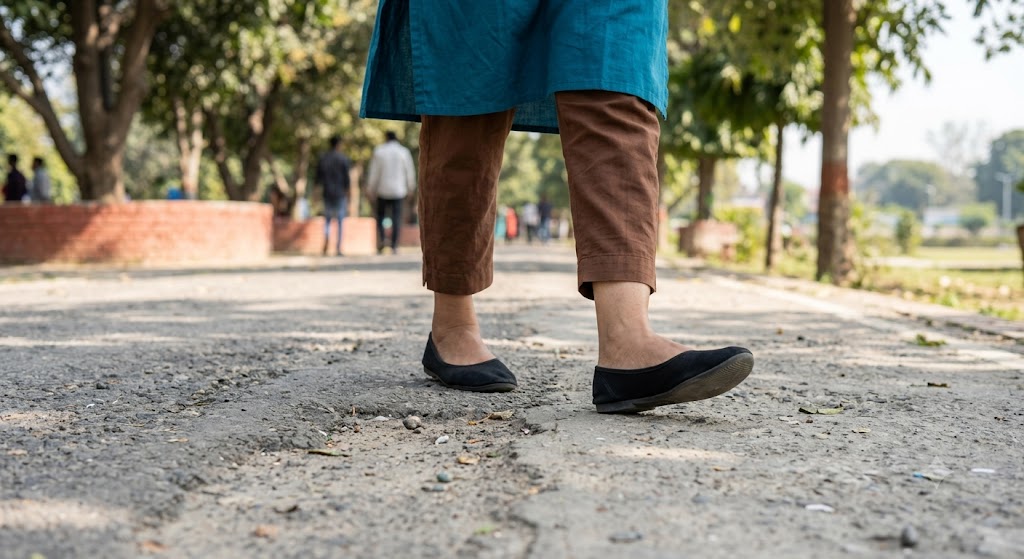
The dose does not have to be a gym personal record. Walking, carrying, hanging, rising from the floor and changing direction are the loads the tissue grew up with. Sudden high strain on a quiet tendon is a different story — that is how mid-portion Achilles problems and rotator-cuff irritation often start. The system still prefers frequent, varied, submaximal tension, the same grammar your tendons still use when they expect gradual loading rather than a weekend of heroics after a quiet week.
Bone and disc make the same point from another angle. Osteocytes and disc cells live inside a matrix that only stays fed if load pumps fluid through it. Collagen in those tissues is not a static scaffold. It is remodeled on a schedule that still assumes you stand, walk and then lie down at night so the disc can re-imbibe fluid. A chair-shaped day plus a soft mattress is a legal modern life. It is a thin mechanical letter to the cells that build type I and type II collagen.
The Vitamin C the Helix Still Expects
Humans cannot make ascorbic acid. The gene for the last enzyme in the pathway, L-gulonolactone oxidase, is a broken pseudogene in our lineage. Guinea pigs, bats and some primates share the same loss. That is why Lind’s 1747 trial on HMS Salisbury still reads as relevant physiology rather than naval trivia. Citrus, fresh greens and some animal organs were the ancestral fix. A modern plate can supply the same molecule from peppers, kiwi, berries, brassicas and potatoes if someone actually eats them. It can also fail quietly on a diet of refined starch, long-cooked meat and almost no raw plant tissue.
Szent-Györgyi’s isolation of hexuronic acid — later renamed ascorbic acid — explained why the hydroxylation enzymes stall. Prolyl hydroxylase and lysyl hydroxylase keep using iron. Without ascorbate the iron oxidizes and the enzyme stops. The cell may still translate collagen chains. It cannot finish them. Plasma levels in the 50–70 µmol/L range are typical of people who eat fruit and vegetables daily. Levels under about 11 µmol/L define frank deficiency. Between those poles sits a gray zone in which wounds heal slowly, bruising comes easily and gums look older than the rest of the face.
Collagens in vessel wall and skin have a higher turnover than the popular image of “inert rope.” That is why a few months of poor intake can show in the mirror and in a dentist’s chair before a textbook case of scurvy appears. It is also why megadose powders are a weak substitute for the combination the cell actually wants: enough ascorbate, plus the strain that tells the fibroblast where to put the new fibril.
The Modern Mismatch
Two cues went quiet at once. Mechanical variety collapsed into sitting, then a short gym block, then sitting again. Vitamin C became optional in a food environment that can be calorically dense and ascorbate-poor. The fibroblast does not get a memo that grocery stores exist. It gets local strain and local cofactor. When both are thin, synthesis slows and the matrix that remains is less well cross-linked and less well aligned.
You feel that as skin that marks easily, tendons that complain after a sudden change in training, a low-back disc that hates the first hour after a long sit, and gums that bleed when the brush is only moderately enthusiastic. None of those complaints is “a collagen deficiency” in the supplement-aisle sense. They are the same old manufacturing line missing parts of its brief. The brief still looks like a walking, carrying, reaching primate that ate plants capable of preventing scurvy.
Indoor climate and washing habits add a surface chapter. A skin barrier that rarely meets weather and friction lays down a different collagen and elastin pattern than skin that works outdoors. That is adjacent to, not identical with, the barrier biology that still expects weather. The dermis and the epidermis are having related conversations with a world that became softer and more climate-controlled.
What Load Does That a Scoop Cannot
Oral collagen peptides are absorbed as free amino acids and small peptides. Some of those peptides can be measured in blood. Whether they preferentially rebuild your Achilles is a different claim. The limiting steps in a healthy adult are usually the hydroxylation machinery, the mechanical cue, total protein intake and the absence of smoking and uncontrolled glucose — not a missing 10 grams of hydrolyzed hide in a shaker bottle.
Load remains the address label. A tenocyte that is never stretched will not aim new fibrils along the tendon’s line of pull no matter how many glycine residues you swallow. A sitting lumbar disc will not pump nutrients through an avascular nucleus because a powder arrived in the small intestine. This is why the useful interventions look boring: daily walking, gradual tendon loading, hanging and reaching, protein distributed across meals, and a plant pattern that keeps plasma ascorbate out of the gray zone.
Smoking is a special case worth naming. It lowers vitamin C and impairs hydroxylation and wound repair. So does poorly controlled diabetes, through glycation of the same matrix the fibroblast is trying to maintain. Those are not “collagen lifestyle tips.” They are direct attacks on the finished product.
Hidden Triggers That Thin the Cue
Long sitting after a quiet training week, then a Saturday of hills or a first racket-sport session, is a classic way to meet collagen that was not briefed. The fibrils can take yesterday’s load. They were not given six weeks of rising strain.
Very low-plant diets, long boiling of the few vegetables that remain, and heavy alcohol intake all pull ascorbate down. So does infection and major inflammation, which consume the vitamin in other pathways.
Chronic high blood sugar cross-links collagen in a messy, non-enzymatic way. The tissue gets stiffer in the wrong sense — less elastic, more yellow, slower to turn over. That is a different chemistry from the lysyl-oxidase cross-links the cell intended.
Night is not optional for repair. Much of the synthetic work in tendon and skin runs on a daily rhythm. A dark, sleep-rich night after a loaded day is the pairing the tissue still understands, the same pairing bone still uses when it expects impact and then an unload.
When to Worry
Easy bruising, poor wound healing, coiled hair, bleeding gums and old scars that reopen together are not a reason to buy a larger tub of peptides. They are a reason to ask about vitamin C intake, malabsorption, smoking and, in the right context, medical causes of scurvy that still appear in people who eat almost no fruit or vegetables.
A tendon that swells, warms and hurts with every step after a sudden spike in load needs load management, not a shopping list. Progressive tendon pain that does not settle, a calf that ruptures, or a shoulder that cannot lift the arm belongs with a clinician who can examine the tissue rather than with a collagen brand.
Unexplained widespread fragility in a child, or blue sclerae and recurrent fractures, is a genetic collagen question — osteogenesis imperfecta and related disorders — not an evolutionary-mismatch essay.
Myths vs Facts
Myth: Collagen supplements rebuild specific body parts because the powder “knows” where to go.
Fact: Digested collagen is amino acids and peptides. The address comes from local cells reading strain, not from the label on the tub.
Myth: If you eat enough protein you do not need vitamin C for collagen.
Fact: Hydroxylation is a separate enzymatic step. Protein without ascorbate still yields a weak helix.
Myth: Stretching is how you “lengthen collagen.”
Fact: Brief stretching changes sensation and muscle tone more than fibril length. Adaptation of collagen happens over weeks of repeated load, not over a 30-second hold.
Myth: Scurvy is only a historical curiosity.
Fact: Frank scurvy is uncommon. Low-range ascorbate with slow healing and fragile gums is not rare in people whose plates have drifted away from plants.
How to Give the Molecule What It Still Expects
Walk most days. Add hills, stairs, carrying and getting off the floor. That is cyclic tension for tendon, fascia, disc and bone, not a boutique protocol.
Load tendons gradually if you are returning to running, jumping or racket sports. Pain that settles within 24 hours and allows the next session is usually information. Pain that climbs week to week is a dose error.
Eat plants that still contain vitamin C without turning them into a puree boiled for an hour. Peppers, citrus, kiwi, berries, broccoli and potatoes are ordinary sources. A supplement of ascorbic acid is a reasonable backup if intake is truly low; it is not a license to skip the mechanical half of the brief.
Distribute protein across the day rather than parking it all at dinner. Fibroblasts need amino acids on a schedule, not only a nightly surplus.
Sleep in the dark after the loaded day. Synthesis is not a noon meeting you can reschedule around a glowing phone.
Do not smoke. Keep glucose in a range your clinician is happy with. Those two steps protect finished collagen more reliably than any powder ranking.
When to See a Doctor
See a clinician promptly for a tendon or calf that gives way, a wound that will not granulate, gums that bleed heavily with systemic symptoms, or bruising that is new, widespread and unexplained. Bring a honest food history. Scurvy is diagnosed more often when someone thinks to ask.
See a physiotherapist or sports clinician for load-related tendon or disc pain that is not settling with a sensible reduction and rebuild. Imaging is sometimes useful. A shopping bag of hydrolyzed collagen is not a first-line test.
FAQs
Does drinking bone broth build collagen?
Broth can be a pleasant protein-and-glycine food. It does not aim new fibrils into your Achilles. Load and ascorbate still do the addressing.
How much vitamin C is enough for collagen hydroxylation?
For most adults, the ordinary dietary range that keeps plasma comfortably above deficiency — often around 75–90 mg/day from food, more if you smoke — is the relevant target. Multi-gram doses treat other hypotheses, not this one.
Can I skip loading if I take collagen peptides?
No. The cell that lays the fibril still reads strain. A quiet tendon remains a quiet tendon.
Why do my gums bleed if this is about tendon and skin?
Gingival collagen turns over and sits next to a biofilm. It is often the first place under-hydroxylated or inflamed matrix shows. Bleeding on brushing is still usually gingivitis first, scurvy second — but the two can coexist when intake is very poor.
Is collagen loss after 40 inevitable?
Turnover slows with age and with estrogen loss after menopause. It does not stop. Loaded tissue in a well-fed, non-smoking adult still remolds. The slope changes. The factory does not close.
Do topical collagen creams rebuild the dermis?
Intact collagen on the skin surface is a large protein. It does not walk through the stratum corneum into the reticular dermis in any meaningful remodeling sense. Barrier creams and sunscreen matter. They are not triple-helix delivery systems.
Conclusion
Collagen is a verb as much as a noun. The verb still conjugates with two old nouns: tension and ascorbate. Lind could see the second from a ship’s deck. Gross and Prockop wrote the chemistry. Kjaer and Magnusson could measure the first in a living human tendon after a walk and a load. None of that expired when collagen became a product category.
Give the molecule a day that pulls on it from more than one direction. Give it enough vitamin C to finish the helix. Give it a night. That is not a protocol from a powder tub. That is the brief the most common protein in your body never stopped sending.