
Sitting cross-legged for a while can leave your hips stiff when you stand. Here is why that happens, what is usually benign, and when the stiffness deserves a closer look.
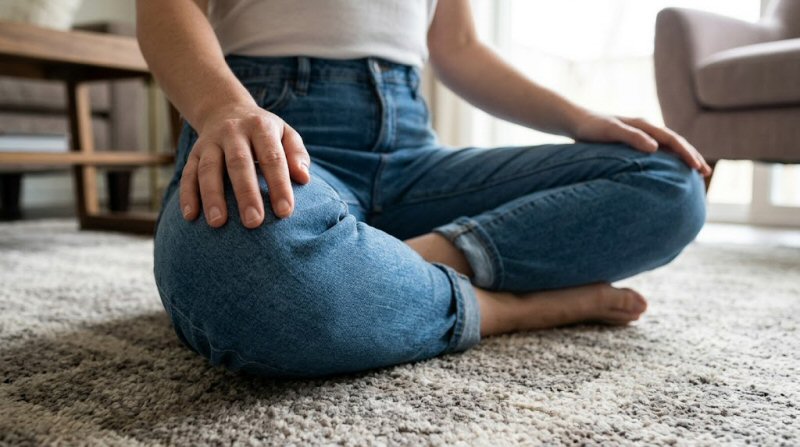
You stand up after an hour on the floor, phone in hand or book in lap, and your hips feel glued. The first steps are careful, the joints slow to unfurl, and there is a dull stiffness that eases only after you walk around. Most people experience this at some point. It is usually the ordinary response of hip tissues that have been held in one position too long.
What This Symptom Feels Like
The stiffness is typically bilateral or slightly stronger on one side. You notice it most when you try to straighten or take a full step. There may be a mild ache deep in the front of the hip or along the outer side, a sense that the joint will not glide smoothly, and sometimes a brief catch or click as you start moving. The sensation usually improves within a few minutes of ordinary walking and is not sharp or accompanied by swelling.
Common Causes
The most frequent reason is simply the posture itself. Cross-legged sitting places both hips in flexion and external rotation. The hip flexors, adductors, and deep external rotators stay in a shortened or loaded position. Over time the soft tissues become temporarily less pliable.
Joint fluid also thickens when a joint is still. Synovial fluid is thixotropic: it becomes more viscous with inactivity and flows more freely once motion resumes. Researchers studying joint mechanics have long noted this property; it is why the first movements after any prolonged static posture feel sticky.
Muscle guarding can add to the feeling. If the position compresses nerves or reduces local blood flow slightly, the surrounding muscles may hold a low-level tension that you only notice when you try to change position.
Why This Happens
Human hips evolved for frequent changes in angle—walking, squatting, climbing, and the occasional deep fold. Modern life often keeps us in one shape for long stretches. Sitting cross-legged is an ancient posture, but it was rarely held for hours while attention stayed fixed on a screen. The tissues respond to that sustained load by becoming temporarily less elastic.
Work by researchers such as Stuart McGill on spinal and hip loading, and broader studies of sedentary behavior led by Neville Owen, show that uninterrupted static postures alter tissue mechanics and circulation. The same principle applies to the hips: stillness reduces the pumping action that keeps joint fluid moving and soft tissue nourished.
If you already spend most of the day in a chair, the cross-legged floor session simply adds another prolonged position rather than providing the variety the hips expect. Related patterns appear in other everyday stiffness, such as the tightness many people notice after ordinary chair sitting, which is explored in articles about hip flexors and long strides.
Less Common but Serious Causes
Stiffness that lasts hours, is one-sided and progressive, or comes with locking, catching that does not clear, or pain radiating down the leg may point to something else. Early osteoarthritis, labral irritation, or referred pain from the lower back can present as hip stiffness. Inflammatory conditions are rarer but possible if morning stiffness lasts more than 30–45 minutes or is accompanied by other joint swelling.
True nerve compression (for example, from prolonged pressure on the lateral femoral cutaneous nerve) can produce a numb, burning patch on the outer thigh known as meralgia paresthetica; pure stiffness without sensory change is less typical of that.
Hidden Triggers
A few everyday factors make the stiffness more noticeable:
- Cold rooms: cooler temperature increases tissue viscosity.
- Prior long chair days: already shortened hip flexors have less reserve.
- Tight clothing or belts that limit subtle shifts while you sit.
- Dehydration or low electrolyte status, which can heighten muscle sensitivity.
- Holding the same exact cross-legged shape without micro-movements.
People who regularly sit on the floor for meals or work in cultures that favor that posture often report less stiffness, largely because they stand, shift, and walk more frequently between sessions.
When to Worry
Most post-cross-legged stiffness is harmless and short-lived. Seek a medical opinion if you notice any of the following:
- Stiffness or pain that persists beyond a few hours or worsens over days
- True locking or giving-way of the hip
- Pain at night that wakes you, or morning stiffness lasting longer than 45 minutes
- Swelling, warmth, or redness around the joint
- Weakness, numbness, or pain traveling below the knee
- Stiffness after a fall or twist, even if minor
Myths vs Facts
Myth: Sitting cross-legged permanently ruins hip alignment.
Fact: Occasional or moderate use does not reshape the pelvis or “ruin” the hips. Chronic extreme postures without movement can contribute to adaptive shortening, but ordinary use is well tolerated.
Myth: You must never sit on the floor if you feel stiff.
Fact: The stiffness is a signal to move, not a ban. Short bouts of floor sitting can be useful if you stand and walk regularly.
Myth: Only weak hips get stiff.
Fact: Even strong, flexible hips feel temporarily stiff after prolonged stillness. The issue is the duration of the static position more than absolute strength.
How to Manage It
Simple steps usually clear the sensation quickly:
- Stand and walk for two to three minutes. The motion restores fluid flow and warms the tissues.
- Perform a few gentle hip circles or pendulum swings while holding a counter. Let the leg hang and move it in small arcs.
- Do a brief half-kneeling hip-flexor stretch on each side, holding 20–30 seconds without forcing.
- Next time, set a timer to shift position or stand every 20–30 minutes.
- Add a short walk after floor sitting rather than going straight to another chair.
If you enjoy floor sitting, place a firm cushion under the pelvis to reduce extreme flexion, or alternate between cross-legged, kneeling, and side-sitting.
When to See a Doctor
A single episode that clears with walking needs no visit. Contact a clinician if the stiffness becomes a daily pattern that limits walking or stairs, if you develop a limp, or if any of the “when to worry” signs appear. A physical examination can distinguish simple postural stiffness from joint or lumbar issues. Imaging is rarely the first step for straightforward, activity-related stiffness.
FAQs
Why does one hip feel stiffer than the other?
Most people have a preferred cross-legged side or slight leg-length or pelvic differences. The side that spends more time in the extreme position often feels tighter first.
Does this mean I have tight hip flexors?
It can. Prolonged flexion shortens the iliopsoas and rectus femoris temporarily. Regular walking and occasional hip-extension movements usually reverse it. Persistent tightness that affects walking may benefit from a movement assessment.
Is sitting cross-legged bad for the knees?
For most healthy knees it is not harmful in short sessions. People with existing knee arthritis or meniscus issues sometimes find the rotation uncomfortable; if the knees hurt, switch positions.
How long should I sit cross-legged before moving?
There is no universal number, but many people notice stiffness after 20–40 minutes of uninterrupted sitting. Micro-shifts and a stand every half hour keep the tissues happier.
Can strengthening the hips stop this?
Strength helps overall resilience, but the immediate stiffness comes from stillness, not weakness. Combining strength work with frequent position changes is more effective than strength alone.
Conclusion
Feeling stiff in the hips after sitting cross-legged is a common, usually temporary response to holding one posture. The joint fluid thickens, the surrounding muscles quiet down, and the first steps feel restricted until motion resumes. Walking, gentle circles, and shorter uninterrupted sessions resolve it for most people. If the stiffness lingers, travels, or comes with other symptoms, a professional evaluation can rule out less common causes and get you moving comfortably again.


