
Yes, tight calves after a long day on your feet are common. Learn why the calf muscle pump and standing posture create that heavy, stiff feeling and what helps.
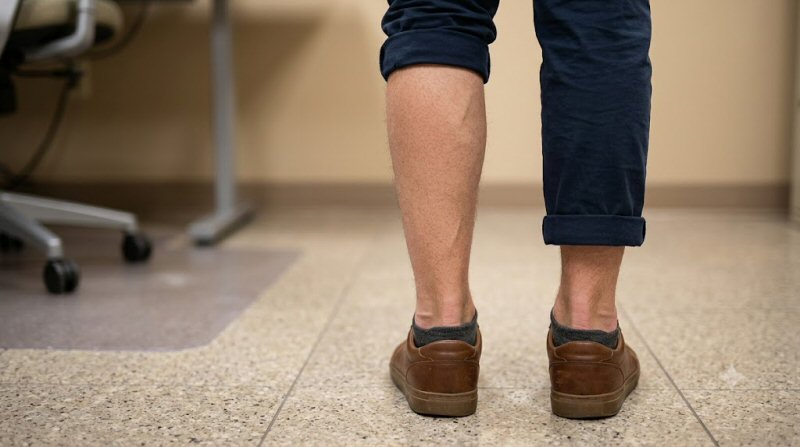
You finish a long shift or a day of errands and your calves feel heavy, stiff, and slightly swollen. The skin over the lower leg seems tighter. When you finally sit down, the first few steps feel restricted. This is one of the most ordinary complaints among people who spend hours upright—retail workers, teachers, nurses, chefs, and anyone whose job keeps them on their feet. In most cases it is a normal response to gravity and stillness, not a sign that something has gone wrong with the muscle itself.
What This Symptom Feels Like
The sensation is usually bilateral. Both calves feel fuller and less flexible than they did in the morning. Some people describe a “pumped” feeling similar to the day after a hard workout, even though they never ran. Others notice mild aching along the back of the lower leg that eases when they elevate their feet. The skin may look slightly shinier or the shoe feels tighter by evening. Stretching feels temporarily helpful, but the tightness often returns the next day if the standing continues.
Common Causes
Prolonged standing without much walking is the main trigger. When you stand still, the calf muscles (especially the soleus, which is built for continuous low-level work) stay active just enough to keep you upright, but they do not repeatedly contract and relax the way they do during walking. Blood and interstitial fluid gradually accumulate in the lower leg. The deep fascia and the muscle itself become mildly engorged, which the brain interprets as tightness.
Flat or hard floors amplify the effect. Without the small ankle movements that soft or uneven ground would encourage, the foot and calf stay in a relatively fixed position. Shoes with little cushion or a raised heel that keeps the calf slightly shortened can add to the end-of-day stiffness. Dehydration and a full day of standing in warm rooms make fluid shifts more noticeable.
Why This Happens
Your lower legs contain a specialized circulatory system often called the calf muscle pump. Every time the gastrocnemius and soleus contract, they squeeze the deep veins that run through them and push blood upward against gravity. Valves inside the veins prevent backflow. Researchers studying venous physiology have long described this mechanism as a “peripheral heart.” Classic work on ambulatory venous pressure shows that walking drops venous pressure in the calf dramatically, while quiet standing lets it rise toward the full hydrostatic column.
When the pump is quiet for hours, pressure inside the veins rises. Fluid leaks into the surrounding tissue. Muscle fibers themselves accumulate metabolites and experience low-grade fatigue. Studies of simulated standing work (including research by Maria-Gabriela Garcia, Thomas Läubli, and Bernard J. Martin) have measured residual muscle fatigue that persists for at least half an hour after five hours on the feet. The subjective feeling of tightness can linger even after the measurable fatigue begins to fade.
In short, the calves are doing continuous postural work while their built-in pumping action is under-used. The result is a combination of mild fluid pooling and muscle fatigue that registers as tightness.
Less Common but Serious
True muscle strain or tear usually follows a sudden movement and is one-sided, with sharp pain and possible bruising. Deep-vein thrombosis can cause one-sided calf swelling, warmth, and pain that does not ease with elevation; it needs urgent medical attention. Chronic venous insufficiency produces progressive heaviness, skin color changes, and visible varicose veins over months or years, not a single long day. Compartment syndrome is rare and dramatic—severe pain, tight compartments, and nerve symptoms after trauma or extreme exertion.
Hidden Triggers
Quiet standing on hard floors is worse than intermittent walking. Crossing the legs or locking the knees reduces even the small muscle activity that remains. High-heeled shoes keep the calf in a shortened position all day, so the muscle feels tighter when you finally stretch it. Low fluid intake, a high-salt meal, or a warm environment all increase the fluid that collects. Previous ankle injury or reduced ankle mobility can force the calf to work harder to stabilize the leg. Some people also notice the tightness more after long car rides or flights because sitting produces a similar pooling effect.
When to Worry
See a clinician if the tightness is mainly one-sided, appears with sudden swelling or redness, or is accompanied by shortness of breath or chest pain. Progressive skin darkening, ulcers near the ankle, or veins that become prominent and tender over weeks are worth evaluating. If the calves remain markedly tight and painful even after several days of rest and elevation, or if you develop numbness or weakness, further assessment is appropriate. Ordinary end-of-day tightness that improves overnight and with movement is not in this category.
Myths vs Facts
Myth: Tight calves after standing mean you need aggressive daily stretching or the muscle will shorten permanently.
Fact: Temporary tightness from fluid and fatigue usually resolves with movement and elevation; adaptive shortening takes weeks of continuous shortened posture.
Myth: Only people with varicose veins get this feeling.
Fact: Healthy veins still allow some pooling when the muscle pump is inactive for hours.
Myth: Compression socks are only for serious vein disease.
Fact: Light graduated compression is commonly used by people who stand all day and often reduces the end-of-shift tightness.
How to Manage
Build short walks into the day. Even two or three minutes of easy walking every hour restarts the calf pump more effectively than standing still. When you must stand, shift weight, rise onto the toes briefly, or do small ankle circles. At the end of the day, elevate the legs above heart level for 15–20 minutes; gravity assists drainage. A cool (not ice-cold) shower or a light self-massage from ankle toward knee can feel good. Stay hydrated. If your job involves long standing, consider shoes with modest cushion and a low heel, and experiment with light compression socks.
Over the longer term, regular walking or cycling keeps the soleus and gastrocnemius strong and the pump efficient. Simple calf raises performed slowly, both with the knee straight and bent, maintain the range the muscle needs. For related reasons your body still expects more movement, see why your soleus still expects you on your feet and why your veins still expect the calf muscle pump.
When to See a Doctor
Most people never need medical care for this pattern. Arrange a visit if the tightness is asymmetric, worsens steadily over weeks despite movement, or comes with skin changes, persistent swelling that leaves a dent, or pain that wakes you at night. Mention any personal or family history of blood clots or vein disease so the clinician can decide whether simple observation or further testing is useful.
FAQs
Is it normal for only one calf to feel tighter?
Mild differences are common if you favor one leg, but a clearly one-sided, sudden change deserves attention to rule out a clot or strain.
Will stretching every night fix it?
Stretching can ease the feeling temporarily, but the underlying pooling returns if you stand still for long periods the next day. Movement during the day is more effective.
Do compression socks help ordinary tightness?
Many people who stand for work find that light graduated compression reduces the end-of-day heaviness. They are not a substitute for walking breaks.
Why do my calves feel worse in the summer?
Heat dilates veins and increases fluid leakage. Combined with longer standing, the pooling sensation is more noticeable.
Can flat shoes make calf tightness worse?
Very flat, hard-soled shoes reduce the small natural ankle motion that helps the pump. A modest cushion or slight heel drop is often more comfortable for all-day standing.
Conclusion
Tight calves after a long day on your feet are a predictable consequence of gravity meeting a quiet muscle pump. The soleus and gastrocnemius are built for repeated contraction during walking; when they hold posture instead, fluid collects and the muscle fatigues. Short walks, brief elevation, and attention to footwear usually keep the feeling manageable. If the pattern stays one-sided or progressive, a clinician can check for less common causes. For most people it is simply the body reminding you that standing still for hours was never its preferred way of spending the day.


